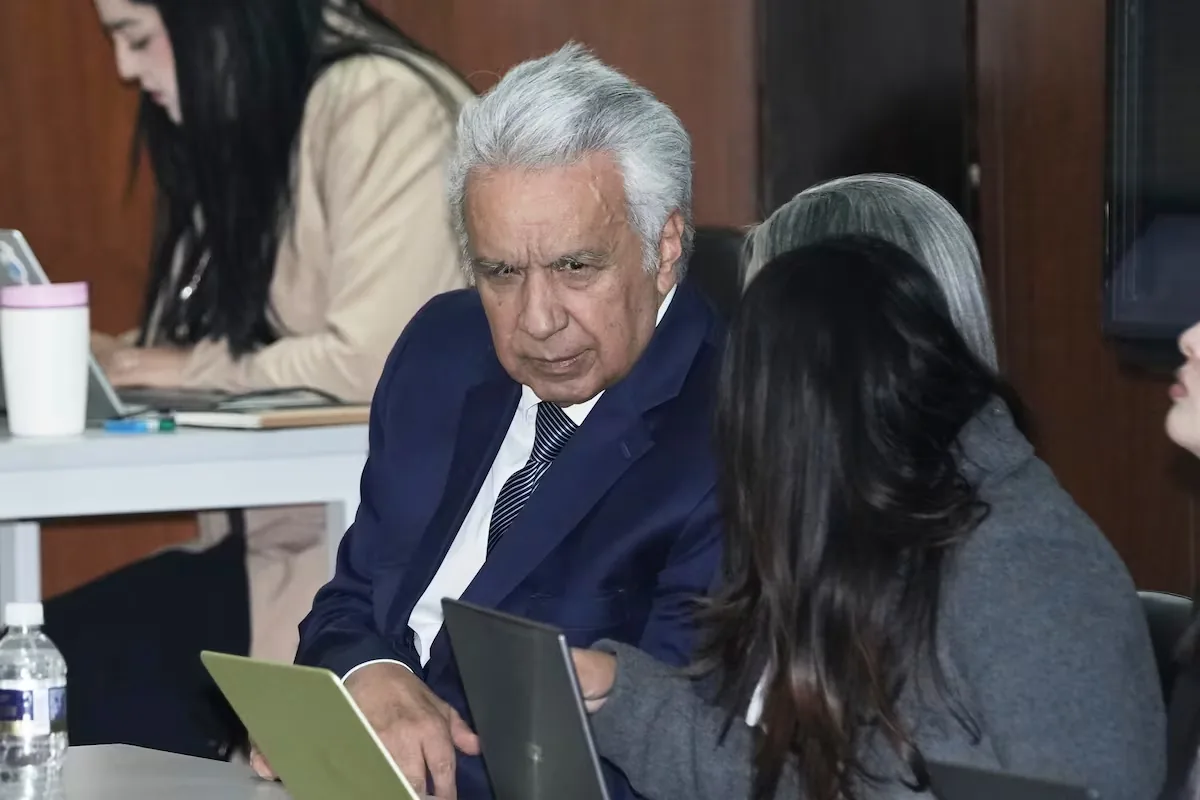
Former Ecuadorian president Lenín Moreno, who led the country from 2017 to 2021, was found guilty by a Quito court of the crime of bribery, as part of a corruption scheme related to the construction of Coca Codo Sinclair, the country’s largest hydroelectric plant. The sentence was read this Friday, August 28, when the court detailed the elements supporting its decision. After declaring him guilty, the judges requested a recess and the nature of the sentence is yet to be announced. The Prosecutor’s Office was seeking six years and six months in prison.
Read more UNAM Control Exam 2026: When Results Are Published and How to Check Them
The case revolves around a network that, according to the Prosecutor’s accusation and what was presented during the trial, operated between 2009 and 2018 and used companies and 20 prosecuted individuals to channel payments linked to the contract for the construction of the hydroelectric plant. The court stated during the reading of the sentence that around 76 million dollars in bribes were moved within the scheme. That amount corresponds, according to the Prosecutor’s Office, to 4% of the contract value signed with Sinohydro, the Chinese company awarded the construction of the project.
According to the Court, Moreno used his position when he was vice president of the country (2007-2013) to favor the network linked to Conto Patiño, a businessman, lobbyist, and close friend of the former president. The sentence also reconstructs the payment trail: Sinohydro allegedly transferred the money to companies linked to Patiño, some established in Panama, from where it was distributed through transfers, checks, and other mechanisms. Part of those funds ended up, according to the ruling, in the hands of people from Moreno’s family circle and officials who would have been involved in dealings related to the contract and financing of Coca Codo Sinclair.
After nearly seven hours of reading, the Court began to announce the individual sentences of each of the 20 prosecuted and declared the former manager of Coca Codo Sinclair, Luciano Cepeda Vasco, guilty as a direct perpetrator of passive bribery. According to the magistrates, Cepeda received 175,000 dollars from Comercial Recorsa, a company linked to Conto Patiño, through a check and transfers from Panama. The payments, the sentence notes, had no legitimate commercial or tax backing and were related to the functions he performed in the awarding and execution of the contract with Sinohydro.
Once he learned of the sentence, Moreno rejected the decision and said that to prove the crime of bribery, it is necessary that a high-ranking government official in charge of the contract with Sinohydro be prosecuted, “because otherwise the bribery falls apart,” he added. “There is no case, I have not received a single cent,” he said outside the Palace of Justice and pointed to the then Minister of Strategic Sectors, Jorge Glas. “Jorge Glas himself said that he dusted off the project and carried out the entire project and that in 2010 he went to obtain the financing,” Moreno said. “I wonder where I participated, in what part did I intervene… Because I was friends with the Patiño family, did I have to have intervened directly in the matter?” he added.
During the trial, which lasted 31 days, former vice president Jorge Glas testified as a witness for the Prosecutor’s Office; he was then Minister Coordinator of Strategic Sectors and is currently serving a sentence in maximum security prison. Glas recounted that Moreno called him to ask about the progress of the project and its financing, even though, according to his testimony, those matters were not within his responsibilities.
“I received calls from Lenin Moreno asking me details about how the project was progressing, the financing, which surprised me because it was not within his competencies,” Glas declared.
Read more Mexico City Marathon 2026: route, schedule, closures, and traffic alternatives
According to his account, when Glas was already vice president, he received another call from Moreno from Switzerland. The then president asked him to receive Xavier Macías Carmigniani, one of the prosecuted in the case. Macías, according to Glas, informed him that by Moreno’s decision, from that moment on all matters related to Sinohydro had to be dealt with him.
The investigated events date back to 2009, when Moreno was vice president under Rafael Correa. At that time, the construction of Coca Codo Sinclair was in the hands of Correa’s government and Sinohydro was at the center of the process to execute the project.
Coca Codo Sinclair is the most important hydroelectric project built in Ecuador and one of the flagship works of Rafael Correa’s decade in government. Construction began in 2010 and it was inaugurated in 2016. Since then, it has suffered problems that have limited its operation. Among them are failures in the turbine distributors and the regressive erosion of the Coca River, which threatens to destroy the facilities.
Moreno was Correa’s vice president for two terms, between 2007 and 2013, and became president in 2017 as a candidate of Alianza PAIS, the political movement created by his predecessor. His rise to power was initially marked by the continuity of Correa’s political project. But, a few months after taking office, they politically broke apart.
Moreno distanced himself from the former president, dismantled much of his political legacy, and supported judicial investigations against former officials of Correa’s administration. That rupture turned someone who had been one of Correa’s trusted men into one of his main political adversaries, whom they consider a traitor.