Alexia Putellas (Mollet del Vallès, 32 years old) is left-footed, although not entirely. Alexia has what is called cross laterality, that is: she is left-footed but right-handed. She plays with her dominant left foot but signs contracts and autographs with her right hand, just like Maradona, Leo Messi, and Lamine Yamal.
Read more “Rafa is not Rafa”: living ten years with a con artist
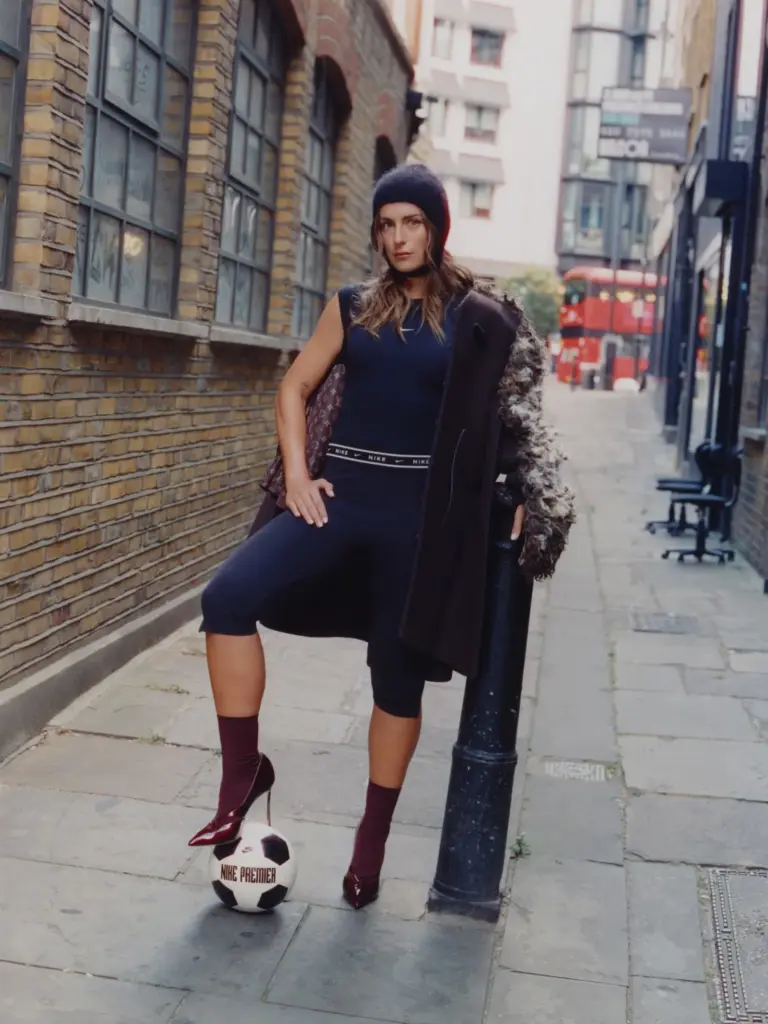
Alexia kicks again and again with her left foot against a brick wall in an alley in East London. She doesn’t say kick, of course, she says strike. Wearing 10-centimeter burgundy patent stiletto heels, dressed in a wool hat and a huge coat on a hot July morning during a heatwave, she poses for the photographer. The first time she strikes the ball, a collective sigh is heard. Stilettos, cobblestones, coat, and ball? “She is such a star,” says the production manager with a very strong English accent. No wonder they call her The Queen. The Queen.
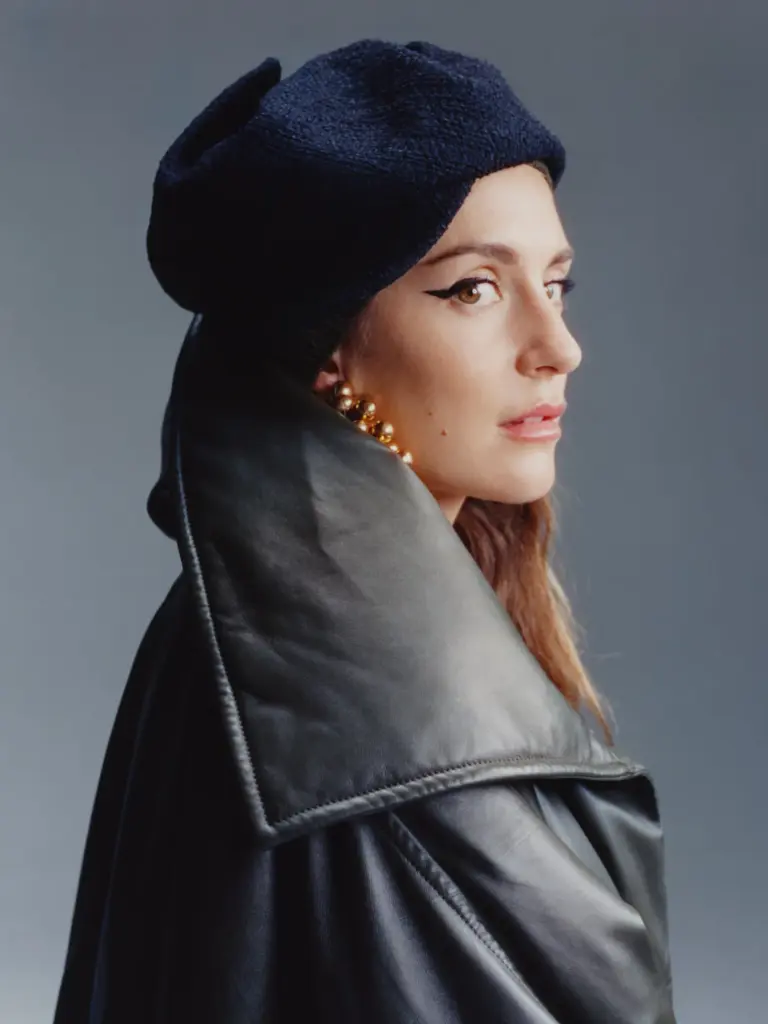
She strikes the ball with just the right force and catches it as if it weighed the same as a balloon. When she started playing at Sabadell, at seven years old, she could barely lift the ball off the ground. She shared a team with girls aged 12, who “made spectacular passes and shots,” and she got upset because she couldn’t imitate them. But she also persisted, and there, on the left wing, through persistence, began the training of what today is one of the best players in the world and a two-time Ballon d’Or winner. At that time, children under eight were not registered, so they lied about her age, a “small loophole” so she could play on the team. Her aunt took her to training from her village to Sabadell after school, after having a snack. Her father picked her up after work, and if they couldn’t, then her grandfather did. “The poor man, we would get lost in Barcelona and well, we got lost,” Alexia says during a break in the photo session.
She has just settled in London, where she will start playing in September with the London City Lionesses, an exclusively female club owned by businesswoman Michele Kang, who since 2022 has invested in women’s football teams (besides London City, she owns Washington Spirit in the US league and OL Lyonnes in France, the most decorated team in Europe), signings, equipment, and research on injuries in women. Alexia’s presentation in New York as the new player of London City generated much expectation: she was leaving Barça after 14 years and having won four Champions Leagues, ten Leagues, ten Queen’s Cups (and one more before with Espanyol, in 2010), and six Spanish Super Cups for a team barely seven years old that has only been two years in the WSL, the top division of the English women’s league. The media gathered there saw in this move a longer-lasting alliance between the Spaniard and Kang than the three years stipulated in her contract. Two women with the same goal, a strategic and formative union to boost women’s football globally. At that presentation, Alexia recalled the phrase Michele Kang had told her: “Women’s football is not charity.”
The American investor, who made her fortune with a medical technology company, knows there is a market niche in this sport that is yet to flourish. Her million-dollar signings are not so common in women’s football. Besides Alexia, who according to Transfermarkt has a market value of 1.5 million euros, Kang has signed this summer Mapi León, also a Barça player, Mary Earps, Kadidiatou Diani, Nicole Anyomi, Janni Thomsen, and the Murcian Daniela Arques, demonstrating her ambition and commitment to winning titles with her London club. In fact, season tickets have already sold out, and they are selling tickets at a volume and speed far exceeding last year’s. However, in a sport still living outside the vices that money causes in the male game, these signings, as well as the multi-ownership of teams, generate some controversy.
“In women’s football, there are other groups, and in men’s football, multi-ownership has existed for years. If you analyze it from the outside, I think it all has to do with timing. You can draw up a medium- and long-term plan and invest gradually or do it all at once because you want to cut time. I have lived both parts, I experienced the gradual one at Barça, and now I am living the other. I think it’s all part of the industry; the important thing is to add many perspectives,” explains Alexia. For the player, there is no better or worse way to invest in women’s football; what matters is to add. Money is the fuel of this sport and the excuse used by those who don’t want to bet: if it doesn’t yield the profits of the men’s game, it shouldn’t demand equality with it. That’s why those who label Kang as opportunistic implicitly acknowledge that there is indeed an economic opportunity. This is the constant paradox. Or, as The New York Times journalist Megan Feringa defined it, the “corrosive limbo” in which women’s football finds itself, between the will to preserve the essence and values that have distinguished it or to embrace the necessary changes to grow, attract investment, and pay players as they deserve.


The Alexia who signed in 2012 for FC Barcelona from Levante, where she played for a year, is described as shy, reserved. She played on the left wing but gradually gained ground in midfield. She felt comfortable making decisions and at only 24 was already the team captain. “In life and in sports, I love having a goal and drawing up the plan to achieve it. I enjoy that process.” She started playing in front of 200 people on a non-professional team. Women’s football had no visibility, and Barça relied on the image of its stars, on Alexia’s image, to boost its growth. Now Alexia’s and Aitana Bonmatí’s jerseys share the podium of best sellers with those of their teammates Raphinha or Pedri.
Alexia walks to take another photo, this time crossing a traffic light trying to look at the correct side of the road, although she ends up entering a Tesco supermarket with part of the team (what could be more British?). On her back, under the crop top, peeks the tattoo of the silhouette of a photo of her father and her as a baby holding a small Barça ball. From the cradle, she seemed destined to be a culé. As a child, she watched all Barça matches on TV with her family, besides belonging to the Penya Blaugrana of Mollet del Vallès, with which she traveled by bus on Sundays to Camp Nou. Her family is also culé by birth. I ask if this generated extra responsibility towards them. “No, gratitude. The way to give back everything, right? But I think it’s a bit the syndrome we all have as children when we feel super grateful to our parents, I feel that way.” In her family, it was always normal that the girl played football. She did it all the time, in the village square, in the schoolyard, and in the hallway of her house.
—Have you broken many things with the ball?
—No. I haven’t broken much because we had a short hallway. We lived in a humble house, you know? And there were no glass or anything in the hallway.
—What did your family say when you told them you were considering leaving Barça?
—I consulted with my mother, my sister, and my group of friends who are like my sisters, and they understood me. They haven’t told me, but I know they also breathed a lot of air because they suffered when things didn’t go well at Barça. For them, it has also been a learning process. The same as for me, who started with 200 people on the field and there was no press, no criticism, nothing, so the dimension it has now, big or small, also affects them. After making the decision, there were days when I broke down, I didn’t even go outside because the Champions final was very emotional…

It must be difficult to consider leaving one of the best teams in the world to start a project almost from scratch, so she divided the decision into two parts: did she want to leave Barça? And if so, where would she go? With Barcelona, she had played more than 500 games, becoming the club’s second-highest scorer behind Leo Messi. “I would have played my whole life at Barça; it was the ideal scenario, but the last year we spent a lot of energy, mental and physical, and there came a moment when I thought: I don’t know if I’ll be able to go back to winning everything. I had always said I wanted the last image fans had of me to be at the top. And I thought: I don’t know what the perfect ending is, but something similar is playing a Champions final and lifting it.” Then she began studying playing styles and where she would like to land. It is a World Cup year, and that is a risk, as she needed a team to improve. She considered two very competitive leagues, the English and the American. In Spain, the difference between Barcelona, with 87 points, and the next team, Real Madrid, with 72, was a consolidated gap. Perhaps boredom also influenced Alexia’s decision. “The demand at Barça was set by ourselves in training because we were competing among ourselves with the best.” She chose the English league despite the US offer being economically much more attractive. “Within England, there were two types of proposals, the ones most similar to Barça, where everything has already been won, where everything is consolidated, where they know the way and have fans, which is something I had already experienced, or something totally different, like London City. It caught my attention that in case of success, it was all more epic,” and also, as she says, there is something she hasn’t won yet, and that is the English league.

Her father passed away before seeing her play with her team in the senior categories. Alexia dedicated her first Ballon d’Or, which she won in 2021, 41 years after the only Spaniard who had achieved it to date, Luis Suárez. The player wrote Alexia a few words congratulating her, saying: “Maybe you don’t realize the importance of this recognition until some time passes, but it means a lot to you and Spanish football (…) if you allow me some advice, this trophy should be the basis of your departure, not your goal.” She won it again the following year (then came Aitana Bonmatí, three times, and Rodri), but she heeds Suárez’s advice and does not consider it a goal, although this year she could win the third: “Being there is a pleasure, especially after a serious injury. It is an award given for everything you have done in a season within a team with more teammates and for your personal evolution. If I win it, I will be very happy for my family for all they have suffered. And if someone else wins it, I hope it is a teammate, and I will be very happy.”
The injury she refers to is the cruciate ligament rupture she suffered in training before traveling to play the 2022 Eurocup. The injury was a blow. It always is, but she even thought her career was over; in the first days after the injury, she considered quitting herself. But just as when she played at Levante she insisted on training her right leg, she recovered quickly.
Read more Iceland closes the door to integration into the European Union
Alexia Putellas’ tenacity and perfectionism are well known. Former Barça coach Luis Cortés says the player always wanted him to tell her what she did wrong to improve. “We started working on my mistakes, which are necessary to improve, and one day he took me and said: ‘Now I’m going to tell you everything you do well because I want you to keep enhancing it. Don’t focus so much on the mistake, which is very good and says a lot about your mentality because you want to be as complete as possible, but don’t forget what you do well.’”
That extreme concentration, effort, and perseverance are not only put on the field. Unlike a large majority of male players, female players not only look out for their team, their own game, or their signings but also for the future of their sport, so they know they have to fight a lot in the offices. The women’s football league was only professionalized in 2021 after tough negotiations. The first collective agreement was signed in 2019 after a players’ strike, and until the 2025 agreement, some rights were established, such as a base salary of 23,500 euros, travel conditions, 30 calendar days of vacation, and maternity protection, with salary guarantees and daycare support.
The issue of pregnancies and work-life balance in elite sports is complex. “I’m going to tell you because it’s already official. When you start training camps with the national team, there is always feedback with the federation about how the group is doing. The captains’ group had a concern because it is very important for a player to experience World Cups, but that implies that people who want to be mothers, because I didn’t want to but it developed in me some time ago, don’t find it easy to fit in. And after incredible work done by the federation, they have agreed with a clinic the possibility of freezing eggs while we are active until you want. For me, it is a huge advance because the federation understands that you are serving your country against your biological clock, that you can’t stop and can’t be a mother because you need your body to work.” At 32, she has no idea when her career will end, but she believes it won’t last more than another five or six years.

—What have you learned on the field that helps you in your daily life?
—I have a big obsession with wasting time. And before, when I felt I was wasting time, I transformed. I got frustrated and entered a mental block and told myself I had to leave or we had to change this now, now, now. Now I’m much calmer. The injury, for example, has made me much more empathetic. It has changed my way of relating, not just with strangers but even with my mother. Before, I was much more introverted about my emotions, my feelings, and now I’m not the most extroverted person in the world [laughs], but you do evolve.
—And what do you do in your free time?
—I have little free time, but I like to be a lot with my friends because it gives me a bit of the reality of what happens to people of my generation. We are seven. The only boy we have I’ve known since we were three, when we went to school together, and then there’s another girl also since five, and the rest since 12.
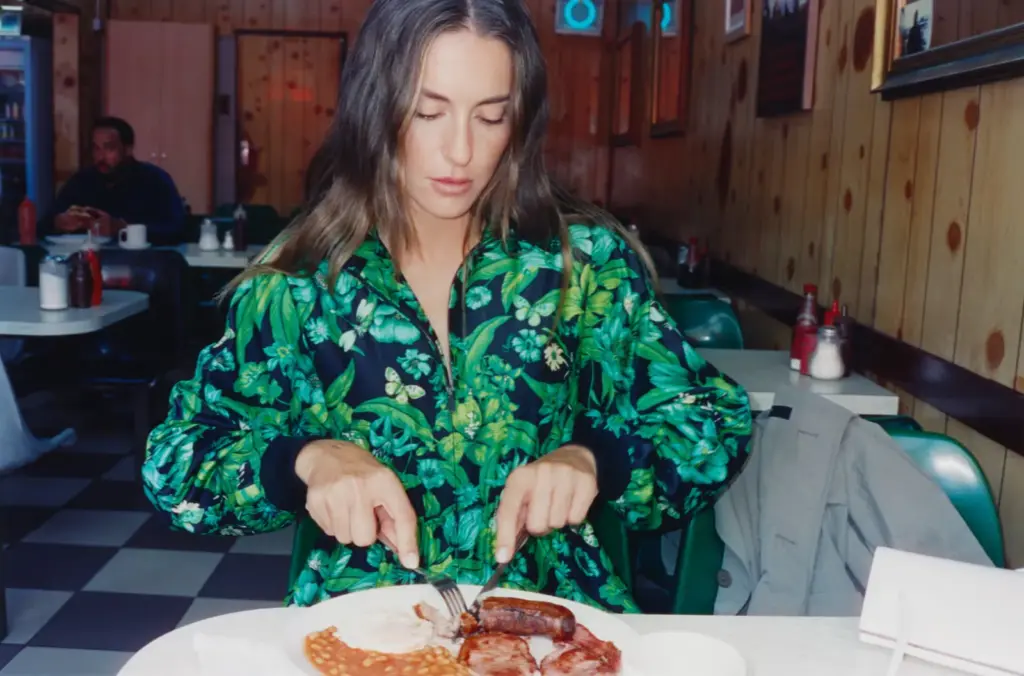
Her lifelong friends don’t play football, but in London, there is already a large group of footballer teammates. In the photo session, Misa Rodríguez appears, the former Real Madrid goalkeeper who has just arrived in London to play with Arsenal. Between photos, the Canarian turns up the volume of reggaeton that Alexia dances to timidly, in small movements, while adjusting her clothes. Throughout this session of outfit and location changes for photos, the player doesn’t get tired and participates with great humor. She changes in a café bathroom to pose with a full English breakfast, although she is not convinced by the baked beans.
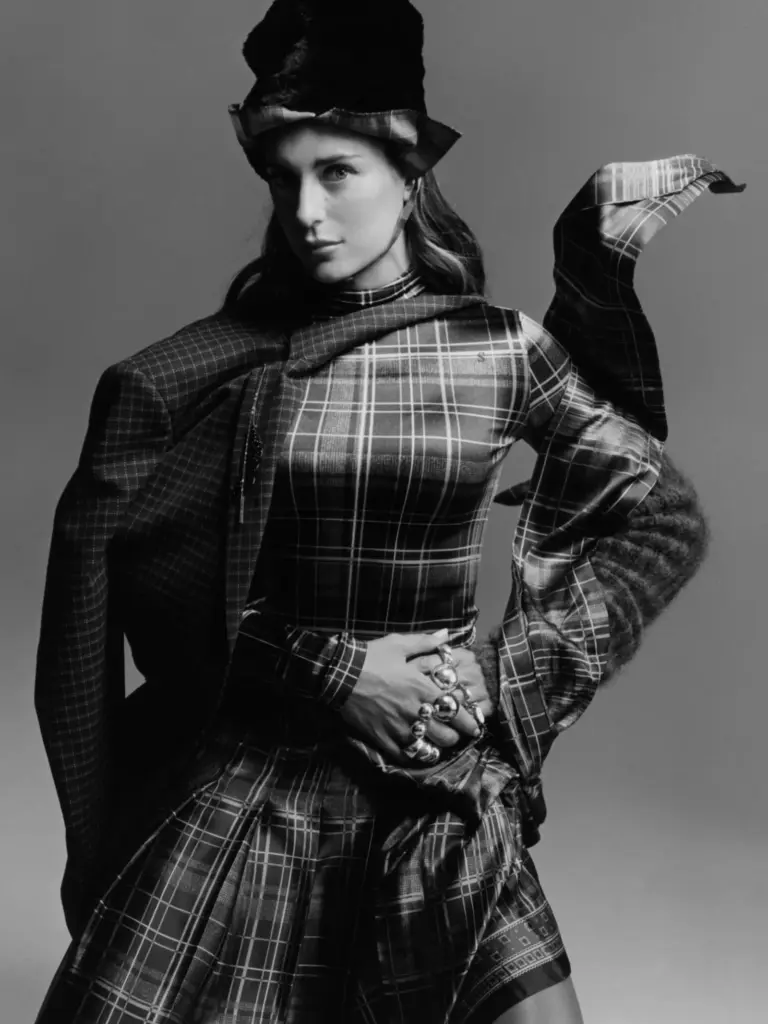
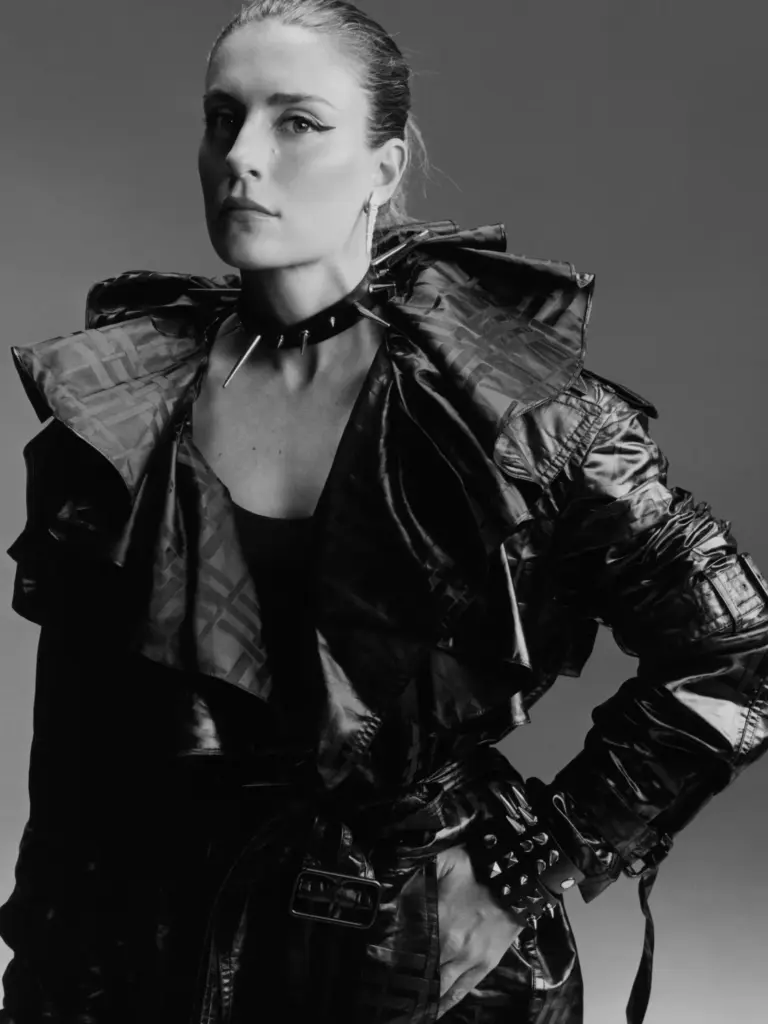
Footballers have always used fashion to build their personas. Beckham is perhaps the best known for this, but Pep Guardiola walked the runway for Antonio Miró, Leo Messi is known for the extravagant Dolce & Gabbana suits he wears at galas, Haaland and his passion for Hermès Birkin bags made headlines during the last World Cup, and Jude Bellingham is a Louis Vuitton ambassador. “In the end, it’s a way to convey how you feel. I got interested because I’m a person who knows one thing and wants to go deeper. It’s something I feel comfortable with. I like it and have fun,” says the footballer.
Building an image is one thing, becoming an icon is another, although they are closely related. During this World Cup, Alexia Putellas’ presence on the field cheering the men’s national team placed her on that podium that very few reach. The photo with Penélope Cruz and Rosalía is another step in that construction, although it happened in the most natural way. “I didn’t know Penélope and was very impressed.” However, she has known Rosalía for years. “I started following her when she released [the album] Los Ángeles, I really liked what she did because it was disruptive and started to inspire me. I use music a lot, to motivate myself, to escape, and she has been in many moments of my career. And then I was lucky to meet her and share moments with her, and she is an incredible person who does extraordinary things with her art and talent. I admire her a lot because she can reinvent genres and break established things, and only geniuses do that, taking you to places you couldn’t even imagine existed.”
—Are you tired of being a pioneer?
—I would have loved for previous generations to have lived what I have lived because in the end, I think it’s fair to also have a bit of memory, that our generation didn’t start playing, you know? I mean, players from the seventies, the eighties… We have had contact through the national team or Barça with them, the real pioneers, and they have told us anecdotes that make you say “at what moment,” unthinkable things not only in football but in society. That’s why I don’t really feel like a pioneer.

I show her a map to visit London through the history of its women. Her gaze is also well trained. The first thing she sees is the photo of Emma Clarke, considered the first black female footballer. Then she looks at Virginia Woolf: “I read A Room of One’s Own, I liked it a lot.” I show her the place where Mary Shelley, author of Frankenstein, lived, and glance at the street where Mary Wollstonecraft’s house is, Shelley’s mother and author of the book A Vindication of the Rights of Woman, but I don’t insist because I have heard Alexia Putellas say many times that true equality will come when we don’t talk about women’s and men’s football.
We talk about London, a city that has welcomed her with good weather and little traffic, or at least not enough to bother her yet. “I like how I feel. Laia Codina, who has been here for four years and has lived in other countries, told me: ‘Get ready because in each city you develop a personality of your own that you have to embrace.’ You know? I’m eager to see which one comes out. Looking forward to it.”
Read more At least one dead and five injured in a shooting during a rave in northern Switzerland