






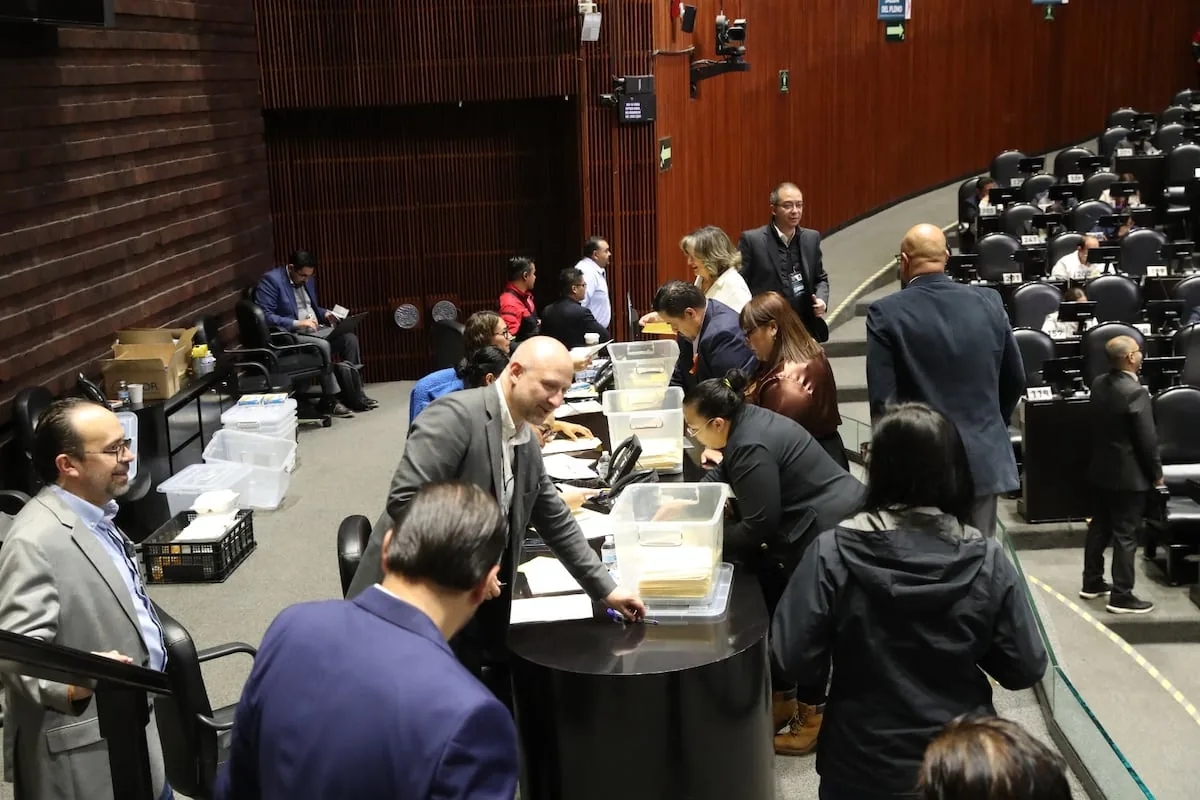
EL PAÍS previews an excerpt from the book Que el pueblo decida, la democracia según la Cuarta Transformación; a political chronicle by journalist Ernesto Núñez Albarrán about Andrés Manuel López Obrador’s six-year term, which explores the dispute over democracy and the repercussions of this confrontation in President Claudia Sheinbaum’s government. This episode describes the renewal process at the Instituto Nacional Electoral in 2023, an issue that, three years later, is once again coming to life with the appointment of three councilors by the Chamber of Deputies on April 22. This excerpt is reproduced with the authorization of Grijalbo publishing house.
Read more The adventures of Papá Marcelo
Lottery Councilors
The renewal of four vacancies in the General Council of the INE was initiated by the Chamber of Deputies in December 2022, at the same time that Andrés Manuel López Obrador’s Plan B electoral reform was being processed. The process, which began on December 12, stipulated that two male councilors and two female councilors should be appointed, one of whom would hold the presidency of the INE. The outgoing councilors had been appointed in 2014: Lorenzo Córdova, Ciro Murayama, José Roberto Ruiz Saldaña, and Adriana Favela.
Between January and March 2023, the Chamber of Deputies developed the procedure starting with the issuance of a public call on February 14, and then the formation of a technical evaluation committee that would review whether the aspiring councilors met the legal requirements and would select the most suitable profiles based on tests and interviews. This committee, composed of seven people proposed by other autonomous bodies (the National Human Rights Commission and the National Institute of Transparency and Access to Information) and by the Political Coordination Board of the Chamber of Deputies, had a Morena-aligned majority made up of five people: Enrique Galván Ochoa, Norberto García Repper, Evangelina Hernández Duarte, Araceli Mondragón González, and Ernesto Isunza. The other two members, with a critical stance towards the 4T, were Maite Azuela, a media commentator, and Sergio López Ayllón, an academic and former director of the Center for Economic Research and Teaching (CIDE).
The committee evaluated hundreds of applications and invited 531 aspirants to take an exam. From there, they selected the 102 best-qualified women and 102 best-qualified men, and finally, they refined a list of 92 people (46 men and 46 women) to interview them between March 17 and 22.
On March 26, the committee formed four lists, with five names each, from which two female councilors and two male councilors would have to emerge. The first group was composed of Diego Forcada Gallardo, Luis Alberto Hernández Morales, Jorge Montaño Ventura, Netzaí Sandoval Ballesteros, and Bernardo Valle Monroy. The second list consisted of Arturo Castillo Loza, Armando Hernández Cruz, Víctor Humberto Mejía Naranjo, César Ernesto Ramos Mega, and Luigui Villegas Alarcón. In the first list of women were Nayma Enríquez Estrada, Claudia Arlett Espino, Jessica Jazibe Hernández García, Miriam Guadalupe Hinojosa Dieck, and Rita Bell López Vences. And in the second list of women, from which the president of the INE would have to emerge, were Bertha María Alcalde Luján, Guadalupe Álvarez Rascón, Rebeca Barrera Amador, Iulisca Zircey Bautista Arreola, and Guadalupe Taddei Zavala.
It was up to the Political Coordination Board of the Chamber of Deputies, made up of the coordinators of the parliamentary groups, to take the next step. As established in the Constitution, the Board had to build a political agreement and choose one name from each of the quintets. The four new members of the General Council of the INE should be proposed to the plenary, where they would be approved by a qualified majority. Although the law provides that, in case of disagreement, a method of insaculation can be used to designate a name per quintet, in the 2023 process the majority party pushed this procedure from the beginning, renouncing the possibility of an agreement, as did happen in 2020.
Despite talk of the president’s preference for Bertha Alcalde Luján, daughter of two Morena founders, to preside over the INE, the majority bloc – and its Green and PT partners – did not have the 334 votes necessary to push through the appointment, was unwilling to negotiate with the opposition, and did not insist on imposing its names, leaving everything to chance. The Political Coordination Board was then composed of coordinators Ignacio Mier, from Morena; Jorge Romero, from PAN; Rubén Moreira, from PRI; Carlos Puente, from PVEM; Alberto Anaya, from PT; Jorge Álvarez Máynez, from MC; and Luis Espinosa Cházaro, from PRD. Of all of them, the only one who opposed the lottery was Máynez, who accused Morena and the leaders of PRI and PAN of not proposing any profiles and obstructing the construction of a political agreement for the designation.
Thus, on March 30, instead of proposing an agreement with the names of the councilors who would have generated consensus, the Board proposed formalizing the lottery as a selection method, and only Movimiento Ciudadano voted against it. “It is not fair to stain the referee due to our lack of capacity to build agreements. We, to what is chosen here, to what is done here, to what is sung here, we will give those people our vote of confidence to organize the 2024 presidential election and that complex electoral process that will convene us next year. But we do not agree with the insaculation because it is to renounce politics and because it is to renounce our constitutional attribution,” said Álvarez Máynez from the rostrum.
In response, Gerardo Fernández Noroña, vice-coordinator of the PT, denied that an agreement had been renounced and suggested that the lottery sought to protect aspiring councilors from a possible adverse vote, in which two-thirds of the Chamber would not be gathered to endorse them. Furthermore, he reminded the assembly that, if that qualified majority was not reached, the lottery would still have to be held, but no longer in the Legislative Power, but in the Supreme Court of Justice of the Nation, as established by the constitutional procedure.
“It is false that we have not made an effort to reach an agreement, but it would have been unfortunate to present four names that did not reach two-thirds and that we would harm different women and men who have demonstrated sufficient preparation, according to the technical evaluation committee, to be in the electoral body, and every time we presented new names and they were rejected, we would continue to harm people who, in the end, in an insaculation process, could be elected according to the constitutional mandate,” explained Fernández Noroña.
Read more Marcelo Ebrard: his hedonic adaptation
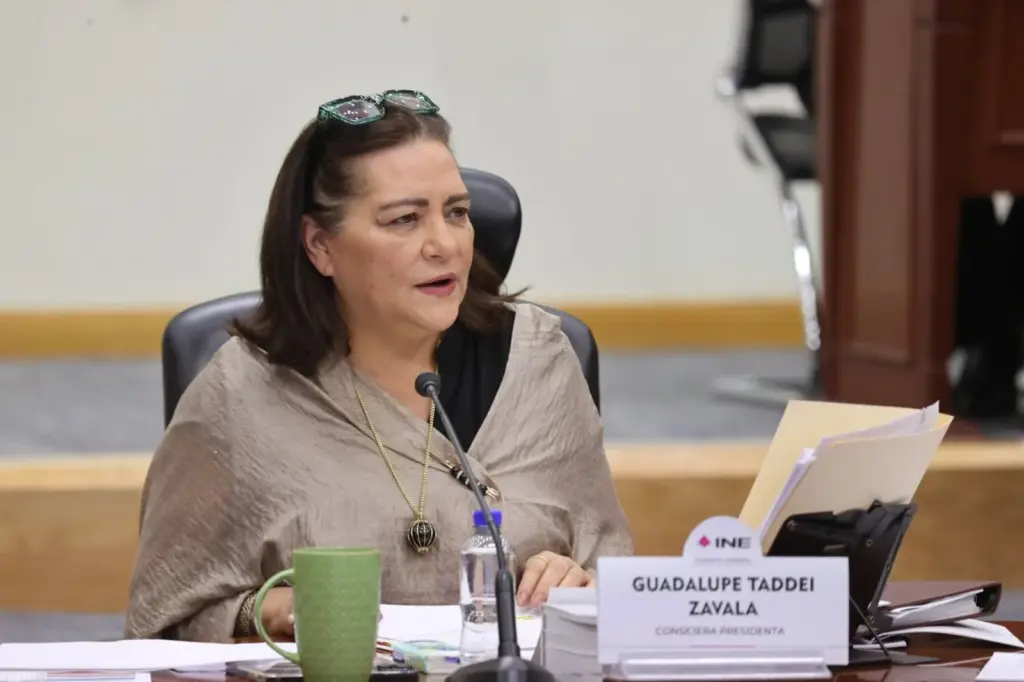
The lottery took place in the early hours of Friday, March 31. Finally, luck fell on four individuals not exempt from ties to the official party, starting with Guadalupe Taddei Zavala, who won the lottery for the presidency of the INE. The elected president-councilor belongs to a political family from Sonora, has connections with Governor Alfonso Durazo and with Deputy Sergio Gutiérrez Luna and his wife, Diana Karina Barreras, then a local PT deputy. Taddei had at least two relatives in the federal government: the federal government’s superdelegate in Sonora, Jorge Taddei, and the director of the state-owned company Litio Mx, Pablo Taddei.
The other three councilors drawn by lot were: Jorge Montaño, former prosecutor for Electoral Crimes in the state of Tabasco, with strong ties to the Secretary of the Interior and former governor Adán Augusto López. Rita Bell López, former councilor at the State Electoral and Citizen Participation Institute of Oaxaca, close to local Morena leaders. And Arturo Castillo Loza, who had been Secretary of Study and Account for magistrate José Luis Vargas at the Electoral Tribunal, and who had the most solid and independent academic profile regarding the 4T.
The new councilors would take office on Tuesday, April 4, in the General Council of the INE, the so-called “horseshoe of democracy,” but Lorenzo Córdova’s INE still had one last skirmish pending.
Córdova’s last days at the INE
While the Chamber of Deputies was operating the appointments, Lorenzo Córdova and his team were preparing their departure from the National Electoral Institute, with calculated but abrupt decisions not shared by the rest of the councilors, who would stay to receive a new president and three colleagues in a context of maximum confrontation with the government.
On March 28, two weeks after resuming his position, Edmundo Jacobo announced his irrevocable resignation from the powerful Executive Secretariat of the INE, effective April 3, 2023. That is, the official was leaving a position he had held since 2008, despite the fact that his re-election in 2020 would have allowed him to remain in the Executive Secretariat until April 2026. “I have completed a cycle in the Executive Secretariat of the Institute to serve the INE and Mexican democracy, which I conceive not as a job, but as a cause. It is time for whoever is designated or drawn by lot to preside over this institution to propose to their peers a person who will diligently and uprightly undertake the tasks of the Executive Secretariat,” expressed the secretary, who wanted to get ahead of the appointment by the Chamber of Deputies to prevent the new president from taking his resignation as a personal matter.
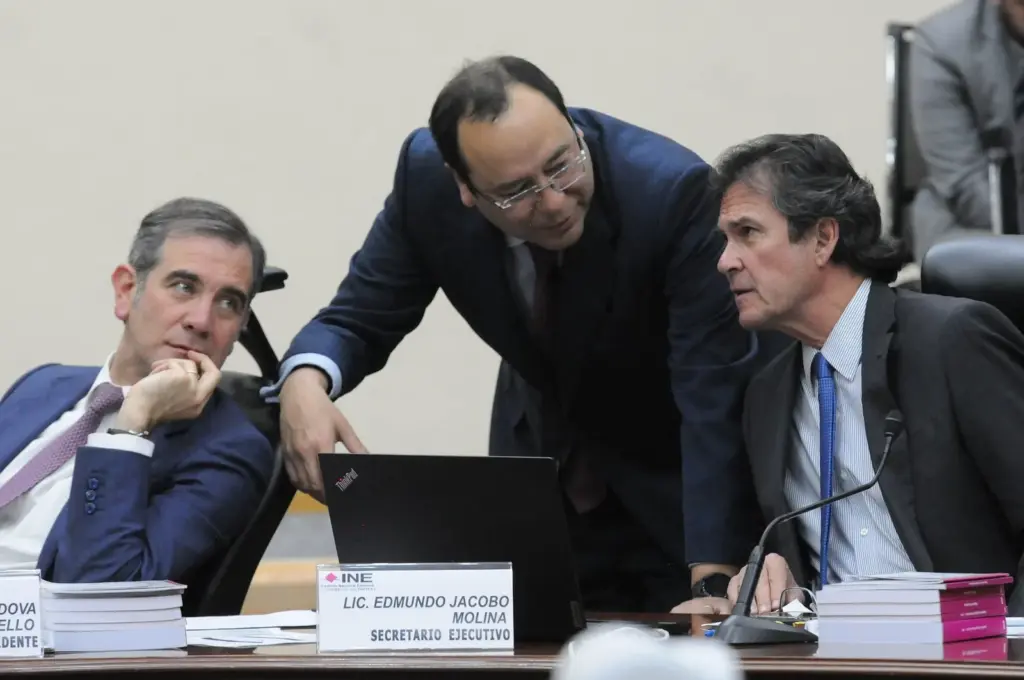
Edmundo Jacobo’s decision was preceded by an even more outlandish decision: the resignation of almost all members of the General Executive Board, that is, the team that had accompanied Córdova in recent years and who were responsible for the institute’s operations. In the midst of the electoral process in Coahuila and the State of Mexico (the latter, the most populated state in the country), the resignations —valid between March 31 and April 3— of eight key officials were announced: Ana Laura Martínez de Lara, Executive Director of Administration; Jacqueline Vargas Arellanes, Head of the Technical Unit for Fiscalization; Carlos Alberto Ferrer Silva, Head of the Technical Unit for Electoral Litigation; Gabriel Mendoza Elvira, Legal Director; Daniela Casar García, Director of the Secretariat; Cecilia Azuara, Head of the Technical Unit for Transparency and Personal Data Protection; Laura Liselotte Correa, Head of the Technical Unit for Gender Equality and Non-Discrimination; and Rubén Álvarez Mendiola, National Coordinator of Social Communication.
In addition, it was announced that two other areas would be left headless on April 1: the Executive Directorate of the National Electoral Professional Service and the Executive Directorate of Electoral Organization, as their heads, María del Refugio García and Sergio Bernal, had decided to occupy the Executive Vocalías in the states of Hidalgo and Quintana Roo, respectively.
Even without knowing who she would be, the new president of the INE would find a headless institute, with only three high-level officials: Humberto Torres, in the Technical Unit for Information Services; Miguel Ángel Patiño, in the Technical Unit for Linkage with OPLE; and Roberto Heycher Cardiel, in the Executive Directorate for Electoral Training and Civic Education, who had to stay as the longest-serving official in the position and who was responsible for occupying the Executive Secretariat as acting head.
Under these conditions, Lorenzo Córdova called two final sessions of the General Council for Thursday, March 30, exactly the same day that the Chamber would begin the designation process that resulted in the lottery in which the new councilors were drawn.
Read more A post-Maduro Caracas