
August is a bad month for employment in Spain, with hardly any hires at the end of the tourist season and most sectors operating at half capacity due to the summer slump in activity, especially in classrooms. This year that pattern has repeated, with the destruction of 162,000 jobs compared to July and an increase of 44,000 people registered as unemployed, according to figures released this Wednesday by the Government. Beyond the recurring seasonal dynamics reflected in these data, this year the figures differ from previous years due to the extraordinary regularization of foreigners: job losses are moderated thanks to the unusual boost in foreign affiliation and, at the same time, registered unemployment grows twice as much as last year for the same reason.
Read more No bail set for the woman who fatally stabbed a man in a bar in Valencia
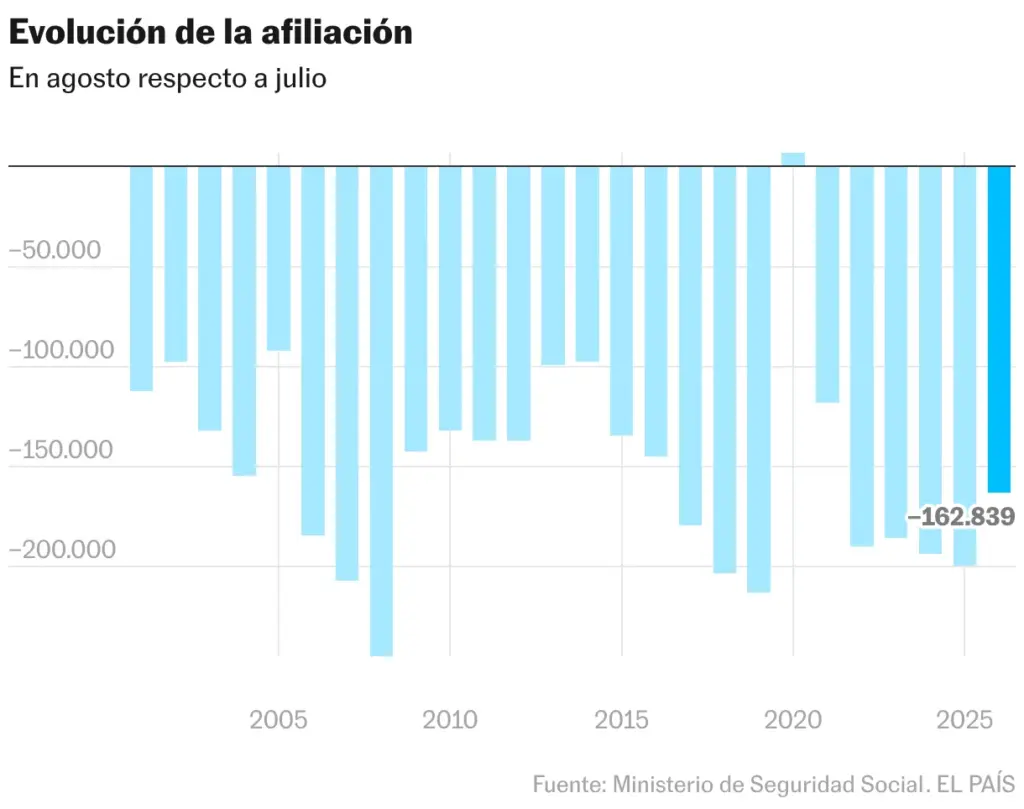
According to data released by Social Security, in August there was an average of 22.34 million contributors, 162,000 fewer than the previous month. This is a month-on-month contraction smaller than that recorded in 2025 (-199,000), 2024 (-194,000), 2023 (-185,000) or 2022 (-190,000), all very positive years for the Spanish labor market. One has to go back to the anomalous 2021 (-118,000), during the recovery from the coronavirus crisis, to find a better figure than that of this last August, which nevertheless marks a record for that month since records began.
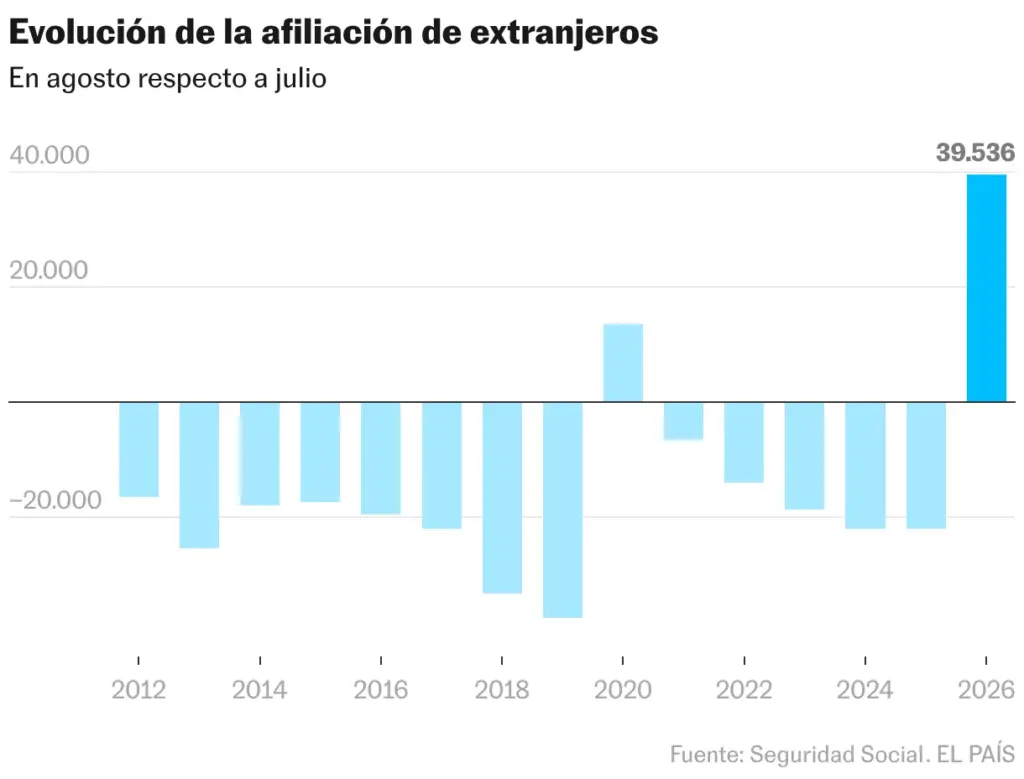
This year’s figures are heavily influenced by the extraordinary regularization of foreigners promoted by the Government, whose administrative phase took place from April 16 to June 30, but whose effects are still visible in labor statistics. As specialists have been emphasizing, it is normal for there to be a lag between obtaining the work permit and it translating into formal employment. Thus, in August Spain gained 39,500 foreign contributors, whereas last year this same variable decreased by 22,100 people. Normally, the eighth month sees a drop in employment of this nature, contrary to what has happened this time. The boost raises the total number of foreign affiliates above 3.5 million, for the first time with more than three million in the general regime (the most common among salaried workers).
According to Social Security, up to August 31 the regularization has led to the registration of 337,900 more foreign affiliates, of whom 203,400 are men and 134,500 are women. By country of origin, Colombia has the most regularizations (97,400), followed by Venezuela (66,700). Together, these two nationalities account for almost half of the total.
679,000 more jobs in a year
The year-on-year look at the data also shows a strong impact from the regularization of foreigners, which adds to the effect of the positive economic cycle that the Spanish economy had already been experiencing. The labor market has gained 679,000 affiliations in the last 12 months, well above last year’s figure at this time (+476,800), a year in which Spain created 41% of the employment generated in the entire European Union. The annual data also shows a record in foreign job creation, with 482,000 more jobs than in August 2025. So far this year, seven out of ten new jobs are held by foreigners.
The sectoral analysis shows, once again in August, the usual job destruction in education, with 78,000 fewer jobs in August than in July, a phenomenon much more relevant in non-formal education (academies and language centers) than in schools and high schools. It is such a deep drop that it accounts for half of the month-on-month job destruction. The eighth month also reduces employment in administrative activities (-17,500), scientific and technical activities (-17,300), and manufacturing industry (-17,000). Almost all areas of the economy decline, with some exceptions such as hospitality (+7,100) and health and social services (+17,200).
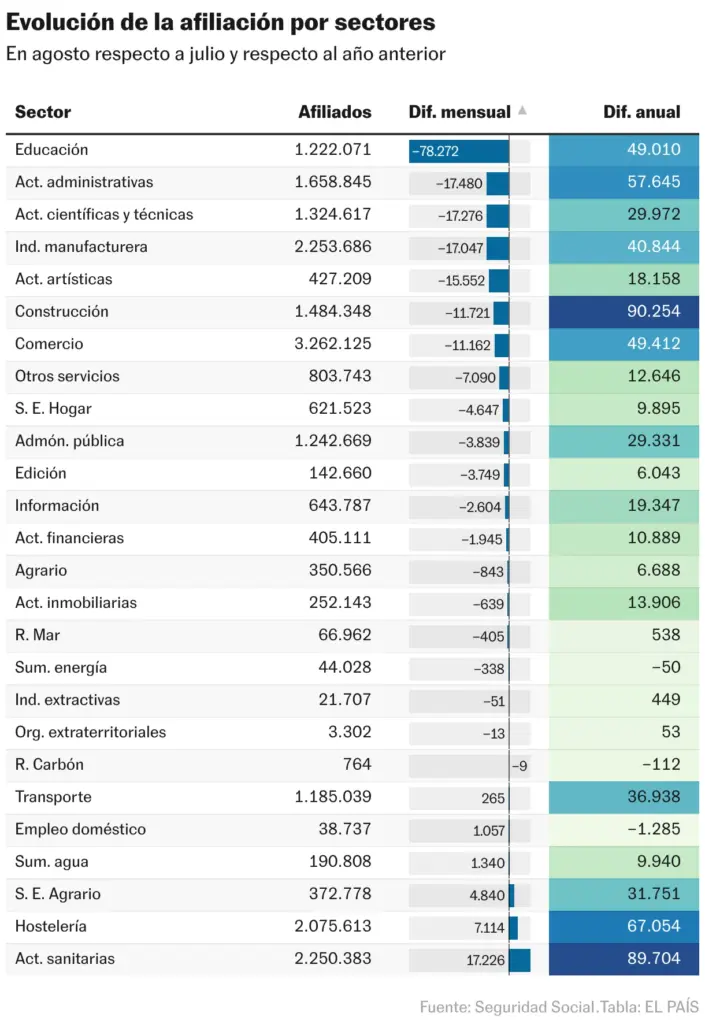
In year-on-year terms, without the seasonal impact of August, the picture changes. There are very strong increases in affiliation in several sectors, led by construction. In the midst of a housing access crisis, this branch of the economy has gained 90,200 jobs so far this year. Health activities (+89,700), hospitality (+67,000), and administrative activities (+57,600) have also grown strongly.
Read more Why is there almost never fruit for dessert in restaurants in Spain?
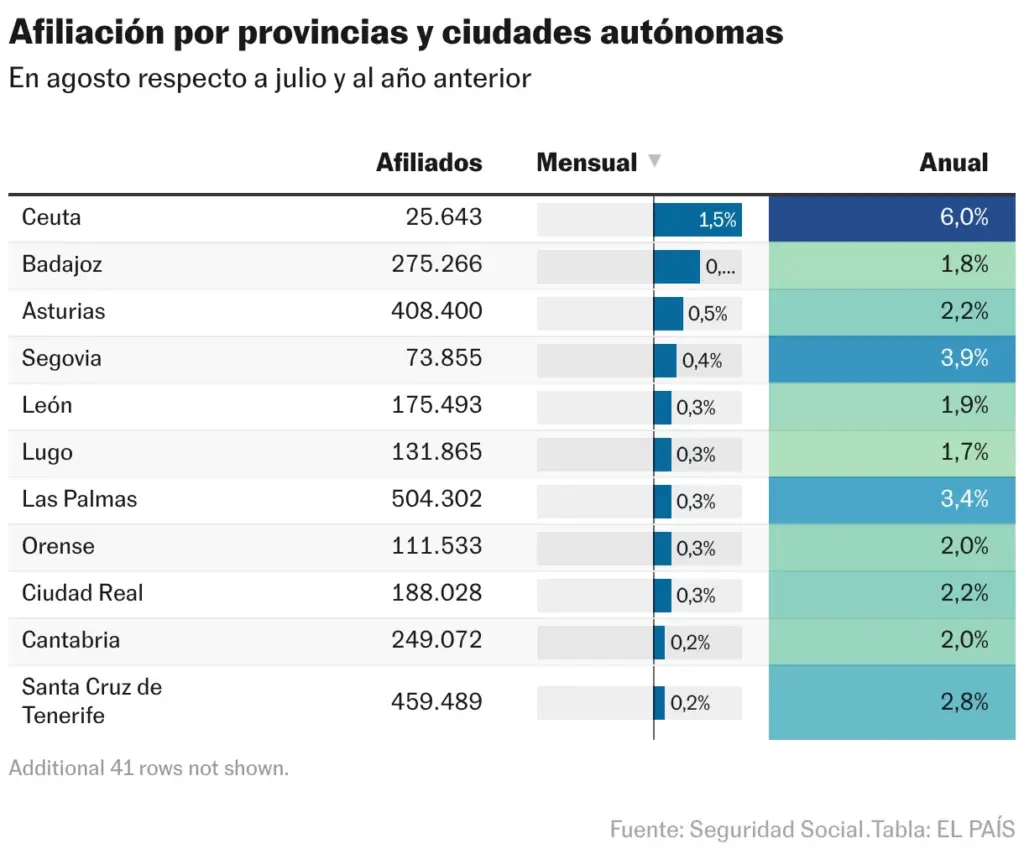
By territories, the provinces that lose the most employment in relative terms are Álava (-2%), Murcia (-1.9%), and Barcelona (-1.8%), while Segovia (+0.4%), Asturias (+0.5%), and Badajoz (+0.8%) are the provinces that improve the most strongly. All of them are surpassed by the autonomous city of Ceuta, which has been experiencing a deep crisis since early August due to the irregular entry of thousands of immigrants. The affiliation in the autonomous city grew by 1.5% in August compared to July (369 contributors), a much higher increase than in the provinces and also exceeding that recorded in Ceuta itself the previous year. Then affiliation increased by 0.4%, with 98 more affiliates.
In its analysis of the data, the Ministry of Social Security emphasizes that “temporality is drastically reduced and the quality of employment improves, with 4.8 million more affiliates with permanent contracts than before the labor reform.” It also applauds the boost in the number of self-employed: there are 63,700 more in the last year, bringing the total to 3.47 million.
Registered unemployment rises
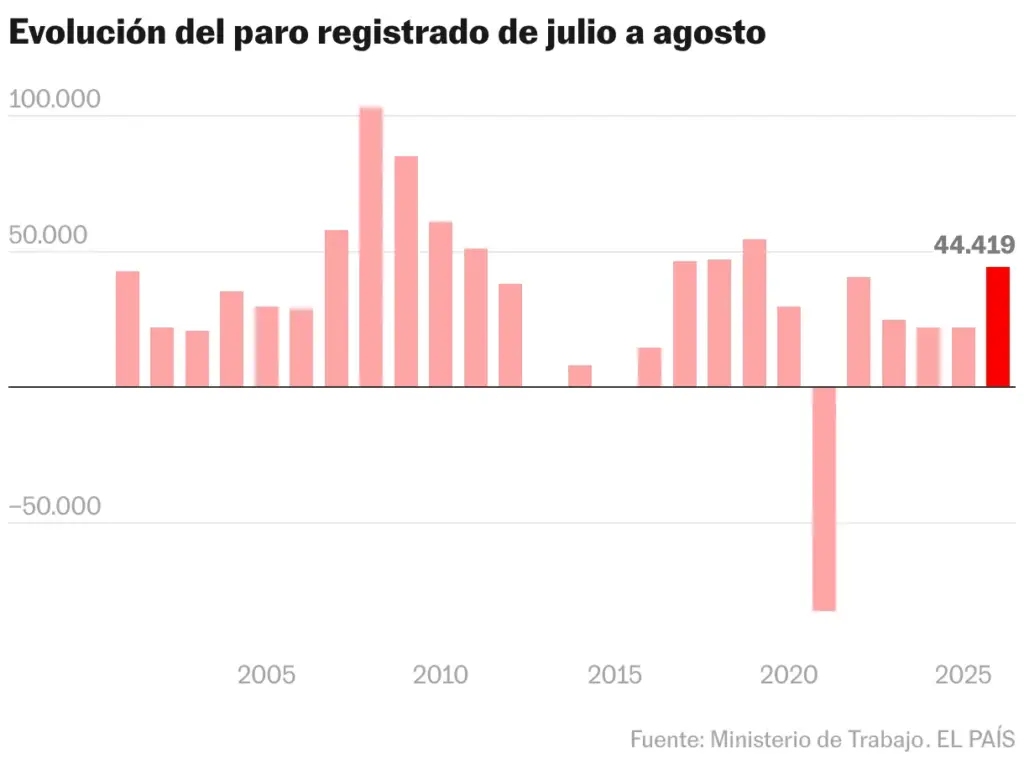
Registered unemployment grew in August more strongly than usual. This variable increased by 44,400 people, more than double that of 2025 and 2024 (with about 21,900 more unemployed in both years). This new figure worsens the year-on-year balance, which shrinks by 70,600 people, when the previous year saw a decrease of 145,600. Despite this, the 2.35 million registered unemployed in Spain are the lowest figure in an August since 2007, which does not prevent the country from remaining among the Europeans with the highest unemployment rate (10%, compared to the average of 6.1%).
The poor performance of registered unemployment in August is also connected to the process of regularizing foreigners. This month, foreign unemployment increased by 16,000 people, when it usually falls in the eighth month. Last year it contracted by 4,000 people and the year before by 2,100.
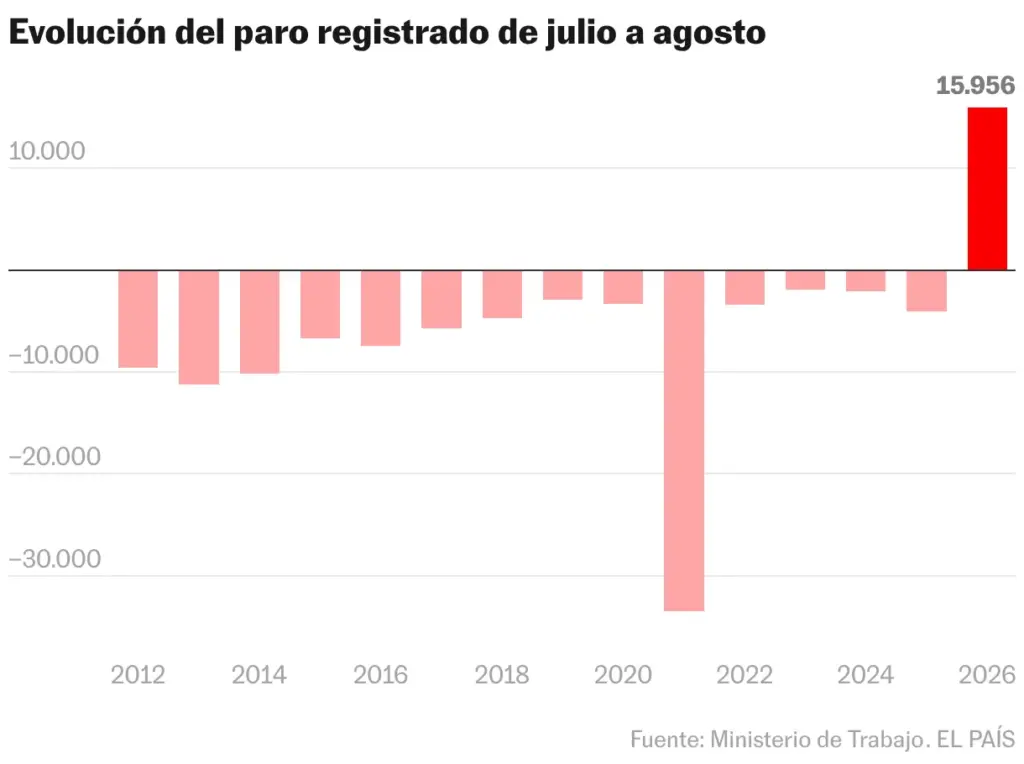
Labor market specialists had already warned that the increase in affiliation and registered unemployment were phenomena likely associated with the regularization. The first injects new employment into the economy, with contributions in taxes and social security contributions, while the second increases the welfare burden on the system. It is likely that many of these unemployed foreigners are registering at unemployment offices as a preliminary step before obtaining a job.
The Ministry of Labor highlights that registered female unemployment increases by 22,700 women (+1.6% compared to July) and stands at a total of 1.42 million, “its lowest level in an August since 2008.” At the same time, it emphasizes that youth unemployment under 25 years old increases in August by 8,200 people (+5.1%) compared to the previous month, but “remains below the 170,000 barrier,” a minimum in this century so far.
Read more ‘American Horror Story’ on Disney+, ‘Babies’ on Filmin and other recommended series for September