










Things are happening at the ends of Barcelona’s Diagonal. If on the Besòs side, the future Media City neighborhood and audiovisual hub is advancing, in Les Tres Chimenees, 32 hectares in Sant Adrià del Besòs and Badalona; on the Llobregat side, in a less advanced phase, the future Clínic hospital and its surroundings, 70 hectares straddling Barcelona, Esplugues and L’Hospitalet, is progressing. The General Council of the Porta Diagonal-Campus Clínic Consortium met this Wednesday and approved the preliminary document of the Urban Planning Master Plan, a figure led by the Generalitat and resorted to for large plans involving several municipalities. The preliminary plan quantifies between 800 and 1,125 flats (most in L’Hospitalet and half public) and locates the future Faculty of Pharmacy and Food Sciences in Esplugues, between the Finestrelles shopping center and the Ronda de Dalt. In large numbers, 63% of the future built area will be for health, teaching and research uses, 23% for economic activity, 10% for housing and 4% for local facilities.
Read more The Police report points out that Moroccan agents «guided» the entry of migrants into Ceuta
From the spectacular Espai Corberó in Esplugues, the Minister of the Presidency, Albert Dalmau, included the area in the “projects of real Catalonia, with a shared vision between the metropolitan municipalities and the Government”. And he pointed to the new Clínic as “a project that happens once a century”. “It’s been 100 years since the hospital moved from Ciutat Vella to the Eixample, where it transformed its surroundings, and now it’s growing again.”
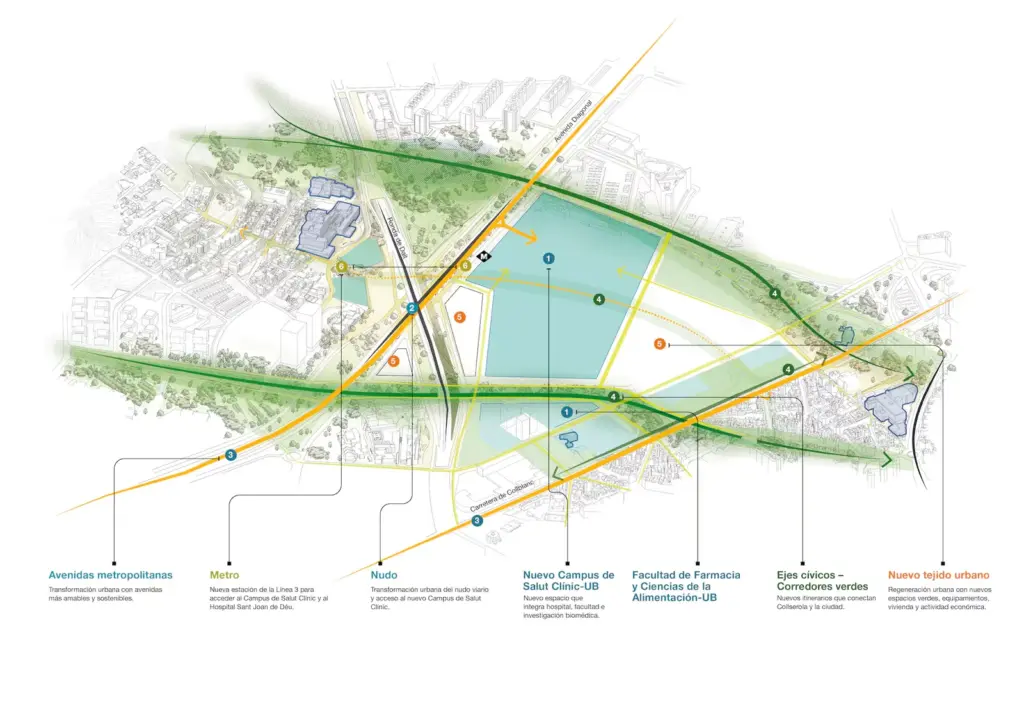
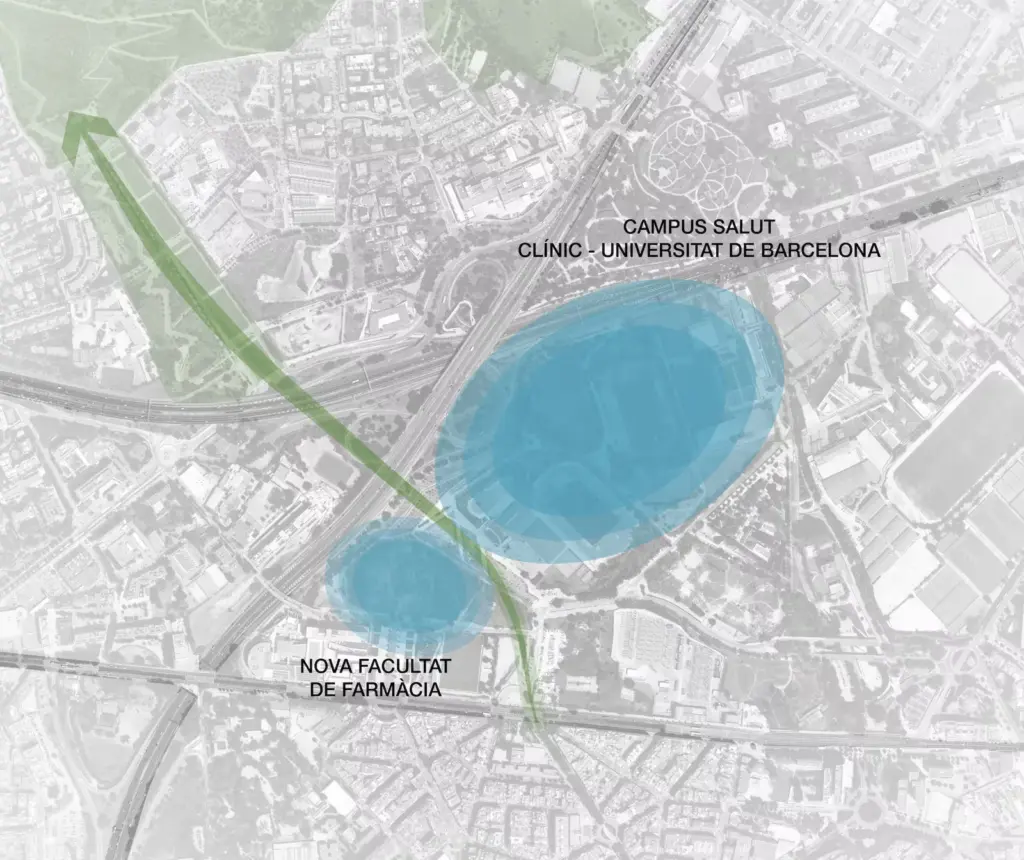
The area of the future Hospital Clínic and its surroundings (where the three cities each have a third of the total surface area) will allow for the re-stitching of a tip of the city heavily conditioned by the asphalt scalextric where Diagonal crosses with Ronda de Dalt, and the Collblanc road. In the municipality of Barcelona, “permeating”, in technical terms, the road junction connecting Cervantes Park (above the avenue) with the future Clínic campus (below, where the University of Barcelona’s sports area is now located).
L’Hospitalet gains a second university hospital, where residents of Samontà (the northern part of the city, densely populated, with neighborhoods like La Florida) will be attended, in addition to Bellvitge, and 800 flats (half protected), as well as a park in the vicinity of the Collblanc road, the extension of the Finestrelles rambla to Collserola and the expansion of Can Rigal park. As in Les Tres Chimeneas del Besòs, here too an electrical substation must be moved and buried.
The mayor of L’Hospitalet, David Quirós, celebrated the arrival of the Clínic in L’Hospitalet. “Specifically in my neighborhood of Pubilla Casas,” he specified. And he argued for the “positive impact” of the entire area, but especially “that the residents of L’Hospitalet can be attended to in the new hospital. People would not understand that hosting such a large facility would not benefit them.” Quirós also celebrated the increase in the percentage of protected housing, which was initially barely 25%. “It’s a historic milestone, we are moving forward, never in such a short time has so much progress been made,” he said.
In the case of Esplugues, the idea is that the transformation of the road scalextric that marks the intersection of Diagonal with the Ronda will overcome the “barrier effect”. It will also benefit from the relationship between Sant Joan de Déu hospital and the future Clínic. And it gains two L3 metro stations, which now ends at Zona Universitaria and will be extended with a stop at the new Clínic and another in the city center. The horizon, however, is long: 2035 for the new Health Campus to become operational. And the investment, millions: 1,700 million euros.
Another novelty from Tuesday’s meeting is that the future Clínic hospital will grow from 10 hectares planned to almost 13 for facilities and complementary activities. The main campus will have almost 400,000 square meters of built area for health, teaching and research uses, with the UB’s Faculty of Medicine, and up to 120,000 square meters of complementary uses, such as a residence for researchers or resident doctors and other services.
Read more The couples of ‘La isla de las tentaciones 11’ include a Bourbon
Housing has up to 90,000 square meters of floor space with a maximum potential of 1,125 flats, a figure yet to be finalized. Half will be protected and the majority, about 800 homes, in L’Hospitalet and the rest in Barcelona. The presence of housing, the Generalitat argues, will ensure that the area has citizen activity throughout the day.
Another relevant novelty of the meeting has been the concretization of the new Faculty of Pharmacy and Food Sciences of the UB, which will abandon obsolete facilities from 70 years ago (behind a university residence in the Zona Universitaria of Diagonal) “to lead training and innovation from Esplugues,” according to the Generalitat. The PDU’s preliminary plan places the faculty on a plot on Sant Mateu street, 2-6 and 8. A “strategic” location that will allow it to coexist with the Clínic-UB Health Campus, the Faculty of Medicine and Health Sciences, the Barcelona Science Park, and reference hospitals such as Sant Joan de Déu. The project will expand the university center’s capacity by 30%, which means reaching 3,000 students. A good part of the planned investment (152 million euros) will be paid for by the Government’s purchase of the sports use land from the UB.
The mayor of Esplugues, Eduard Sanz, stated that the municipality “becomes a university city with a new engine of opportunities.” “A city with a long history linked to pharmacy, with the presence of companies in the sector and laboratories, and because for some time we have been developing a health and wellness hub around Sant Joan de Déu, where a research building for rare diseases is being built” and other projects.
The rector of the University of Barcelona, Joan Guàrdia, acknowledged that the Faculty of Pharmacy “was a piece that was not planned in the area,” but considered that “it makes perfect strategic sense, a public, metropolitan university that responds to the comprehensive training and development of society.” Guàrdia recalled that pharmacy “has represented a first-rate sector for Catalonia and that the Clínic was born to have a different model between teaching and assistance, where teaching, research and patient care were together. Now we are giving a boost to the model.”
Núria Montserrat, Minister of Research and Universities, celebrated the construction of the new Faculty of Pharmacy and spoke of the day as “important, for the territory, for the people, to continue positioning Catalonia as one of the most innovative regions in Europe and a promoter of talent.” And the Deputy Mayor for Economy and Finance, Jordi Valls, stressed that “the physical relocation of the Clínic is not only a physical relocation, but also an improvement in healthcare.” “We are talking about much more, about health, housing and economic activity, the public sector must fulfill its obligation,” he noted.
Read more Feijóo blames Morocco for the Ceuta crisis and attacks Sánchez: “He knew and covered it up”