









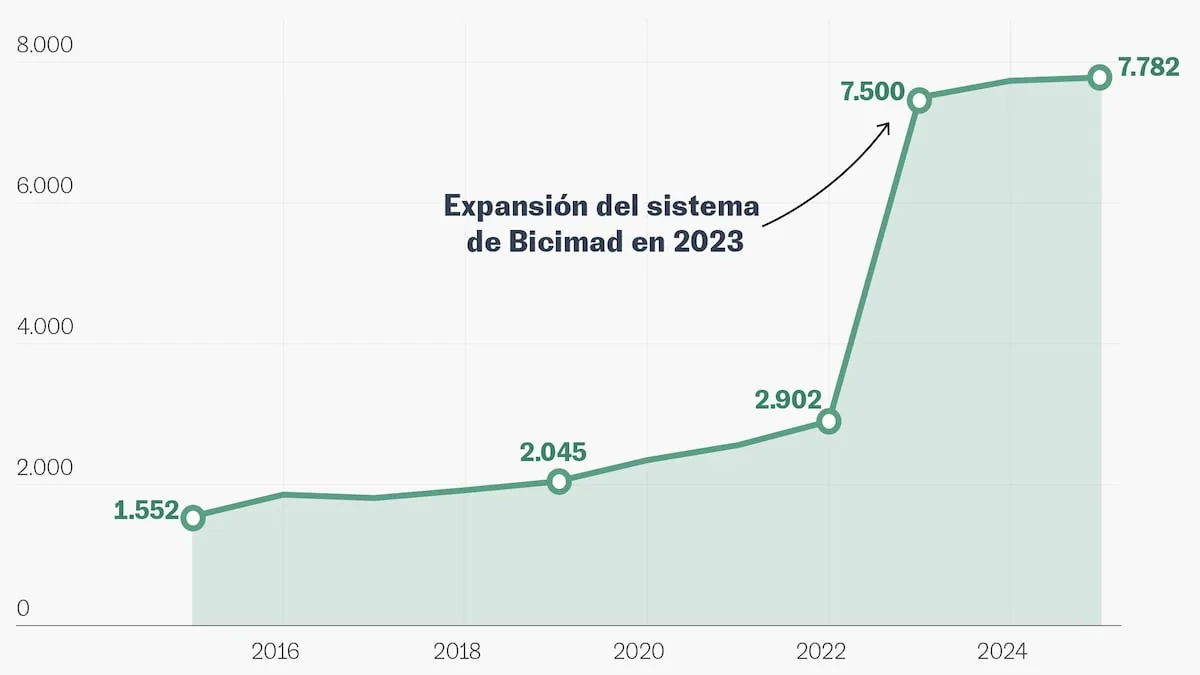
Madrid’s public electric bicycle rental system, better known as Bicimad, has completed three years since its renovation, with 635 operational stations and 7,795 bicycles available. “It’s a success story for this Government team. When we came in, there were three million users, and now there are 13.7 million,” boasted the capital’s mayor, José Luis Martínez Almeida, in March. After several expansions, the network will reach 653 stations and a fleet of 8,015 bicycles in May. The City Council insists that cycling mobility is gaining ground, even beyond the public system: the total number of bicycle trips, including privately owned ones, would have increased, according to their data, from 24.7 million in 2023 to 49.2 million in 2025. These figures clash with public data and the perception of experts and users. David Lois, professor of Social Psychology at the National University of Distance Education and a member of the Transport Research Center, suggests focusing on the quality, safety, and connectivity of the protected network, aspects in which the capital, in his opinion, fails.
Read more Peridis: the disciple Peter
The modal share of bicycles — the percentage of trips made by this means of transport out of the total number of journeys — is 1.3%, according to data provided by the municipal government’s Mobility department. But Paris already achieves 11%, Seville 7%, Barcelona 4%, Vitoria 8%, Zaragoza 3.5%, and Berlin 18%. The key is protected bike lanes.
Between 2017 and 2022, Bicimad averaged about 300,000 trips per month, with predictable drops in winter and during the toughest periods of the pandemic, according to the scarce open data from the City Council. The big leap came after the service transformation in 2023, although a good part of that year’s figures have not been made public. In the last two years, the system has already approached one million monthly trips, with peaks exceeding 1.6 million in September and October.

The increase in journeys has been a consequence of the service expansion. Between 2015 and 2022, the system grew gradually, from having around 1,500 bicycles to about 2,900 on an annual average. In 2023, a turning point occurred: the fleet soared to 7,500 units after expansion to all 21 districts and the installation of more than 600 stations.

If the number of available Bicimad bicycles is cross-referenced with the number of daily trips each one makes, it is clear that after reaching its highest levels between 2018 and 2019, with an average of about 4.9 daily trips, the indicator falls. It only recovers those levels after the major expansion in 2025. This is a possible indicator that where the network has expanded, some stations remain underutilized.

It is important to note a limitation in public data that hinders a more precise evaluation of Bicimad’s performance. Currently, the City Council does not publish disaggregated data by station, which prevents knowing, for example, which ones are used more and which ones less. This information was available before 2023, which makes its absence even more striking during the period of greatest service expansion.
Consolidating cycling
What makes the difference is consolidating the bicycle as the usual means of transport in citizens’ routines. This is explained by the Dane Mikael Colville-Andersen. His blog Copenhagenize became a global reference for urban cycling and led him to advise cities that wanted to transform their mobility. “It’s great that Madrid has a shared bike system; it was one of the first cities to have 100% electric support, but that’s already standard in other cities. Its growth has value, although we need to see what type of cycling it attracts,” he indicates. He points out that the capital has many recreational routes, especially on cycling infrastructures that surround the city or run near rivers.
“The most successful shared bike systems are found in cities where people use them for daily commutes and short trips in the center and neighborhoods, for shopping, going to restaurants or bars, all those everyday things,” he says. He insists that protected bike lanes are indispensable. He acknowledges that Bicimad has a good number of bicycles and calls the usage figures “respectable,” but indicates that in the European ranking of shared systems, such as Shared Ambition 2024, “it doesn’t fare so well.” He is critical: “Years ago I called Madrid the black hole of cycling in Europe, and according to all the indicators we use to measure this, it still is.”
Compared to other European cities of similar size with public systems, Madrid is in an intermediate position in terms of size, but lagging in bicycle density. Although Bicimad has nearly 7,800 units, the ratio per inhabitant is 2.2 per 1,000. This is far from benchmarks like Paris, which exceeds 9, or Barcelona and Helsinki, around 4.5.

Alejandro Cencerrado, a daily Bicimad user, acknowledges that the service “is a gift” for him since he arrived in Spain in 2021 after living in Copenhagen, despite living in the Delicias neighborhood, where Almeida recognized the existence of a very dangerous cycling infrastructure that has not been modified. “At first, anchor failures were frequent, but everything has improved a lot in recent years,” he comments. However, he believes that the main obstacle is the lack of safe bike lanes: “In Denmark, my wife always went everywhere with me; now she’s afraid to cycle among cars. For me, with small children, it was a very hard blow.”
The lack of data and transparency in the public bicycle system is exposed when measuring how many kilometers of bike lanes the city has. If the official geographical file (shapefile) published by the Madrid City Council and updated monthly is analyzed, the capital has a total of 344.22 kilometers of exclusive bicycle lanes, known as “carril bici.” Additionally, there are 402.44 kilometers of shared use (including streets where cars travel with a 30 kilometers per hour limit). Another 67.55 kilometers belong to the green cycling ring. In total, 833.87 kilometers of infrastructure, according to the analysis of available data carried out by EL PAÍS.
Read more The first cycle of childhood
At the end of March, the Department of Urban Planning, Environment and Mobility, however, reported another figure: the cycling infrastructure would reach 1,167.2 kilometers, divided between 764.7 kilometers of segregated bike lane and 402.4 kilometers of “ciclocarril” (which include streets shared with cars). The City Council claims it has adapted the measurement to international standards to conform to the usual norm in the European context.
The collective En Bici por Madrid has refuted this information by providing its figure on the social network X, very similar to that of EL PAÍS and calculated with a publicly disclosed methodology: 338 kilometers of segregated bike lane, “also not counting ‘encaminamientos,’ which instruct cyclists to use the sidewalk without a bike lane, which is not allowed.” The head of urban cycling for the Pedalibre Association, Miguel de Andrés, insists that vehicles do not respect the speed limit on “ciclocarriles.” “Some are located in the middle of other lanes. They are reckless,” he points out.
On many occasions, bike lanes end in the middle of nowhere, as if someone built a bridge that is cut in half. “This is the case of Conde de Casal, Luis Rosales, Cuatro Caminos, or the section built on La Castellana, from Raimundo Fernández Villaverde to Plaza de Castilla. In this case, even the northbound bike lane is cut 400 meters before reaching the square,” he indicates in a quick mental review.
Colville-Andersen points out that boasting about kilometers is absurd. What makes the difference is the connection of the urban network, which should be “uniform, dense, coherent, and cohesive.” This is what influences modal share. He recalls that this was around 5% in Paris in 2020 and today reaches 11%. “Seville has been an exemplary city for many years: they went from 0.2% to 7% in just four years after implementing an urban cycling infrastructure network,” he indicates.
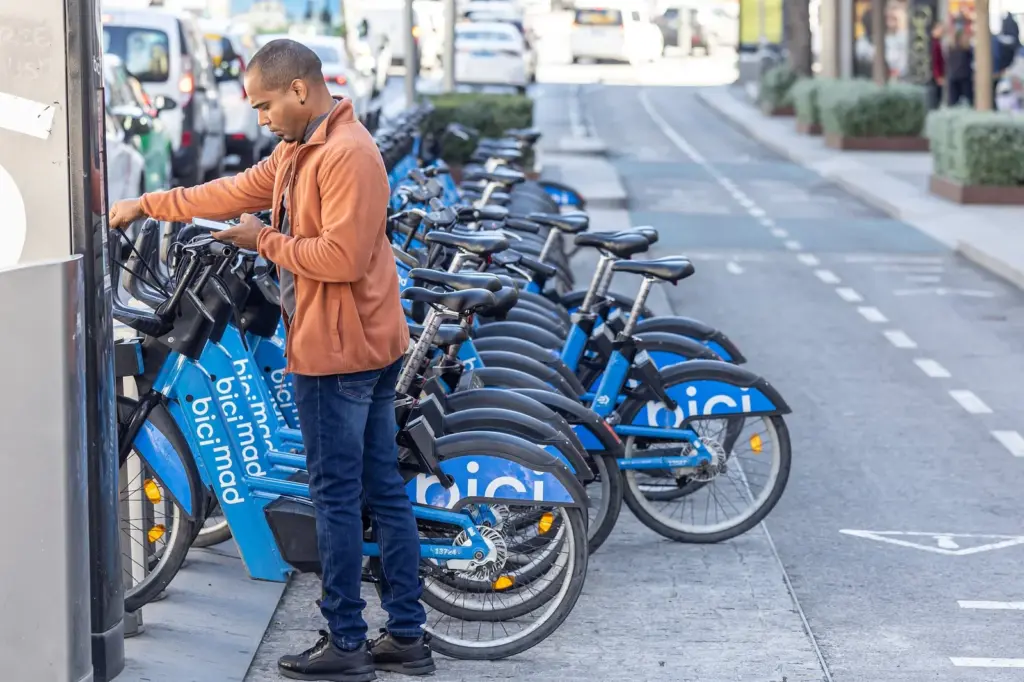
Fernando García, appointed Madrid’s “bicycle mayor” in 2021 and an active user, laments the removal of spaces where he could previously cycle. “A recent example is the removal of the passage over the Puente de Toledo,” he indicates. He feels that the capital is not implementing positive policies in this regard: “For example, in Concha Espina, near the Bernabéu, the municipal project included a bike lane. However, in the latest modification, the City Council has eliminated it. It is particularly striking because that section had three lanes in each direction, and yet it was decided to suppress the cycling space to widen the sidewalk, reducing the road section by more than 50%. That bike lane was part of the Master Plan, but it has been halted without technical explanation,” he indicates.
Unfulfilled promises are accumulating. García denounces that in recent years, several cycling projects have been budgeted but not executed, such as a bike lane between Puerta de Toledo and Carrera de San Francisco or a footbridge over the Manzanares to connect Arganzuela with Carabanchel. “At Madrid’s railway accesses, there are hardly any safe and free bicycle parking facilities, which prevents both modes from being combined,” he laments.
From En Bici por Madrid, they believe that Bicimad lacks logistical resources to cope with its expansion, which causes imbalances in the system when demand increases. They advocate for secondary routes that they consider safe, given the lack of bike lanes, although they acknowledge that this task becomes more complicated in the periphery.
“Although the PP likes photos with Bicimad, it has not developed the network that its own 2008 Cycling Mobility Master Plan contemplated,” Lois denounces. He explains that a rental system helps people try this mode of transport, but it only works as a complement and its importance diminishes when the city is truly cyclable. Ignacio Benito, PSOE Mobility Councilor, denounces the lack of execution of already approved measures, such as the elimination of sidewalk bike lanes, and questions why the Castellana bike lane is presented as a “backbone” when it is neither finished nor connected to other key axes.
According to an information request registered by his party in January, the actions planned in the municipal budgets for this year barely add up to five kilometers and in many cases correspond to the renovation of existing sections. “Madrid will not gain new bike lanes in 2026, and projects will be postponed at least until 2027.” In his opinion, Almeida’s only relevant action has been the renovation and expansion of Bicimad: “30 of the 48 million it cost to give it a facelift were provided by the Spanish Government, from European funds.”
Read more A master’s degree, an advisor and two letters: dissecting the ‘Begoña case’