









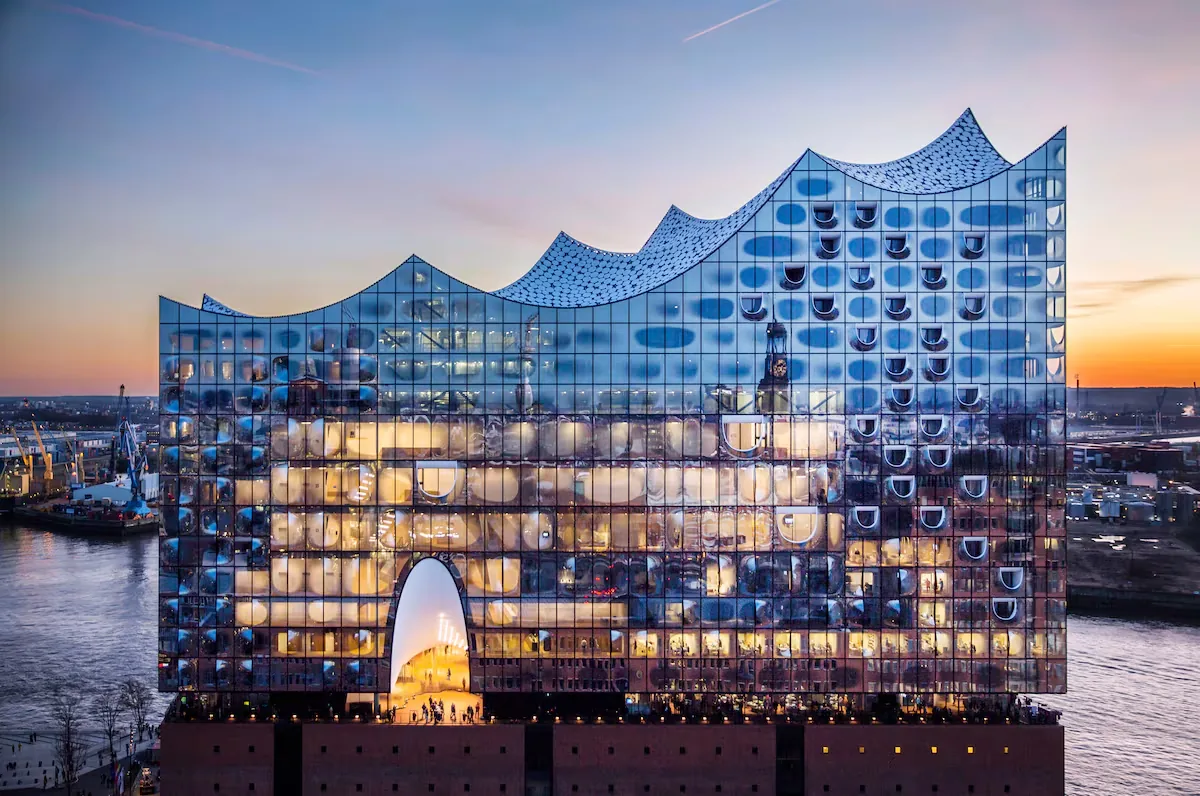
On April 17, The New York Times published a list of the most controversial buildings of all time. Nine constructions arranged chronologically, from the Tower of Babel to the ballroom that Donald Trump is building in the White House. In eighth place was the Elbphilharmonie in Hamburg, the only building included for a happy reason. For one of the three voices consulted, Japanese architect Toshiko Mori, its undulating halls, suspended over an old brick port warehouse, illustrate how a controversy ages. Scheduled for 2010 and with a budget that ended up almost tripling to reach 866 million euros, the Elbphilharmonie finally opened on January 11, 2017. Since then, Mori wrote, “everyone loves it and there are no tickets.”
More than an auditorium, the Elbphilharmonie is a small vertical city. On the old Kaispeicher A, architects Jacques Herzog and Pierre de Meuron built a Grand Hall with 2,100 seats in the shape of a vineyard, a Recital Hall for 550 spectators, a hotel, residences, parking, restaurants, and a public square located 37 meters high, which has already received almost 30 million visitors.
They were not later additions or architectural whims: director Christoph Lieben-Seutter recalled last Tuesday, September 1, during the presentation of the tenth anniversary season, that the original concept already incorporated private uses to help finance both construction and operation and conceived the Plaza as its great public space. The figures have exceeded all forecasts: 7.4 million spectators in the halls since 2017, a Grand Hall occupancy close to 96%, and 380 annual concerts, compared to the 240 initially planned.
At that same round table, held in the Recital Hall, De Meuron confessed that he was unaware of the New York ranking and finished with a jab: eighth place was not bad, but at least the Elbphilharmonie was finished, unlike the Tower of Babel. Social Democratic senator Carsten Brosda later defined the building as a symbol of the 21st century and “of a democratic era,” born from art. He also recalled that, in brand studies conducted in the 2000s, neither Hamburgers nor visitors identified culture as a hallmark of the city, while today more than half of tourists say they come to Hamburg for it. No journalist asked questions. At the end, as a preview of that night’s concert, pianist Alexandre Kantorow performed Chopin’s Prelude in C-sharp minor, op. 45.
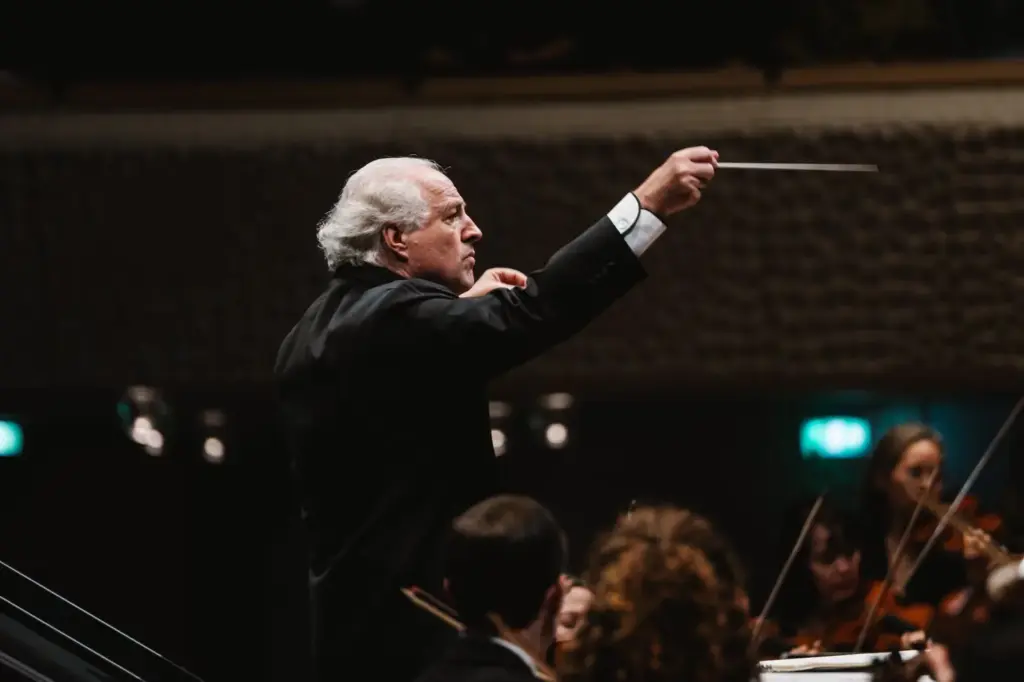
But the real hinge between the building and the music in this season opening has been Manfred Honeck. The Austrian conductor, about to turn 68, was the first to test the acoustics of the Grand Hall, months before its opening, leading the then NDR Sinfonieorchester. He told this newspaper yesterday during an interview in the lobby of The Westin Hamburg Elbphilharmonie, the hotel occupying the eastern part of the building’s spectacular undulating glass structure. Honeck then toured the hall with acoustician Yasuhisa Toyota, who warned him not to be surprised if the sound changed in three years, “because the wood works.”
Ten years later he maintains that Toyota was right: “I think it has changed, although we have probably also gotten used to it. The clarity is still there, that is undisputed.” Honeck adds that the sound has become rounder and warmer. He demonstrated this last night with the two encores that closed the second of his concerts at the Hamburg symphonic opening. If in the Hungarian Dance No. 1, orchestrated by Brahms himself, he showed the hall’s balance through admirable contrasts, in his orchestral arrangement of Schubert’s Litany for All Souls’ Day, D 343, the tender and solemn prayer embraced the audience with a pianissimo sound mantle. Almost thirty seconds of silence followed before the applause, with the audience visibly moved.
Honeck, music director of the Pittsburgh Symphony since 2008, has just extended his contract until 2033, which will make him the longest-serving conductor in the orchestra’s history, ahead of William Steinberg. Since then he has hired almost half of the current staff and defends the identity of each ensemble with a very simple argument: “Why does an orchestra go on tour if they all play the same?”
His two programs at the Elbphilharmonie, as part of a European tour of thirteen concerts in six countries, frame a dual identity. On Tuesday the 1st, a tribute to Hamburg with the Piano Concerto No. 1 by the city’s most famous composer, Johannes Brahms, alongside the orchestra’s signature work, Shostakovich’s Fifth Symphony, whose 2013 live recording earned them the 2018 Grammy. On Wednesday the 2nd, an entirely American program. Pittsburgh thus opens the series of thirteen concerts with which seven American orchestras will tour the season: Franz Welser-Möst’s Cleveland and Gustavo Dudamel’s New York Philharmonic in October, Chicago with Klaus Mäkelä in January, Boston with Andris Nelsons in March, and San Diego with Rafael Payare in May.
Brahms found the first favorable audience for his Piano Concerto No. 1, op. 15 precisely in his native Hamburg, in March 1859, two months after Leipzig received it with whistles. Kantorow, resident at the Elbphilharmonie during the 2024/25 season, showed from his first intervention, fluid and singable, after the telluric force of the orchestral introduction, an outstanding mastery of Brahmsian sonority. The tense octaves of the development shone especially, well projected over the orchestral mass. But the best of the French pianist was heard in the adagio, where Brahms traces, according to a letter, a portrait of Clara Schumann: deeply felt harmonies and a discourse shaped with a mix of care and spontaneity.
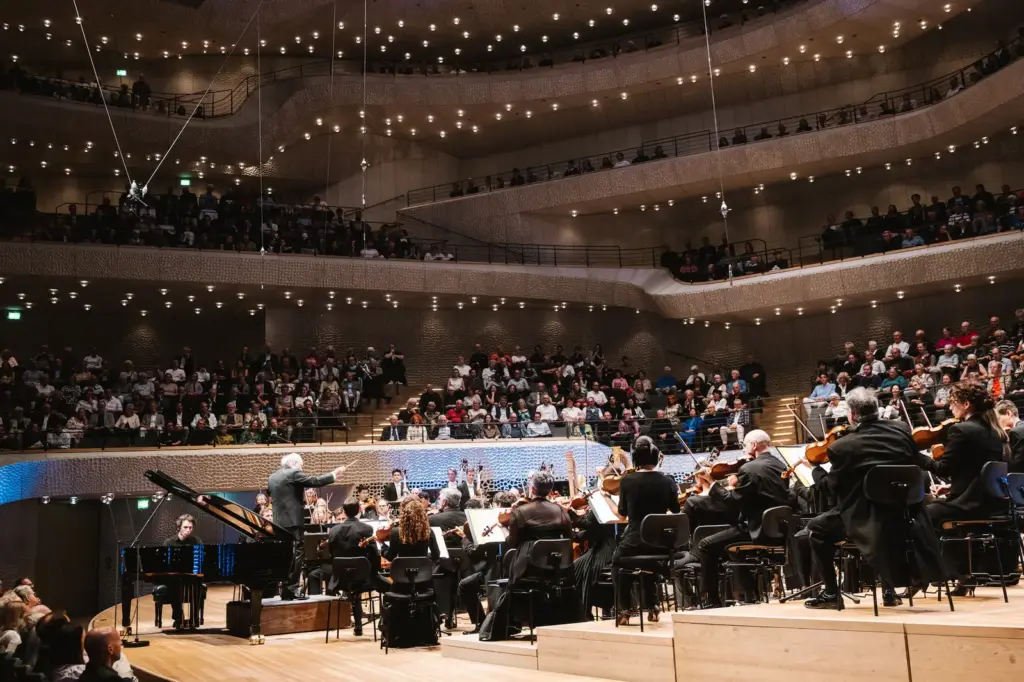
The rondo was a worthy finale, although the encore was even more revealing. In the Ballade op. 10 no. 1, Kantorow found an epic and narrative sense, with a dense and atmospheric sound that ideally evoked Edward’s macabre dialogue with his mother, taken from Scottish folklore. Honeck, who the next day praised a pianist “who listens like a chamber musician and does not choose for effect but for the music,” offered attentive and accomplice accompaniment, capable of supporting the soloist without giving up either volume or the dark sonic weave of the work.
Shostakovich’s Fifth came with built-in debate. The program notes, signed by Clemens Matuschek, rely on Testimony by Solomon Volkov, a source that musicology today considers fraudulent, as Marina Frolova-Walker and Jonathan Walker recall in their recent monograph on the work (Oxford University Press). It also addresses the controversial history of the metronome marking of the final coda after its publication in 1939: the indication was halved in the second edition of the score, and later editions restored the original fast tempo. The issue has since divided conductors between the slow, led by Mravinski, and the fast, with Bernstein as a reference, two readings that the composer himself endorsed.
Honeck places himself in the first camp. “My instinct always said no: the glorification of a human triumph cannot be fast,” he explained yesterday morning, although he admitted that the double marking was “irritating” and that Shostakovich himself had admitted the fast reading “as a possibility.” His interpretation refers to Mahler, whom Shostakovich admired precisely for his ability to say one thing and suggest another beneath the surface, so that the same message could be heard by the regime as glorification and understood by the composer’s friends as a human triumph. “Maybe we have to thank Stalin for this symphony,” he said.
In the hall, Honeck offered an excellent interpretation of the symphony on the 1st, very much in tune with his award-winning recording for Reference Recordings. After the start, the pianissimo came with well-sharpened edges, although in the initial moderato he opted for a slower tempo than usual. The allegretto approached a Mahlerian Ländler, mischievous and deliberate, with excellent interventions from Victoria Luperi’s piccolo clarinet and concertmaster David McCarroll. The largo, which Honeck considers the core of the work, reached the night’s highest point, with the strings divided into long, almost cinematic sound planes, and the oboe, clarinet, and flute recitatives administered with contained breath. The finale had just the right dose of frenzy and acidity in the initial march, although the extreme slowness of the coda introduced a strange nuance of bitterness and frustration, without preventing the final outburst of the audience.
As an encore, they performed Teobaldo’s death from Prokofiev’s Romeo and Juliet, another funeral pomp that again showcased Pittsburgh’s amazing orchestral apparatus. In fact, the concert was recorded by Elbphilharmonie Live and can be seen in full on YouTube.
Wednesday the 2nd’s program also started from a recording reference: its latest release, published in July, which brings together Dvořák’s New World Symphony and American composer Carlos Simon’s Four Black American Dances. Added was Barber’s Violin Concerto, with Augustin Hadelich, this season’s resident artist, as soloist. Simon’s dances, a commission from the Boston Symphony, traverse the slaves’ ring shout, the waltz of the black debutante balls of the 1930s, tap dance, imitated by the snare drum rim, and the Pentecostal “holy dance,” in which the composer asks the orchestra to play semi-improvised to evoke a congregation speaking in tongues. Precisely, this last movement of the colorful suite was the highlight of the performance, with a spectacular praise break led by three trombones standing. Honeck had explained in the morning that he programs Simon “not because he is black, but because he is a genius.”
Barber’s Violin Concerto has some Pittsburgh pedigree: it was first read privately under Fritz Reiner, then music director of the orchestra, before its public premiere in February 1941. German-American violinist born in Tuscany Augustin Hadelich confesses in the program notes that he did not know it until arriving at Juilliard in 2004, as it was barely played in Europe, and sets his own interpretive criterion: to avoid the music slipping into kitsch. Far from that, he displayed a moving intimacy in the allegro, with the sound of his 1744 Guarneri Leduc, ex Szeryng; his dialogue with oboist Cynthia Koledo DeAlmeida in the andante was sublime, and he faced the final perpetual motion with the exact dose of precision and flexibility. As an encore, he offered his personal arrangement for solo violin of Schumann’s Dreaming, the seventh of the Kinderszenen, op. 15, with refined handling of double stops and double harmonics.
Dvořák’s New World Symphony closed the program with another issue that Honeck raises in the notes of his disc and defended bluntly during yesterday’s interview: the tweaks he introduced in the Czech composer’s score. They are minimal details, such as dynamic changes to reinforce a crescendo, alterations in the timpani part, or added accents. “Every time I open the score I ask myself if things are right; I make small changes so it sounds clearer, and I’m sure Dvořák would approve,” he said, with a generational argument: today’s audience, living among planes and mobiles, needs to hear music “in a compact and intense way.”
It is worth remembering, however, the Czech composer’s express prohibition to his publisher Simrock to introduce any changes in his editions, even at the performers’ request. In the hall, Honeck again showed his natural connection with the Pittsburgh musicians and gave full meaning to each of those interventions. The result was again admirable, with a freshness capable of shedding new light on such a well-heard score, especially in the largo sections, or covering the scherzo trio with a halo of nostalgia.
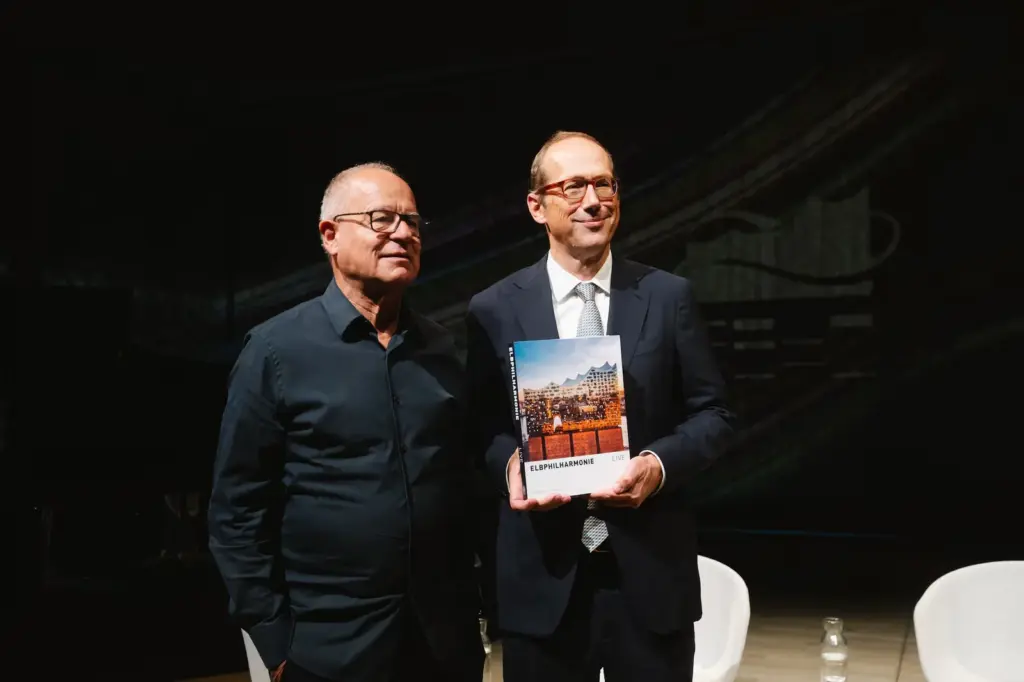
Back at the round table, the house presented its anniversary book the same day, Elbphilharmonie Live (Hoffmann und Campe), a photographic volume in German and English that, more than architecture, portrays the life of the building: artists, backstage, children’s projects and, according to Lieben-Seutter, “things that even insiders don’t know,” such as the air conditioning plants under the roof or the acoustic canopy suspended above the stage. De Meuron was right in the Recital Hall: unlike Babel, the Elbphilharmonie was finished and will turn ten in January. The symphony with which Honeck opened this anniversary season, however, has remained unresolved since 1937. The night before last it again did not resolve, with that slow coda.
Read more Elliot Page laments not having received any job offers after participating in ‘La Odisea’