









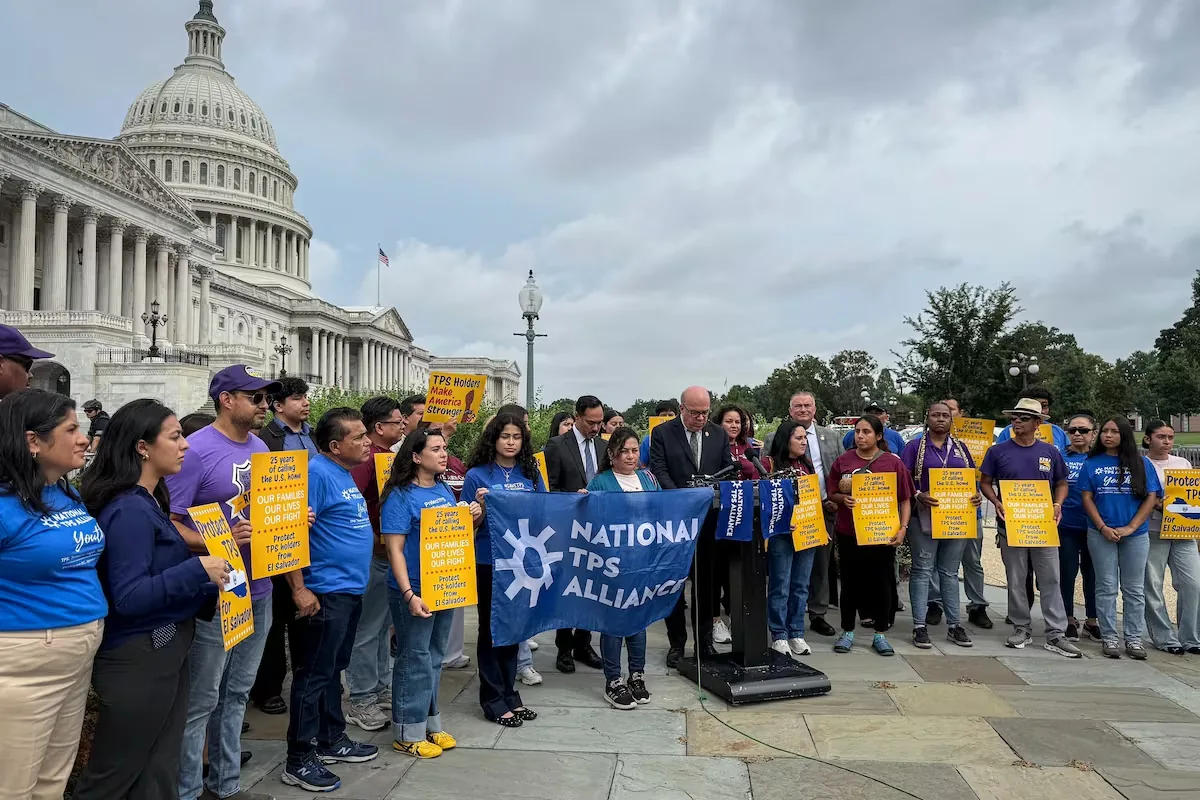
With just six days left before about 170,000 Salvadorans lose the protection that allowed them to live and work legally in the United States, several lawmakers and activists gathered this Thursday in front of the Capitol in Washington D.C. to request the extension of the Temporary Protected Status (TPS) for El Salvador, which ends on September 9.
“I want to make it clear from the start that this should not be a partisan issue. There is bipartisan consensus that extending this designation is not only the right thing to do morally, but it also benefits the United States. It is beneficial for our economy, our national security, and our communities,” said Massachusetts Representative Jim Govern. The Democratic congressman led a letter in July signed by 80 Democratic representatives addressed to the Secretary of the Department of Homeland Security (DHS), Markwayne Mullin, asking that the program not be canceled. To date, there has been no response.
El Salvador is the first country to benefit from TPS, a humanitarian program through which the U.S. hosts people fleeing situations of extreme violence, armed conflict, or natural disasters. The Central American country obtained it in 2001 following the civil war that left a trail of poverty, violence, and chaos from which hundreds of thousands of people fled.
Decades after residing in the United States, having formed families, created businesses, and bought homes, the Donald Trump administration, immersed in its anti-immigration campaign of mass deportations, wants to expel them.
“I know firsthand. I have had the opportunity to meet Salvadoran citizens benefiting from TPS living in Omaha; I sat down to talk with them. When I was elected in 2017, I really didn’t know what TPS was; it was the Salvadorans in our community who explained what it consisted of,” said Nebraska Republican Representative Don Bacon, one of the voices in his party who has most supported the continuation of TPS. Bacon stated that most had already been in Omaha for ten years, many worked as shift supervisors and were in charge of hundreds of people. “I asked how many owned their homes and half raised their hands; also, almost all have families here. It was an eye-opening experience to know who you are,” he said to the TPS beneficiaries present in front of the Capitol.
“My colleagues may disagree a bit with what I am going to say, but I feel we have gone from one extreme to the other in immigration policy. I think people did want a secure border; it was an important factor in the last elections. People want dangerous individuals expelled, but they do not want law-abiding people who work, have families, and contribute to our communities deported,” he insisted.
The lawmakers present, including Joaquín Castro, a Democrat from Texas, and Luz Rivas, a Democrat from California, highlighted the contribution of Salvadorans to the U.S. economy. TPS holders pay about $1.5 billion in taxes each year and contribute nearly $6 billion to the economy annually.
Read more Eugenio Garza Sada Award, 33 years of leadership, entrepreneurship, and innovation from Nuevo León
The Trump administration has been eliminating TPS for all countries that had it, leaving more than a million people who legally resided in the United States on the brink of deportation. “They have deported Venezuelans to third countries after devastating earthquakes shook the nation. They have deprived Haitians of their protections and subjected them to deportation to a country that, according to our own State Department, is too dangerous for Americans to travel to,” said Castro.
The Trump administration argues that the TPS program is temporary and therefore must end. “For some people, it is called something ‘temporary.’ Let me ask you. English is my second language, is 25 years something temporary?” questioned José Palmo, director of the National TPS Alliance. Palmo, Salvadoran by origin and a TPS beneficiary, arrived in the United States 28 years ago and built his family and life in this country. He emphasized that TPS must be renewed every year and a half and is not allowed if any crime has been committed. “We have been doing everything according to the rules. But now, the only thing we know is that we are protected for six days,” he said.
More than a quarter of a million families have parents with TPS immigration status, and many are Salvadoran. Their children now live in fear that their parents will be expelled. “The current situation — awaiting official news on whether TPS for Salvadorans will be canceled in less than a week — generates immense stress, as the lives of hundreds of thousands of people will be altered forever,” said Cristel Argueta, a young criminology student and activist, daughter of a TPS beneficiary who came to the United States at 19 fleeing violence in El Salvador.
Argueta denounced the human cost of ending TPS by recalling Pierre Damas Bel, a 20-year-old Haitian who took his own life this week. His family believes he committed suicide due to the stress caused by harassment from his peers for wearing an electronic ankle bracelet. Immigration and Customs Enforcement (ICE) placed it on him in June when he lost TPS status. “Personally, I am also 20 years old. He was forced to wear an electronic shackle, a measure allowed by this administration. How can this nation allow future neurosurgeons and professionals to commit an irreversible act like this?” she asked. “I don’t want to lose my mother; this should not be the reason many American children lose their relatives,” said Argueta.
In Congress, there have been advances to promote legislation that opens a path to grant permanent residency to foreigners with TPS and so-called dreamers, who arrived irregularly as children. Yesterday, three congress members joined to support the Dream & Promise Act, bringing the total to 217 lawmakers who back it. Only one more Republican representative is needed to join the group for the bill to be presented to the full House for a vote.