


Obsessed with endings, Camila Cañeque compiled hundreds of last literary phrases, even though the most famous ones are usually the first. With 452 of them, she put together a rare book, La última frase (La uÑa RoTa), in which she enumerated them, classified them, swirled them to compose new texts, and reflected, between essay and biography, in that contemporary hybrid genre, on things that end.
Read more Fifty photos to tell half a century of history of EL PAÍS
One day, after sending the text to the editor, Cañeque was finally able to review the galleys, and that night, unexpectedly, she passed away in her sleep. It was February 14, 2024, she was only 39 years old, and according to the computer system, that was the last document she saw in her life, her last sentences. There was something of poetry, something of legend, in the great tragedy, if such a thing can be said of such an unfortunate death.
Cañeque, born in Barcelona in 1984, writer, artist, performer, thinker, did not live to see it, but La última frase was a celebrated book on the best of the year lists and still thrives through word-of-mouth and reading clubs: it shows signs of enduring among the most literary-minded community, those fond of literary games and the mysteries that lie between the lines (see Enrique Vila-Matas, a frequent champion of her work). It is in its fourth edition. Now, rescued from the depths of her hard drives (“Camila never stopped working,” recalls her mother, Montse González Xicota), among other texts, especially essays on art and philosophy, another finished novel appears: Anuncios, also published by La uÑa RoTa in its new narrative collection Libros del Condotiero. The novel, apparently, was very well-worked and in its definitive version, as the editor confirmed by comparing the numerous drafts and sketches the author left among her digital archives.
Following her experimental line, Anuncios, which seems to have been written in parallel with the previous book, has a peculiar approach: it presents a jazz musician of Lithuanian origin, with a torrential verbosity and an alcoholic inclination, named Don, residing in New York (the city here is more than just a setting), but through a voluntarily mute narrator, who, like a camera, only records the protagonist’s speeches and actions and provides annotations, mainly in two spaces: his tiny home and the bar. The guy doesn’t even seem to notice his companion’s muteness, as if he were self-sufficient (and very fond of himself) to occupy the entire spotlight. Cañeque herself left an explanatory note for the text, where she refers to this “robotic and forensic” gaze and points out that “their two bodies coexist, touch, share space and time, but the words go in one direction.” The resulting question is, according to the author, who is looking at whom, who is really writing the book.
It is probable that Don is inspired by a real person who was introduced to Cañeque by the celebrated experimental filmmaker Jonas Mekas, to whom Cañeque left a dedication. “Don is a man who has not known how to adapt to the 21st century, who does not understand the codes of the century. This incomprehension, which never falls into nostalgia or reactionarism, is expelling him from the city,” observes Carlos Rod, editor of La Uña Rota. Vila-Matas, in a column published in this newspaper this week, describes Cañeque’s style as a “radical exploration of language” and a “no less radical artistic disobedience” that, in the writer’s opinion, links her with authors like Angélica Liddell. “Absence, taciturnity, exhaustion of discourses, punctuate the style displayed in her two books,” emphasizes Vila-Matas.
Read more Call it peace even if it’s still war
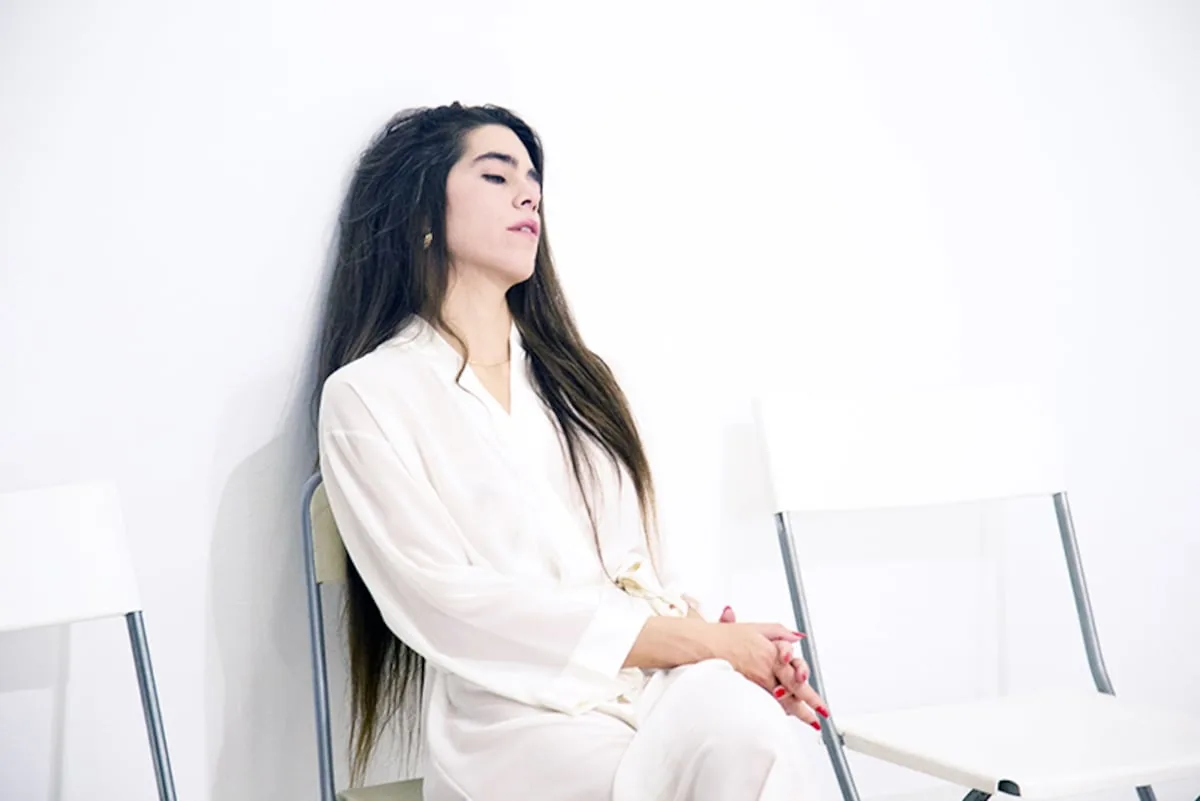
If the narrator of Anuncios decides not to speak, she can be considered an artist of renunciation: in her work, Cañeque explores the inactivity resulting from the fatigue produced by contemporary life, with its continuous (and tiresome) calls for efficiency and productivity, and which the best-selling philosopher Byung-Chul Han has also theorized with his concept of the society of fatigue. The aesthetic of renunciation that, incidentally, Vila-Matas explores in books like Bartleby y compañía (Herman Melville’s Bartleby who said “I would prefer not to”). Thus, her performances revolved around subjects such as waiting, napping, saunas, or massages, and her pictorial work portrayed those pieces of furniture that serve to alleviate daily fatigue. Her work was seen in spaces such as Microscope Gallery, The Kitchen, Glasshouse Project, or The Queens Museum, all in New York, the Kulturhuset Museum in Stockholm, as well as the CaixaForum in Barcelona or the Museo Lázaro Galdiano, La Juan Gallery, or the Teatros del Canal in Madrid.
“The last time I saw Camila, she told me she was only happy when working,” says her mother, Montse González. “And working for an artist is working all the time,” she adds. She recalls how, since childhood, Cañeque was passionate about writing or how on a shared walk an ice cream fell to the ground and her daughter also threw her scoop onto the asphalt: from the observation of the melted substance emerged the sculpture Melting ice cream (helado derritiéndose in English). As can be seen, Cañeque traversed many creative disciplines, “she had an insatiable curiosity and great creativity, but she always considered her work to be fundamentally performative,” her mother adds.
Cañeque’s life had a certain academic wandering, the Sorbonne, Oxford, São Paulo… “The places where she was happiest are New York and Berlin, I believe that if she were alive, she would live in Berlin: she liked the rain and gray days,” says González, who highlights her rejection of the commercialization of art and her radical coherence. For this reason, “she refused to have a gallerist, rejected important projects, and never had an overflowing ego, never blindly pursued success,” her mother recalls.
Cañeque precisely rose to media popularity when she was censored at ARCO 2013 after appearing unannounced, without being part of any gallery or official program, to perform Dead End: dressed as a flamenco dancer, she threw herself to the ground, face down, to recite verses from Lorca’s Romancero gitano, as a symbol of the “death of Spain.” González finds it wonderful to discover new works by her daughter, although she also acknowledges the harshness of the experience: “When I read something of hers, I am hearing her voice.”
Read more María Guardiola and the dogs