




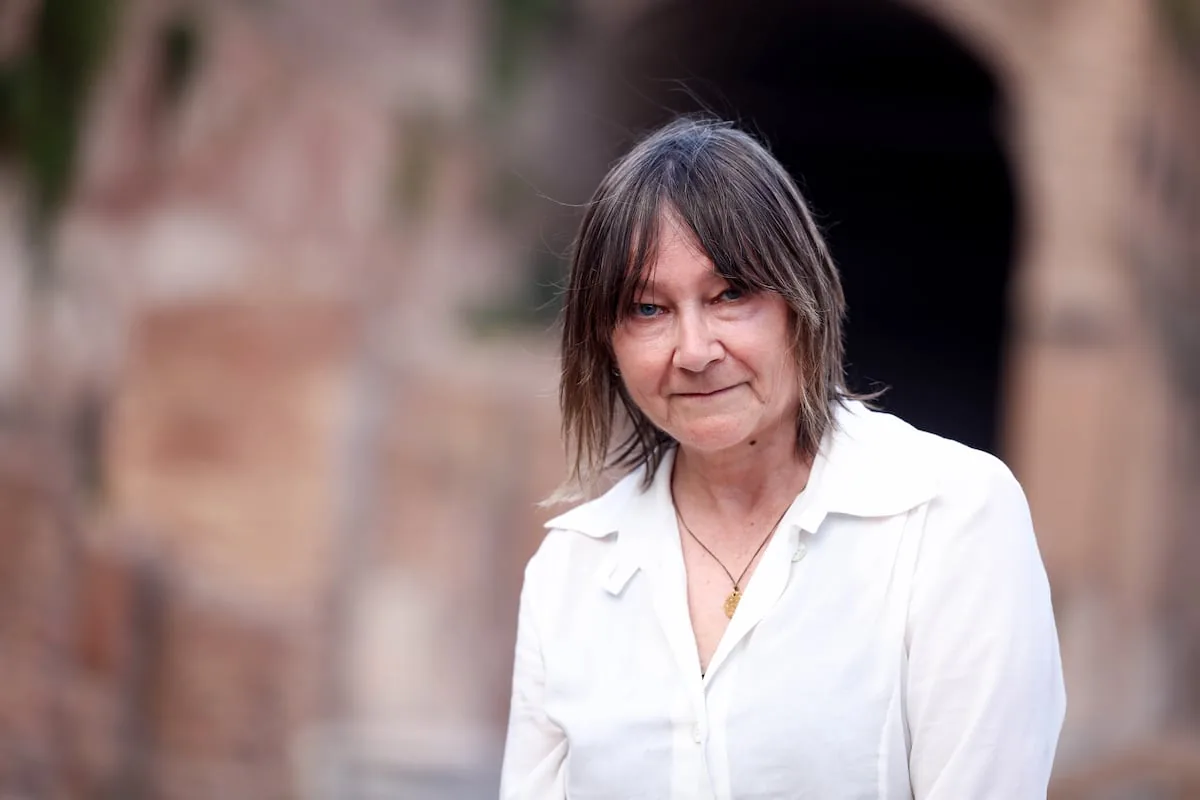
The latest book Raig Verd has published by Ali Smith is the lecture she gave a few years ago in Cambridge, at the same university where Virginia Woolf almost a century ago had presented the ideas that would make up the famous A Room of One’s Own. It is an evocation, in her characteristic informal style, in which she mixes essay and fiction to commemorate Woolf’s revolutionary reflection and rethink it in the present from new perspectives as a model of resistance and imagination. Walking by the river as Woolf does in her book, Ali Smith encounters a young non-binary character who questions everything she says, challenges her, and makes her interrogate her prejudices and preconceived ideas. It is not a representative text of the fiction literature Smith usually writes, but even here, speaking of an author she particularly admires, she does not stop playing with language (in love with the “but” with which Woolf begins her lecture) nor focusing on trivial details from which she seems to build a text absolutely rooted in her time, our own.
Read more Camila Cañeque’s posthumous novel: a «radical exploration of language»
In Catalan, Ali Smith’s first novel was published in 2014, Com ser-ho alhora (How to be both in English), a dazzling story that explores the importance of art and culture, activism, grief, and where past and present merge. One of the characteristics of this and all her books is an absolutely personal way of using punctuation marks, including quotes, ignoring italics, marking dialogues with minimal intervention… To begin with, in this book there isn’t a first and a second chapter, but they are interchangeable; half of the edition has one first and the other half, the other. And her most definitive style mark is wordplay, which creates new meanings or new ways of seeing old meanings, and generates thought. This way of playing at thinking through words does not make the translator’s job of finding equivalences easy (I can attest to that), but at the same time it gives us a lot of room to run with complete freedom. In this first book, the game already begins with the title: how to be both wall and fresco, man and woman, first and second chapter… Nothing is just one thing, but we are many things at once. The meaning and lack of meaning of words —the power they have to dominate and hide the truth from us can simultaneously serve to resist and subvert norms— is a question that runs through all her work.
Since 2014, ten novels by Ali Smith have been published in Catalan, the most notable being those that form the seasonal quartet, which, following her rebellious nature, is followed by a fifth book, titled La torna in Catalan (Companion Piece in English). These five works, written in real time and published immediately like those serialized novels of old, could be considered a fictionalized history of the first quarter of the 21st century. When Autumn (in English in 2016) came out, it was described as the first Brexit novel, which is indeed one of the aspects that appear in it, but it also features climate change, the far right, immigration, US presidential elections, politics, art, human relationships, all tinged with an effervescence that combines dreams, fantasies, and memories and makes the darkest circumstances of society appear illuminated by a kind of hope. Smith uses fiction to allow us to approach truths that are difficult to express or articulate.
In all the novels of the quartet, Smith rescues writers and artists: in Autumn, an unknown Pauline Boty, a painter who died at 26 and left an immense body of work; in Winter, the sculptor Barbara Hepworth; in Spring, Rainer Maria Rilke is about to meet Katherine Mansfield in a hotel in a Swiss village where both spent some time; and in Summer we find writers like Fred Uhlman of L’amic retrobat or Lorenza Mazzetti, film director and author of Il celo cade and Con rabbia. And in all of them, hidden references continually appear, not with the desire to show off but with the intention of bringing in writers from other times —Orwell, Shakespeare, Dickens, Keats, Huxley, Dylan Thomas— who mark her path. To me, it seems like direct, very lively literature, of great simplicity, and with much interest in posing situations that make you go further.
Read more Fifty photos to tell half a century of history of EL PAÍS
Just last year, Gliff was published, a story that has been described as dystopian but takes place in a brutal, and real, Great Britain dominated by totalitarian forces, where the omnipresence and oppression of technology have everyone bewildered. Those who remain outside the system, who don’t have a mobile phone (she calls it an “educator”), are “unverifiable,” they have no place in the system. A recurring device in many other Ali Smith novels is the appearance of teenagers with such a direct view of things and such obvious comments that they leave the reader bewildered. For example, in this story, if you don’t have a passport, you don’t exist, and the girl says: “A passport doesn’t prove that we are us. It proves that a passport is a passport. We are simply us.” In short, it could be said that this book is a contemporary fable about the transformative power of what doesn’t fit.
I wanted to give some examples of the devilish wordplays that have occupied me for hours and hours and made me make endless lists to unravel them, but it happens that, once you have solved a challenge you encountered in translation, it ceases to be a problem and it’s hard to see the difficulty. It occurs to me, however, that perhaps whoever reads this article might be able to help me with the translation I have just started of her latest book, which will initially be titled Glyph, in contrast to the previous Gliff. It’s a small dialogue:
It’s written in the scars.
You mean stars, I said.
Suggestions are welcome.
Dolors Udina is a translator and professor of Translation. Among many others, she has translated Ali Smith’s work into Catalan
Read more Call it peace even if it’s still war