









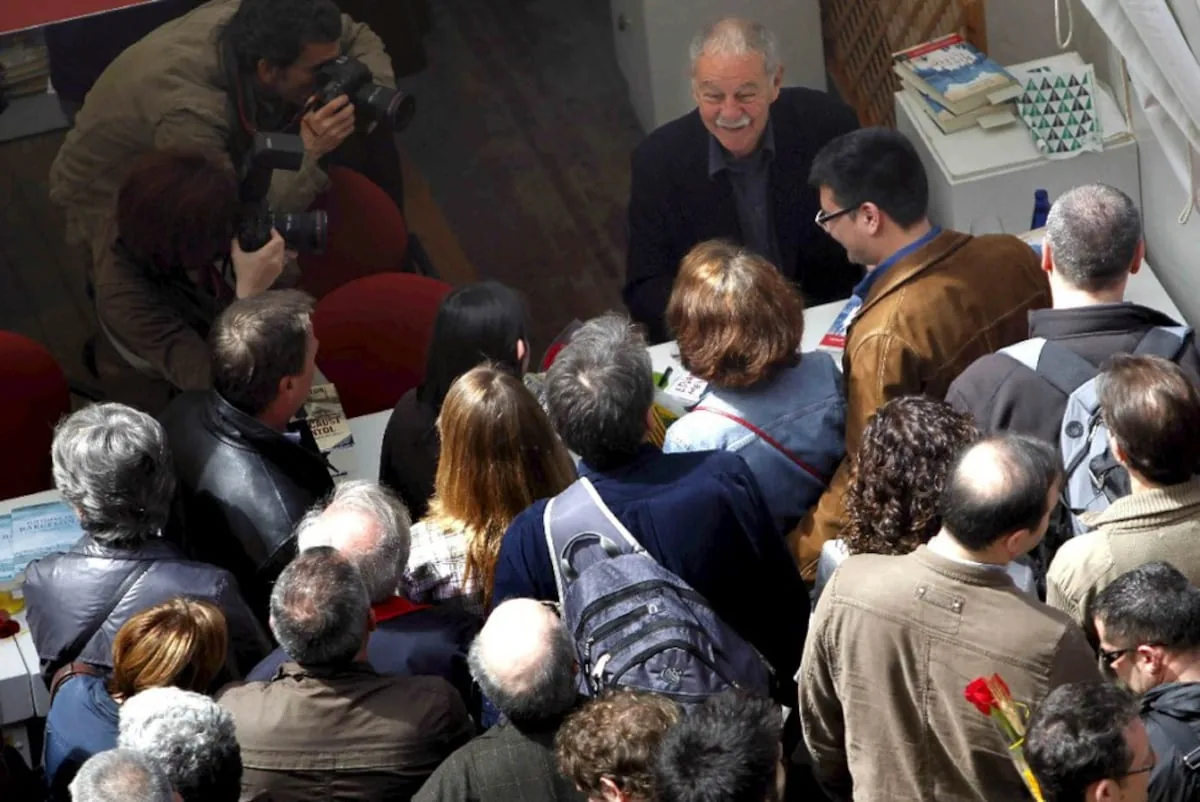
One has to see the fondness this country has for solemnity when identity symbols are touched. The comments by writer Eduardo Mendoza about Sant Jordi’s Day have stirred up a storm worthy of better causes. With what is happening in the world, here we put our passion into diatribes that only distract us from important debates.
Read more El Roto: bites
It has been annoying that he questioned the nature of the festival. First, because of how “overwhelming” it is becoming due to overcrowding. And then, because of the proposal to disassociate it from the figure of Sant Jordi, whom he said was “an animal abuser who probably couldn’t read,” to keep only the celebration of Book Day.
He is quite right about the first point. Sant Jordi’s Day is a bright day, which gives us a very pleasant image of ourselves: books and roses as symbols of civility and streets overflowing with happy people strolling. But like everything that involves large crowds, one must be careful: you can also die from success.
Regarding the disassociation of Sant Jordi from Book Day, the first thing we should agree on is that Eduardo Mendoza is very free to consider and propose whatever he deems appropriate, without that affecting in any way either the esteem we have for him or his worth as a writer. But if the writer’s intention were to re-signify Sant Jordi’s Day to remove the identity symbolism that comes with Book Day coinciding with the patron saint of Catalonia, one must tell him that, jokingly or seriously, it is a vain attempt, as it would be to ask Aragonese people to do without the Virgen del Pilar in the Zaragoza festivities. There are traditions that come from very far away, and if they have survived so long, it is because people want them to endure.
As has been recalled these days in various articles, including an excellent one by Xavier Theros in the newspaper Ara, what is deeply rooted is the celebration of Sant Jordi. It is the basis of the festival. Book Day is the superimposed element. Sant Jordi was decreed patron saint of Catalonia in 1456 and was already associated with lovers’ day then. But the celebration of the rose festival is of pagan origin and, therefore, much older. The legend of the warrior saint who saves a princess from being devoured by a dragon took hold in the 13th century and spread throughout Christendom. If it has crossed so many centuries, it is because, like many other medieval symbols, it has gradually shed the meaning it once had. And, by the way, the dragon has never been an animal.
Book Day, on the other hand, was established in 1931 and for several years was celebrated on October 7 with more sorrow than glory. It was the booksellers’ guild that had the happy idea of moving it to April 23 and linking it to Sant Jordi’s Day. As has been seen, it was a very successful initiative. So it’s better not to touch it. The symbiosis between Sant Jordi, the dragon, the book, and the rose works very well.
The independence movement has reacted to Eduardo Mendoza’s provocation with large doses of overacting, and certain Madrid press outlets have come out in defense of the latest Prince of Asturias award winner, presenting him as a victim of the “independence inquisition.” How much exaggeration!