









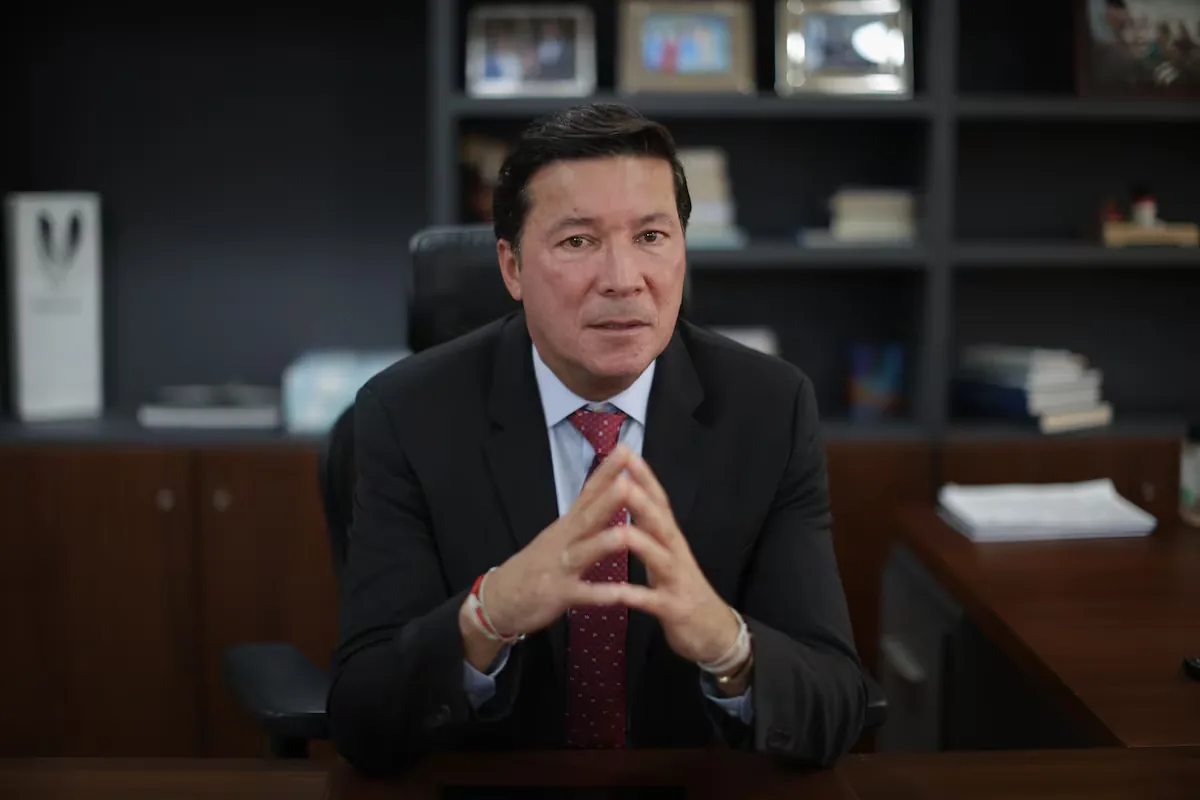
Weeks before the presidential elections, sectors close to the national Government pointed out, without solid evidence, the possibility of fraud. The accusation gained strength after the first round, when President Gustavo Petro stated that there was a plan to prevent his candidate, Iván Cepeda, from winning the presidency. To counter this narrative, the national civil registry officer, Hernán Penagos (Samaná, 55 years old), responded in the media and on the Registry’s social networks with data and explanations for each allegation: for example, with documents in hand, he explained that there was no change of jurors abroad and sent the president a hard drive with all the voting records. Even so, many Colombians arrived on June 21, the day of the second round, convinced that there would be fraud.
Read more John Ternus, the ‘hardware’ man who will lead Apple in the AI era
The preliminary count gave the victory to Abelardo de la Espriella by about 250,000 votes, a difference of 0.96 percentage points. In a polarized country and after weeks of spreading false information, such a small margin would have put democracy on edge if the electoral process had not had credibility. But the speed in delivering the results, the publication of the records, and the development of the scrutiny, recognized by international missions, left the accusations unsupported and prevented a large-scale institutional crisis. Days later, Iván Cepeda accepted his opponent’s victory.
For Penagos, it was an institutional victory. The measures he adopted since taking office on December 6, 2023, allowed overcoming such a complicated scenario. That is why the technological system worked without interruptions, despite suffering more than 30 million cyberattacks during the 2026 electoral cycle and more than 40 attempts to impersonate the Registry’s website detected and contained in time.
These elections put to the test more than two decades of Penagos’s experience in public service, of which he dedicated at least 10 years to studying and analyzing electoral systems. He was a departmental deputy, a representative to the Chamber, a magistrate, and president of the National Electoral Council, as well as an electoral observer. Upon his arrival at the Registry, this lawyer born in 1971 launched a work plan based on five pillars: strengthening transparency, improving citizen trust, further training officials, reinforcing the Registry’s neutral character before public opinion, and accelerating technological modernization.
In his native Samaná (Caldas), Penagos completed primary and secondary school at a public school. He began studying Economics in Manizales, the departmental capital, but abandoned it to switch to Law at the Cooperative University of Colombia in Medellín. He worked several years as an independent lawyer until public service seduced him. Convinced that it requires preparation, he studied two specializations, one in Administrative Law and another in Public Services Law, and completed a master’s degree at the University of Bologna on Constitutional Justice and Human Rights.
Read more Mexico before the penultimate cruelty
That knowledge led him to understand that democracy can only be healthy in the presence of transparency and citizen trust. Hence, when he assumed the position of national registrar, he focused on disseminating electoral information to parties, control bodies, and international missions to reinforce the Registry’s credibility. “If a citizen loses trust in their electoral authority, it is like the referee losing trust in a football match,” he states.
To that effect, he managed to increase the number of in-person observers from about 300 to nearly 1,500 and allowed auditors access to the source codes of the scrutiny and consolidation programs to verify their operation. Additionally, he implemented technological changes to make the process faster and verifiable. For example, about 760,000 records were digitized, compared to the 125,000 previously published; and facial biometrics were incorporated. In the second round, information on 90% of the polling stations was available in just 53 minutes.
Organizing elections in Colombia has always been difficult. Due to its geographical characteristics, population dispersion, and insufficient roads, setting up the 126,000 polling stations in a few days means reaching hard-to-access places, sometimes under the threat of illegal armed groups. To these conditions was added the increase in disinformation that reached unprecedented levels and threatened trust in the Registry.
Despite this scenario, the entity received unanimous recognition from international missions. In the end, the three electoral days he directed under unprecedented pressure left Penagos with two cervical hernias. He does not give them importance because he is aware of what was at stake: “The Registry cannot fail. If the elections fail, the system fails; if the system fails, the State is hit and democracy ends.”
Read more The Falklands: the open wound that unites Argentinians