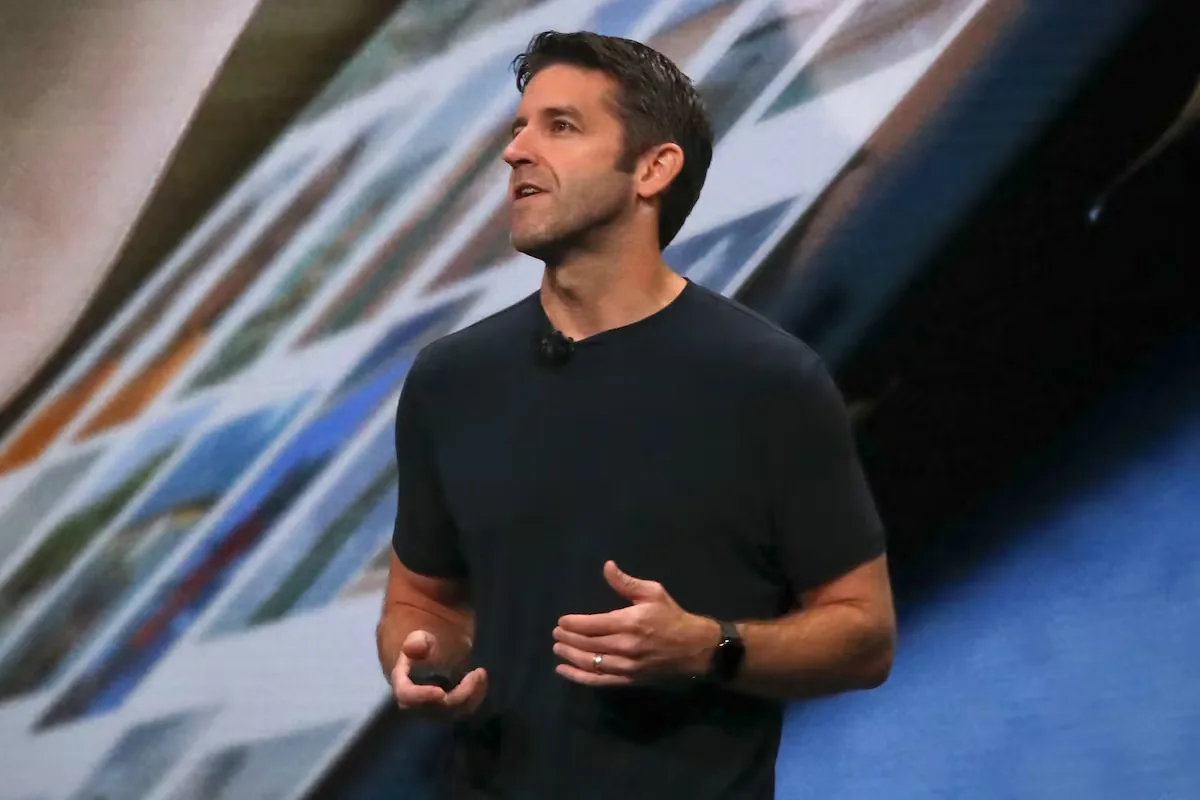
John Ternus’s salary (United States, 51 years old) as the new CEO of Apple will be three million dollars a year (about 2.6 million euros), plus a stock package of 55 million. It is a lot, a great deal. But it falls far short of the billion dollars Elon Musk could earn according to targets in the next decade, or the 200 million a year that Cristiano Ronaldo earns playing in the Saudi football league. It is true that, if anything, Ternus does not seem like a star. He is rather a reserved profile, one of those you always like to have close because of his ease in making few mistakes.
Read more Mexico facing the penultimate cruelty
He replaces Tim Cook, who came in to fill the unmanageable gap left by Steve Jobs (founder, visionary, spiritual leader), and who is retiring after multiplying Apple’s value by 13, leaving an almost equally large gap. In this case, the transition will be smoother. Cook remains as executive chairman and will be in charge of diplomatic tasks, including getting along with Donald Trump and occasionally going to China and Europe. This will be the case, in principle, until the next elections to occupy the White House are held.
The company Ternus inherits is worth around 4.7 trillion dollars (four trillion euros) by market capitalization and has just posted a record net profit quarter. Even so, it has several open fronts, and two of them have to do with artificial intelligence (AI). Ternus will find a chip and memory market very different from a few years ago: data centers have become priority customers for manufacturers because they buy huge quantities and pay more. The second front affects Apple’s own role in this revolution. If OpenAI, Anthropic, or Google build the most powerful models, his task will be to find the simplest, most elegant, and useful way to put that intelligence in the hands of millions of people.
The first thing that stands out about Ternus is how little is known about him. It is not known who his parents were, nor if he is married or has children. Of course, many people must know this, but not the media, which have had to cling to details such as that he was a great swimmer or that, on one occasion, he got quite angry because someone did not put some screws in their place. He also has no social media. In fact, this opacity, far from being deliberate, is relatively common among executives who have made their entire career in the same company.
Not knowing the name of his high school girlfriend, if he had one, or whether he prefers savory or sweet breakfast, does not mean we do not know why he was chosen. Ternus is a hardware expert (physical computing devices) who built a solid relationship with veteran executives. He does not have Jobs’s product design vision, nor is he a supply chain guru like Cook, but he probably knows Apple’s products and the internal gears that allow them to be created better than anyone else.
He studied Mechanical Engineering at the University of Pennsylvania. He was a member of the swimming team and, according to local newspapers of the time, a quite competent one. Paul Feehery, a friend and college roommate, remembers him as diligent, work-focused. “He was always a very discreet guy, very academically applied, very thoughtful and never, ever made hasty decisions,” he said in the local newspaper The Daily Pennsylvanian.
Ternus graduated in 1997 and started working at a virtual reality technology company. In 2001 he joined Apple, in the product design team. Jobs had just returned to the company. It is likely they crossed paths in the hallways and saw each other in some meeting; we do not know if there was any moment of connection between them.
Read more The Falklands: the open wound that unites Argentinians
Long career at Apple
For 25 years, Ternus left his mark, slowly and tirelessly, on much of the company’s catalog. Profiles published in Anglo-Saxon media portray him as a “good guy” and as a meticulous and sensible engineer. He is not, a priori, a revolutionary. However, on occasions when he has been conservative, he has always been right: he opposed the development of the Apple car and the Vision Pro glasses, two projects that ended, each in its own way, in failure.
Outside Apple, Ternus drives. He is a regular at the Laguna Seca circuit, where he drives his Porsche under one minute and forty seconds, and sometimes takes company colleagues to the forests of Washington State to do rally off-road. He also follows motorsports from the stands, as a Formula 1 fan.
Another fundamental aspect in his selection has been age. Apple turned 50 last April. When Cook took the reins in 2011, there were still executives from the Jobs era with careers ahead. But 15 years later, and after having enriched themselves thanks to Apple shares, those executives are claiming their well-deserved rest. Ternus belongs to a later generation and, with a view to his term lasting like those of Jobs and Cook, one of his first tasks will be to complete a renewal of the top management.
As soon as he arrives, he will present the first foldable iPhone, the biggest physical transformation of the phone in years. But where everything is decided is in artificial intelligence. On the one hand, it will be necessary to see if Cupertino’s firm’s bet on staying aside in the development of large models is right. And on the other, the danger that in the new era inaugurated by AI humanity finally finds another device to get attached to. It should not be forgotten that Jony Ive, Apple’s legendary designer, works with OpenAI in search of the device that dethrones the smartphone par excellence.
Perhaps Ternus’s great asset to succeed lies in his meticulousness, the one that caused him great anger at the beginning of his career. His first project was the Cinema Display, a monitor whose casing was held with stainless steel screws. One night, at a supplier’s facilities, he was found with a magnifying glass counting the slots on the head of one of them and arguing because there were 35 instead of the 25 planned. “What the hell am I doing? Is this normal?” he remembers thinking, according to a speech he gave at his university. He decided that maybe it was not. But also that it was the right thing. “It is hard to dedicate so much time and effort to something. It is stressful, requires sacrifice, but it is worth it because our time is limited.” Now he will have many more details to focus on.
Read more Abelardo de la Espriella entrusts his tough immigration policy to a retired police officer