The political and social upheaval caused by the crisis centered in Ceuta has not yet translated into an electoral tsunami. The 40dB. barometer, with 2,000 online interviews conducted between Monday and Wednesday of last week, shows a landscape without drastic changes. However, this lack of disruption does not prevent there from being a winning block and a losing one. Check all the data from the polling work here.
The loser is the left, which was already lagging and is now even more so because all its forces are retreating. The winner is the right, which strengthens its primacy with all the parties that make it up on the rise. The rise of the PP and Vox allows them to mark a milestone by reaching the 50% threshold of estimated vote for the first time in the entire legislature (50.2%), according to the 40dB series.
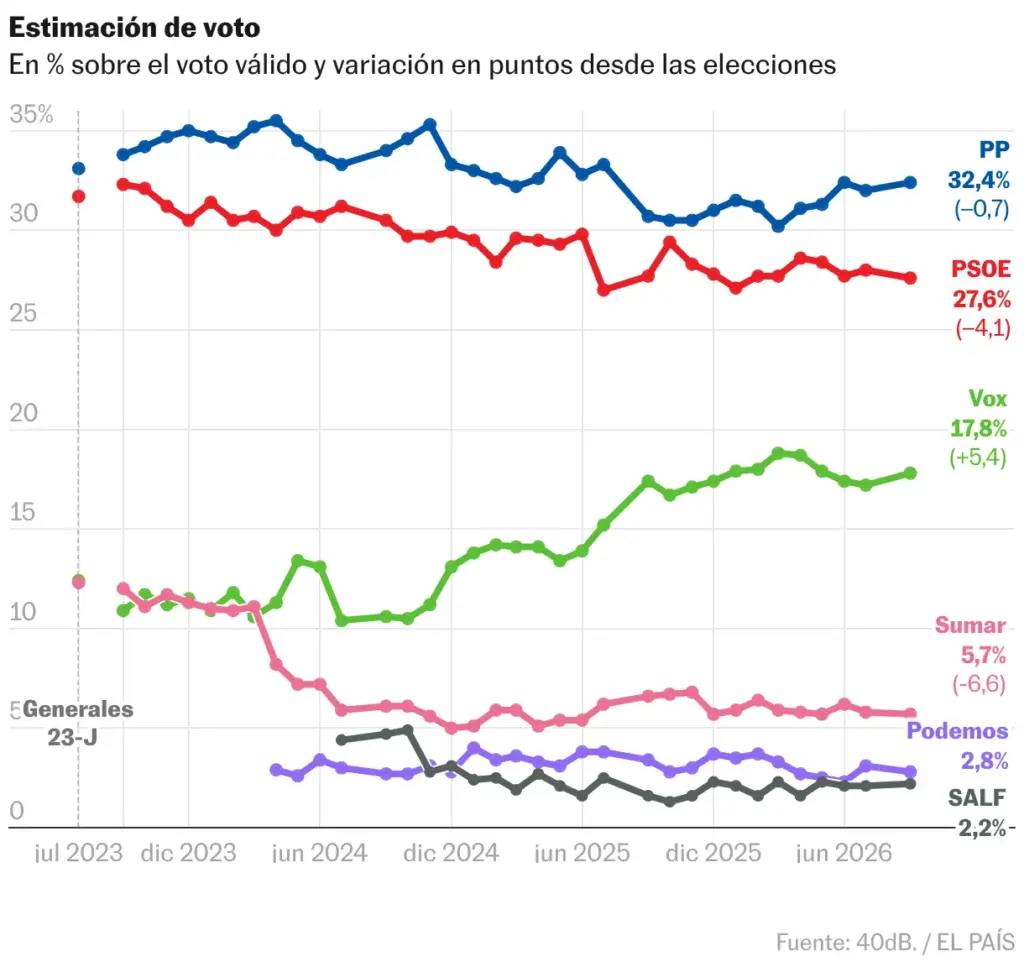
The leading party is the PP, with an estimated vote of 32.4%, 0.4 points more than in July (the series is interrupted in August). The party led by Alberto Núñez Feijóo matches its best record of the year, which it had achieved in June, but it is still somewhat far from the 33.9% it reached in the spring of 2025.
The PSOE remains 4.8 points behind the PP, falling 0.4 points to 27.6%, more than 4 points below its result in the 2023 general elections and its second worst figure of the year after the 27.1% in January. Just as the PP’s rise between July and September is not marked, the socialists’ decline is not either. However, overall, the gap between the two parties opens by 0.8 points more in favor of Feijóo. It has been larger than now, 6.3 points in July 2025, in the midst of the Cerdán case scandal. But it is a significant gap: almost 5 points at the start of the last legislative term.
However, what brings Feijóo closer to La Moncloa is not his own record, 0.7 points worse than in the 2023 general elections, but that he leads a block, the right-wing one, which is reinforced by Vox’s solid position. It is the party that rises the most, from 17.2% to 17.8%, and the only one of the three main parties whose current 40dB. mark is better than the result at the polls a little over three years ago. Specifically, the September estimate is 5.4 points higher than the 2023 result. This has been the legislature of Vox’s strengthening, which heads into the final stretch with its favorite topic, immigration, at the center of the debate.
The fieldwork began a month after the Ceuta crisis exploded, so there has been time for views on it to settle and permeate public opinion. Only the latest events are excluded. Its closure is prior to the publication of a police report that caused a political storm by pointing to the collaboration of Moroccan agents in the avalanche, a point that clashes with the neighboring country’s exoneration discourse that has prevailed in the Government. The appearance before Congress of the Prime Minister, Pedro Sánchez (PSOE), and the bitter debate about the crisis are also after the data collection ended.
Tailwind for Vox
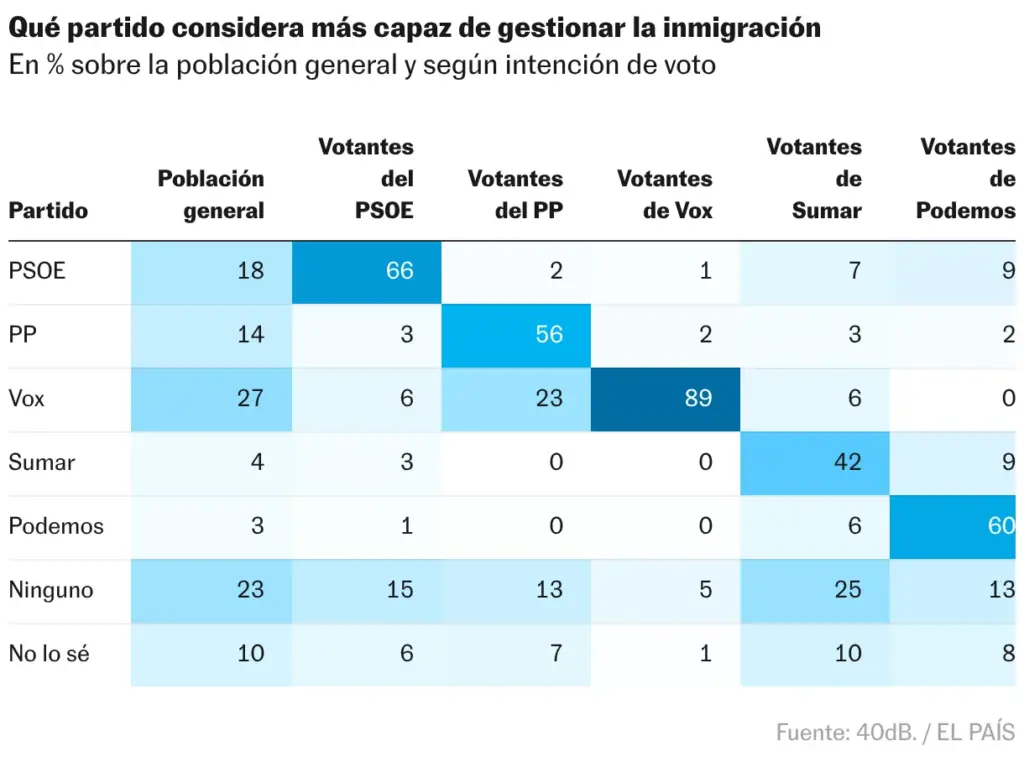
Vox, besides being the party that rises the most, presents itself as a possible beneficiary of the expansion of hardline views on immigration detected by a survey on the Ceuta crisis published alongside this one in EL PAÍS. This work detects that Vox is the party considered most “capable” of managing immigration, just as negative views on it prevail. 27% place the far-right party in this position as the most capable to manage immigration, ahead of the PSOE (18.4%) and the PP (13.9%). There are more reasons for Vox’s optimism: 20 years of research on European countries link the prominence of immigration in public debate, especially related to conflicts, with the electoral rise of xenophobic populism.
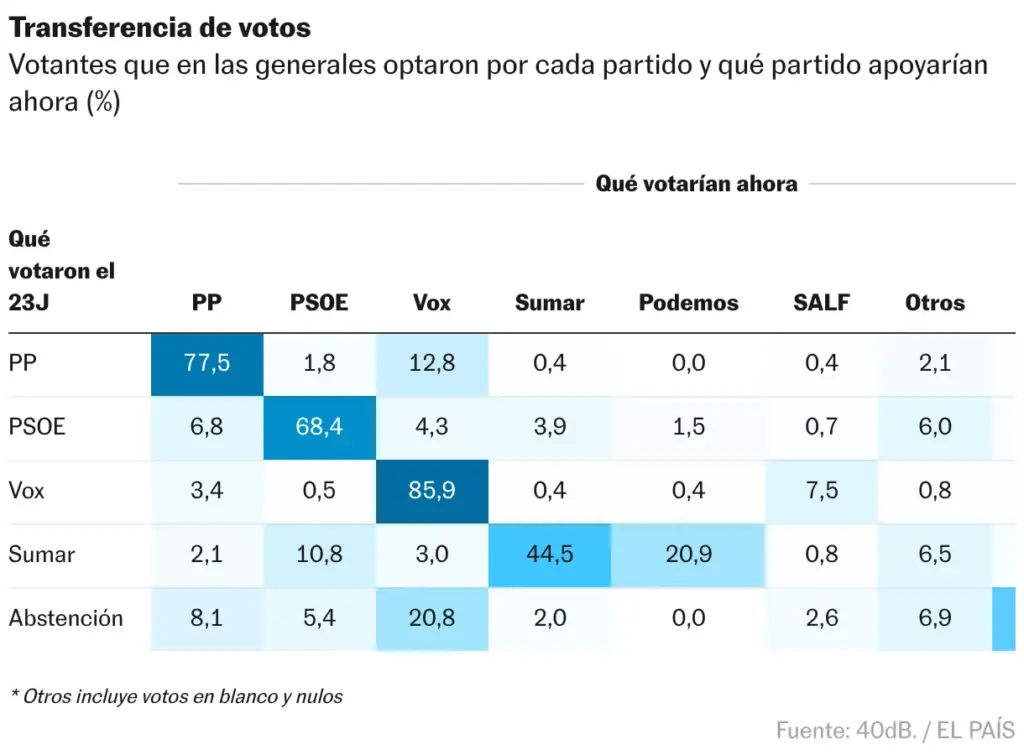
Vox’s electorate is the most mobilized. 71.6% of those who supported Santiago Abascal in 2023 say they will definitely vote, above the certainty of vote among those who supported Sumar (69.2%), the PP (68.5%), and the PSOE (66.3%). Vox is also — by far — the party with the highest vote loyalty. 85.9% of those who supported it in 2023 say they will repeat, ahead of the PP (77.5%), the PSOE (68.4%), and Sumar (44.5%).
Vote losses punish the PSOE more from the right than from the left. More who voted for Sánchez in 2023 now plan to vote for Feijóo (6.8%) and Abascal (4.3%) than those who plan to vote for Sumar (3.9%) or Podemos (less than 2%).
Regarding transfers on the right, they are clearly favorable to Abascal. About 13% of the PP electorate from 2023 now leans towards Vox. The reverse is only 3.4%.
The right block prevails
The PP and Vox together sum more than half of the estimated vote, 50.2%, compared to 45.5% they gathered at the polls in July 2023. To this must be added the 2.2% of Se Acabó la Fiesta (SALF), the party of far-right agitator Alvise Pérez, which rises by 0.1 points and is only 6 points behind Podemos. Altogether, the three main right-wing parties at the national level sum 52.4%.
The 50.2% sum of the PP and Vox is their record for the entire legislature. The parties led by Feijóo and Abascal had come close to the 50% threshold, including 49.8% in April and June of this year, but had never surpassed it until now. If they were already high in July (32% PP and 17.2% Vox), the rise they both register in a month marked by the Ceuta crisis has raised them above half of the estimated vote.
The weakness of the left
The left block is far behind, where the PSOE falls without Sumar or Podemos capitalizing on it, both registering slight declines and together totaling 8.5%, when they achieved 12.3% together in 2023.
Adding to the poor prospects of the alternative left is uncertainty. It is still unclear what form Sumar will finally take, nor is its candidate, brand, or how many of the forces it integrated in 2023 it will now manage to unite under its platform known. The resistance of this political space was key after the November 2019 and July 2023 general elections for there to be investiture majorities led by the PSOE and progressive governments formed.
Overall, the forces of the progressive block, including Podemos, remain at 36.1%, more than 16 points behind the right, including SALF (52.4%). If only the PP and Vox on one side are compared with the PSOE and Sumar on the other, the result in favor of the two main conservative forces is 50.2% to 33.3%.
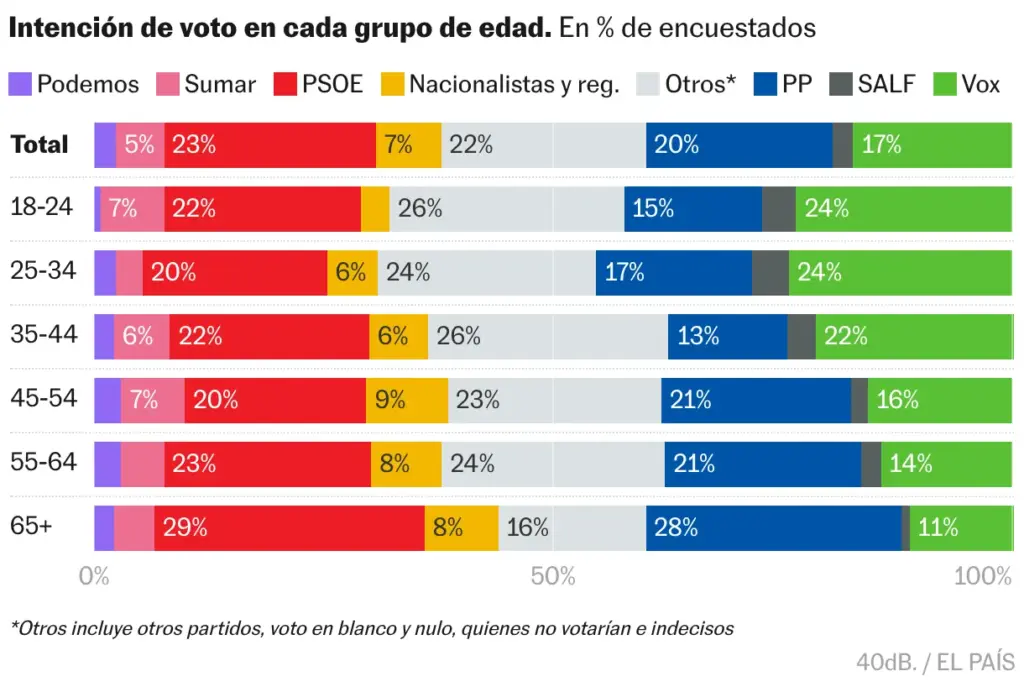
By age groups, Vox appears as the party with the highest direct voting intention — the raw percentage of voters who declare they will support each party, without the cooking that leads to the estimate taking other responses into account — among voters up to 34 years old. As age advances, Vox weakens and the historical forces of the conservative and progressive fields gain strength. The great lifeline for the PSOE is among those over 65, a group where it sums close to 30% of voting intention.
Read more The streets in Germany after AfD’s victory: «We all have to stand up»