









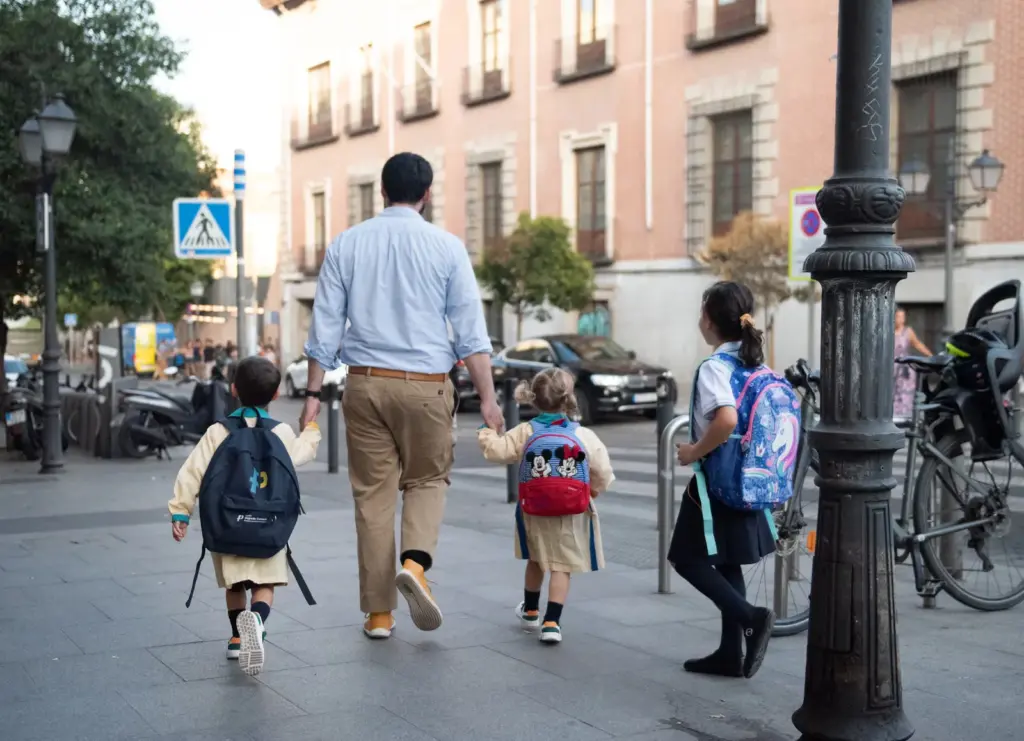
Early in the morning, the streetlights illuminate the path for the first students arriving at the Lorenzo Luzuriaga public school, in the Mirasierra neighborhood (north of Madrid). Marina Pumarada Gómez arrives with her daughter, who is starting third grade, and says that the girl “was already very eager to return and meet her little friends.” Some students run when they see their classmates already inside. The family has just returned from vacation in Asturias and has experienced “a brutal” temperature change, she says.
The heat in the classrooms threatens to become the main protagonist of the start of a school year that began this Monday in Madrid and Euskadi, followed in a staggered manner by other communities starting Tuesday. More than eight million students return to classes this week. In June, the Ombudsman had already received about 400 complaints about high temperatures inside schools. Pumarada says the impact of the high temperatures is noticeable in “her daughter’s character”: “She is more irritable, more aggressive.” At the entrance, everyone complains about the heat. María Pérez, an English teacher at the school, jokes: “We’re going to die!”
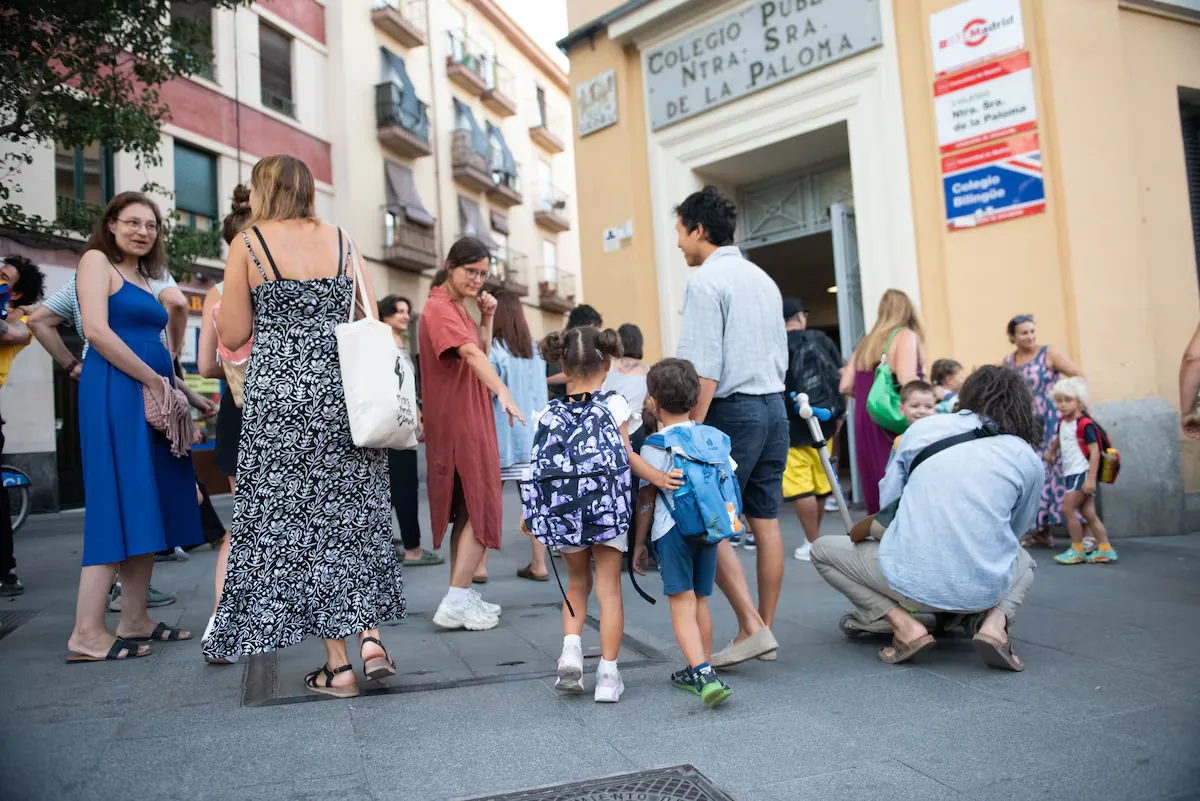
At CEIP Nuestra Señora de la Paloma, in central Madrid, references to the high temperatures are constant. “It’s an old building, it’s not prepared. The older kids have sprayers. The children have to bring their water bottles and the teachers encourage them to wet their hair,” says Ángela Sepúlveda, mother of Izan, four years old.
Sandra Valiente, the principal of this center that has welcomed 430 students from Preschool and Primary, highlights that by 9:30 most of her 18 classrooms already exceed the 27-degree limit. “Air conditioning is not needed in all classrooms, but it is in some areas, like the dining hall. Every day 200 children eat there. With the kitchen raising the temperature, it’s unsustainable. I’m worried about fainting; at lunchtime we have nearly 40 degrees,” she says.
A day of “new hopes and new challenges.” That’s how José Eizmendi, director of the Aldapeta Maria school in San Sebastián, a charter school with 2,200 students and 240 educators, describes this Monday. It’s 9:00 and there is a leaden sky over the Guipuzcoan capital, under which families say goodbye to the children: “It’s a change of routine, they need to return to school, but their nerves must be managed,” says Alejandro Miranda, father of three girls aged four, seven, and ten. Half an hour later, the older students are called, the throng of high schoolers. They form small groups, high-five, hug… “Today we have to convey calm, but at the same time they must know that education demands responsibility and autonomy. They are close to making the leap to university and this obliges us to help them,” says teacher Ion Gil.
It’s not a hot day in San Sebastián, but high temperatures are also a concern in the Basque education system. The Department of Education has launched a pilot program in four public centers in Bizkaia that includes ventilation actions, creation of shaded areas, and renaturalization of playgrounds, among other measures. Aldapeta has a ventilation system that keeps the building “in pleasant conditions,” according to its top official. Ceiling fans have been installed in some areas.
Strikes and teacher demands are the other major issue at this start of the school year, with strikes called in Madrid, Catalonia, and Andalusia to demand improvements in public education. Six other autonomous communities are scenes of tensions that could lead to strikes. The general secretary of the Education federation of CC OO in the region, Aida San Millán, denounces the lack of planning in covering absences, the loss of inclusion specialists, and the failure to comply with agreed teaching quotas. Before the indefinite strike called from October 14, there will be a demonstration on September 27 “if the regional government does not open real negotiations.”
Parents who come this morning to the Rabindranath Tagore public school in Madrid show their support for the teachers. Carmine Herranz, 45, says: “I’m in favor, because if things keep getting worse and we don’t complain or get serious, it won’t improve.” Agui Sabate, the same age, agrees. “We are totally in favor. The government has to prioritize teachers.”
San Millán considers that the start of the academic year cannot be approached normally, “when the teams that attend the most vulnerable students are broken, teacher appointments are delayed, and signed staffing agreements are ignored.” In her opinion, the Ministry is pushing Madrid’s public education to an unsustainable limit.
María Vega, an English teacher at Gonzalo de Berceo school, located in the Carabanchel district, is concerned about classroom air conditioning. “I’ve been working for a week without students at 31 degrees at 12:00, going home 15 minutes before the end of the day with a headache,” she confesses, distressed by the return of the youngest to the classrooms.
Read more Medusa
Sandra Valiente, principal of Colegio Nuestra Señora de La Paloma, in La Latina, fears lunchtime. “We do two shifts, but there are 200 students in each, and the thermometer reaches up to 42 degrees,” she says. Attention to diversity also worries her. “The counselor used to attend our center three days a week, this year only two. There are psycho-pedagogical evaluations that remain pending from one year to the next. There should be one professional of this type for every 250 students and we have one third for 400,” she says.
At CEIPSO Ángel González in Leganés, which houses more than 400 students, teachers Jesús Martín and Irene Verdejo declare their intention to participate in the strike. “The student-to-teacher ratios are not adequate, there is more and more bureaucracy, we need less teaching load and we denounce few tools to address diversity in the classroom,” they say after clarifying that in addition to their 30 hours of teaching, they have seven and a half hours of work at home weekly. Both denounce a lack of administrative staff: “Each high-ability report requires two hours of work, for example, in addition to meetings with families and specialists.”
Sandra Blázquez, a member of the assembly movement Menos Lectivas and a teacher at a center in southern Madrid, denounces the situation. In her entity, they demand a salary increase of 600 euros per month in the general specific complement and pay equalization for vocational training, therapeutic pedagogy, and hearing and language teachers: “1,800 euros to live in Madrid is not enough. We are one of the autonomous communities with the worst conditions,” she denounces. They request a reduction in ratios to 13 students per classroom in preschool, 15 in primary, 20 in secondary, 23 in high school, and 15 in vocational training.
Euskadi begins this school stage with 280,386 students enrolled across the entire educational spectrum, from Preschool to High School, who will be served by 32,000 professionals. Enrollment drops by 4.2%, according to data from the Ministry of Education, a trend also occurring in the rest of Spain. According to the latest published data, last school year ended with 67,000 fewer students than the previous one nationwide, a decrease of 0.8%, to a total of 8,249,174. An evolution that is not homogeneous, neither in stages nor in educational networks. Public education closed with 53,765 fewer students, a 1% drop that doubles the percentage recorded by private education, which lost 13,660.
The difference in favor of private education does not come from compulsory stages, where public schools resist better. In Primary, enrollment dropped by 30,693 students, 1.7%, while private dropped by 18,080, 2.1%. And in Secondary Education, public dropped by 15,414 students, 1.1%, and private by 9,352, 1.3%.
There are many more public primary schools, 10,281, than private, 3,497. Partly because public schools cover almost all rural areas. Despite this, last school year more than twice as many private schools closed, 58, compared to 23 public. This is largely explained because private centers, some of which are for profit, are more sensitive to the decline in birth rates. Last school year also saw the closure of 11 private centers offering Secondary Education.
Non-university private education decreases less than public due to non-compulsory stages, especially Vocational Training. Its strong growth in these teachings continues, partly due to the lack of places in public education, and partly because the distance learning mode, in which it concentrates much of its offer, better suits students who work while studying.
Enrollment in Higher Level Vocational Training in that mode grew last school year by 5,488 students, 5.6%, more, reaching 103,053. Public education lost, however, 352 students in distance higher vocational training, and was left with 66,825 students. The government plans to present new regulations this school year that will make requirements for private vocational training centers stricter.
The accumulated decline in birth rates since 2009 — the decline was broken from 2024, but with very small increases — explains why the 3 to 16 years stages lost almost 100,000 students last school year. The decline would have been even more dramatic for schools and institutes without the incorporation of foreign children into Primary and Secondary classrooms, where they increased by 13,613.