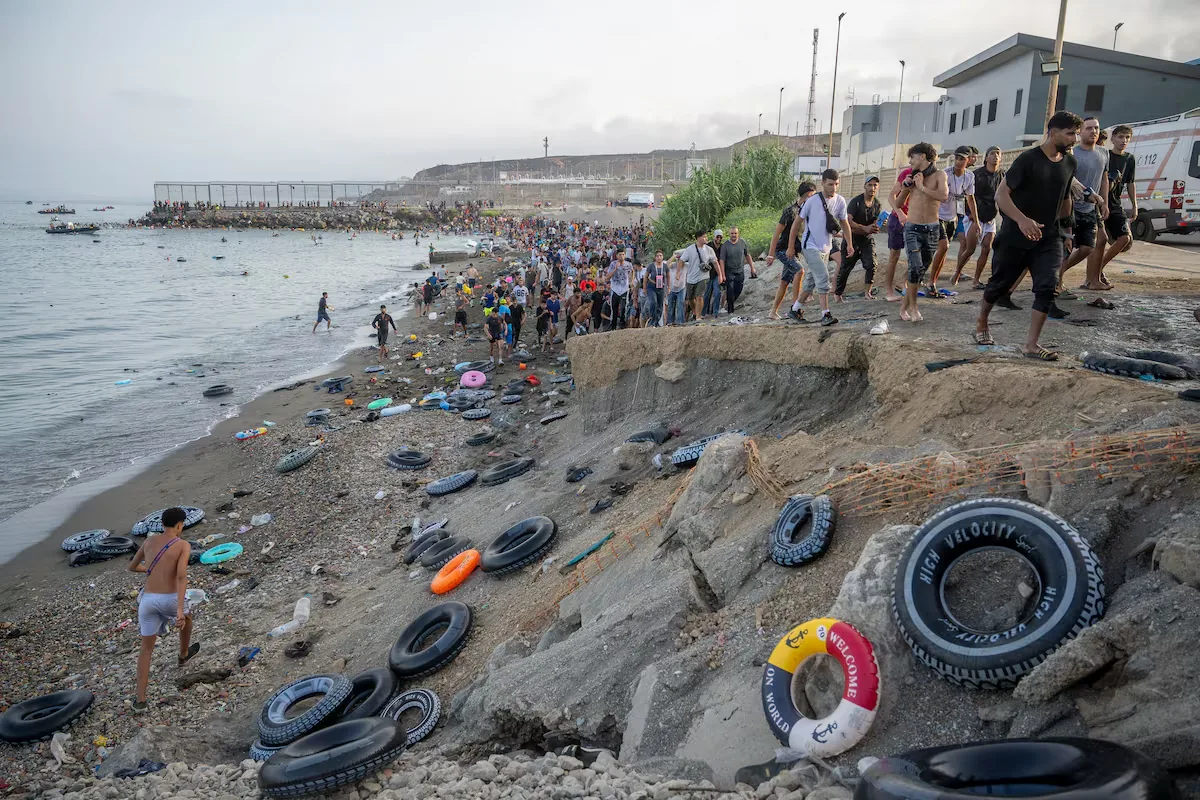
Judge María Tardón, instructor of the National Court, announced this Monday that she is taking over the investigation into the massive irregular entry of migrants into Ceuta on July 30 and 31. The judge, who has the support of the Prosecutor’s Office to take this step, explains that she sees signs of crimes that compromise the peace or independence of the State and against the rights of foreign citizens, in connection with reckless homicide, as well as criminal organization. “We are facing a criminal conduct allegedly committed abroad that has seriously attacked the territorial integrity of Spain, which is guaranteed in Article 2 of the Constitution,” Tardón insists.
Through a comprehensive 26-page resolution, the judge breaks down the content of the report from the National Police gathered about the massive entry into the autonomous city and emphasizes that, according to the evidence provided, this stratagem was “used” — “to which irregular migratory flows that have seriously affected the life and rights of the citizens of Ceuta have joined” — to “destabilize national security.” “These were not incidental, occasional, or spontaneous actions,” María Tardón elaborates, but “a process in which the migratory purpose operated only as a formal cover.”
“It has also been evidenced a clear and undeniable facilitative management of the process from the territory of the Kingdom of Morocco, on the beach of Fnideq itself and places adjacent to that area in the city of Castillejos,” the judge asserts, focusing on the questionable “behavior of the Moroccan Security Forces,” “verified and graphically contrasted” through images disseminated by the press and social networks. In this regard, the judge highlights that, as noted in the report prepared by the National Immigration and Borders Center (CENIF) of the Police, the agents from Rabat not only showed enormous “permissiveness” during the massive entry but also took on a role of “active guidance” for the people who wanted to cross the fence marking the Spanish border.
“It is observed how the uniformed police officers [from Morocco] give directions to the people illegally crossing the border, to guide them through [points for] crossing and overcoming the obstacles existing at that access. They even organized access to the area leading to Fnideq Beach, and already within its own waters,” continues the resolution issued this Monday by the National Court.
The instructor frames these maneuvers as part of an attempt to “attack the Spanish State” through a “violation of its territorial integrity.” She even paraphrases the head of the Executive, Pedro Sánchez (PSOE). “As the Prime Minister rightly pointed out during his visit to Ceuta on July 31, 2026, he defined the events as ‘an attack, a violation of the territorial integrity of Spain.’ And this through a massive migratory flow that constitutes one of the characteristic methods of ‘hybrid war’ or ‘gray zone,’ with the aim of altering the life and rights of Spanish citizens, specifically, of an entire autonomous city,” Tardón elaborates.
In July, while on duty and after receiving a complaint from the extra-parliamentary party Iustitia Europa, the judge requested police reports on the massive entry into Ceuta. The judge, who also sought the Prosecutor’s Office’s opinion on whether she had jurisdiction to take on this investigation, wanted to gather all that data before deciding whether to keep the inquiries — as she announced this Monday. “This massive entry cannot be considered an isolated or casual event, nor can it be described as a spontaneous occurrence,” argues Tardón.
To reinforce her thesis, the judge recalls that authorities estimate that more than 70,000 people entered the autonomous locality — although a definitive figure has not yet been established due to “difficulties in making such a count, derived from different factors such as the collapse of the border control system and the simultaneity of entry and exit flows throughout July 31” — but that most of those alleged migrants “were not seeking to remain on Spanish territory.” In fact, she highlights, they left Ceuta in a “relatively orderly” manner.
Read more Sánchez wields the far-right victory in Germany to revive the PSOE after the wear caused by Ceuta
Along these lines, the judge maintains that various social networks were used to “achieve a massive spread of the call” to enter Ceuta. “Phone numbers [participating simultaneously] in several of the monitored groups have been identified. Numbers of administrators and participants acting as promoters of the message, which have served as a loudspeaker for transmitting messages,” highlights the National Court’s resolution, which considers that the number and profile of the mobilized people (including children) sought the “collapse” of Spanish border management and its response capacity.
“A notable presence of family units, women, and young children disables the possibility of using coercive means or reactive force to restore control and operability of the border,” states María Tardón’s ruling, which simultaneously emphasizes that the alleged instigators of the entry acted with “absolute disregard for the life and physical integrity of some of the most vulnerable people involved.” “The total number of bodies recovered in Spanish territorial waters has been 83.”
The National Court’s resolution does not identify who might be behind all these alleged coordinated maneuvers. But it leaves numerous darts: “The actions of ‘hybrid war’ or ‘gray zone’ are typical of States, criminal organizations, or terrorist organizations committed against States.” “The [National Police] report identifies different levels of action, from digital promoters to organizers on the ground and those responsible for possible strategic planning.” “This is a large-scale operation.” “It must be ruled out that we are facing the direct authorship of any of the criminal immigrant trafficking organizations operating in that geographic area, beyond their mere opportunistic exploitation of some of the effects of the ensuing crisis.”
Popular accusations
The instructing judge has accepted the appearance of several popular accusations in the procedure: among them, Iustitia Europa, the PP, the far-right party Vox, and the ultra-Catholic group Hazte Oír. However, she has rejected the political party Se Acabó La Fiesta (SALF), led by the ultra agitator and MEP Luis Pérez, alias Alvise; who filed a complaint for crimes against humanity “without the slightest justification or explanation,” “expressly and nominatively directed against the King of Morocco, his Interior Minister, his Director General of National Security and Territorial Surveillance, and the commanders of his Auxiliary Force and the Gendarmerie.” “[It is] a mere political instrumentalization of the exercise of criminal action contrary to the principles and foundations of criminal procedure,” the judge reproaches.
For her part, the judge rules out declaring the entire case under secrecy, as requested by the Prosecutor’s Office; and establishes that only those specific inquiries that are commissioned and that, by their nature, could endanger State security or compromise the “success of the investigation” will remain secret.
Read more The Terror: Devil in Silver