




In Chernobyl, tragedy takes the trouble to warn. It does so by phone at four in the morning.
At that hour, Olexander Zelentsov’s home phone rang on April 26, 1986. His shift at the nuclear power plant didn’t start until four hours later, at eight in the morning, but there was a fire in one of the reactors. Nothing serious, they told him. A car is already on its way to pick you up.
It was his mobile phone that woke Serguéi Kirikiev. On February 24, 2022, at the same time, he was told that Russian troops were crossing the border from Belarus. “It’s impossible,” he replied.
It wasn’t.
A convoy of 80 soldiers entered the Chernobyl exclusion zone. “They arrived shooting. Into the air or against house facades. Random shots.” Days later, on one of those facades, a graffiti in Russian appeared that summarizes, probably unintentionally, one of the reasons for this war: “Who gave you permission to live better than us?”
***
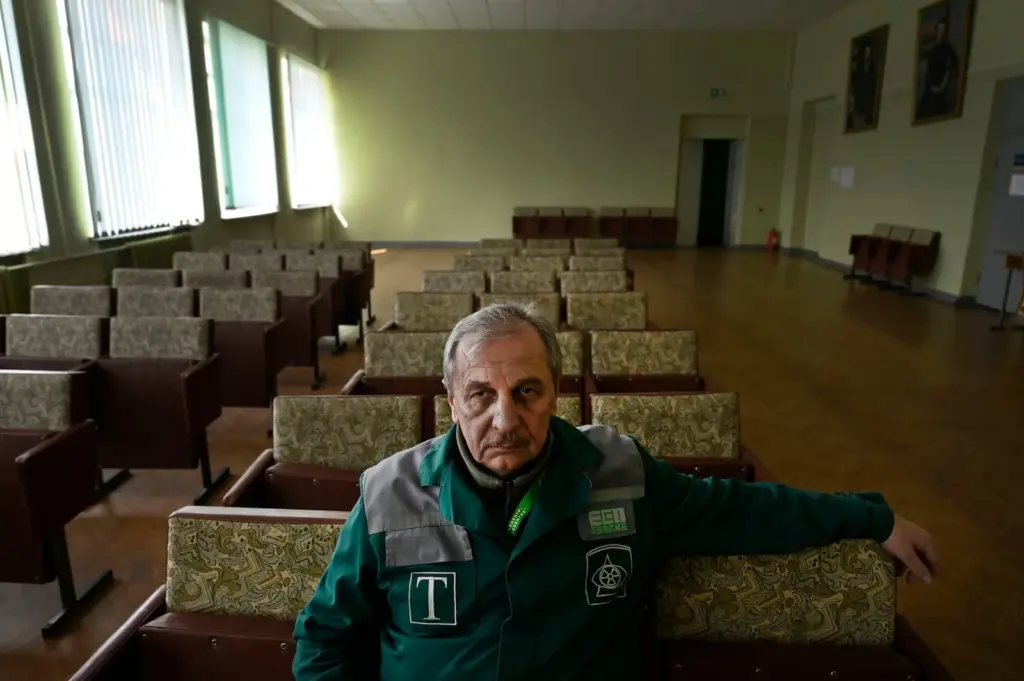
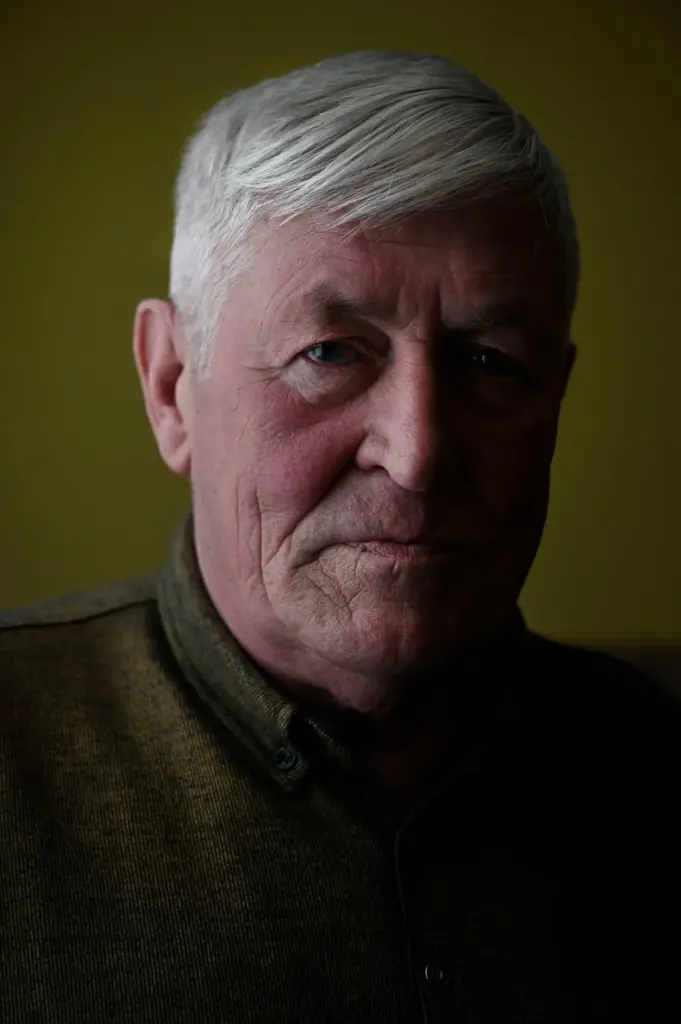
Serguéi Kirikiev recalls that call, stroking his mustache, the same silver color as his hair. He directs Ecocentre, the institution responsible for monitoring radioactive contamination in the exclusion zone. After the explosion of reactor number 4 at the Chernobyl nuclear power plant 40 years ago, Ukraine, then part of the USSR, evacuated a 30-kilometer radius that has remained isolated since that day. Only workers in charge of plant maintenance and environmental control are authorized to access it. And they can do so in shifts of a maximum of 15 days. After that time, they are obliged to return home for the same number of days.
“This is a small world apart, abandoned, isolated, without normal life, where workers try to form a community,” says Kirikiev from the office he rushed out of on February 24 to reach Kyiv. “Nobody believed it. How was Russia going to invade us? How were they going to enter precisely through here, a restricted area full of radiation?”
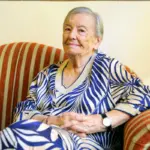
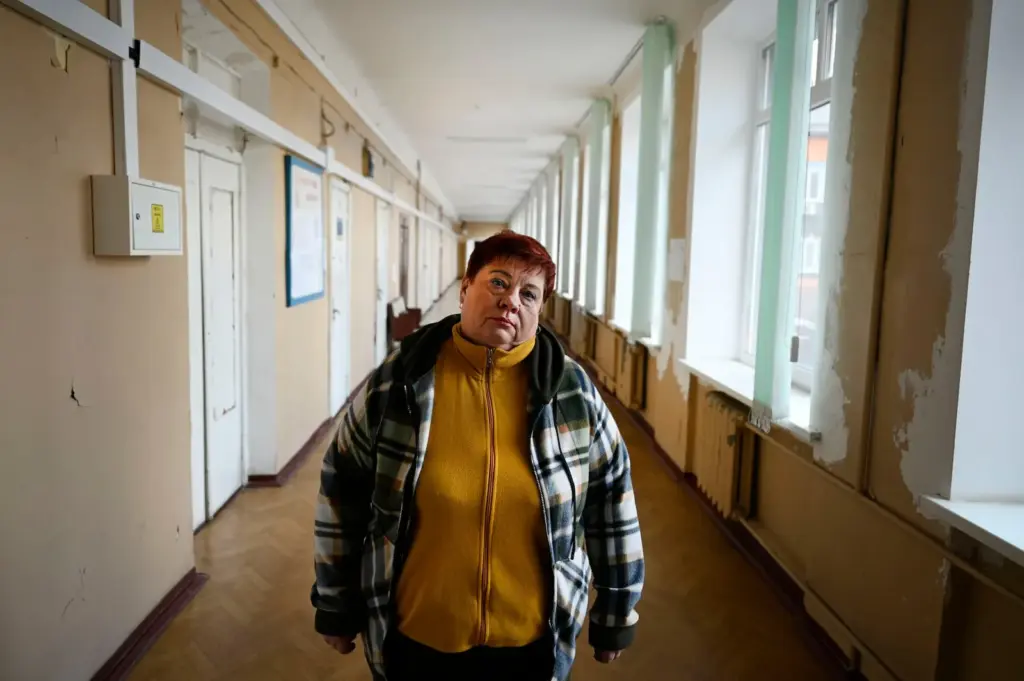
Most of the workers, like Kirikiev, managed to escape, but about 180 were not warned in time. Liybov Zaradenko, a laboratory technician at Ecocentre, was one of them. She called Serguéi on the phone, secretly, but it was too late. “We were trapped, like in a ghetto.”
The entry of Russian soldiers was aimed at Kyiv, but they set up a logistics center in Chernobyl while the capital resisted. They met no opposition because the Ukrainian Army, as the Government would later explain, did not want to engage in combat in such a delicate area. So the Russians occupied the area and remained for 36 days.
Ivan is the fictitious name of one of the workers who stayed behind. He chooses anonymity because he led the resistance network during the occupation. “My grandparents always told me about the Nazi occupation. I listened to them, but I never understood them until I had to live through this,” he says. “The Russian soldiers didn’t allow us to leave our houses. If we did, we had to wear a white handkerchief tied to our arm.” Ivan was held at gunpoint seven times, lying on the ground with a military boot on his back. “Who are you? What are you doing outside the house?” they always asked him the same thing. And I always played dumb. Literally. I pretended to be dumb.” Ivan walked with a limp and stammered simple phrases when the Russians harassed him. Behind the character, and together with six other workers, Ivan established a network to collect food and distribute it among those held in their homes. Also military information, although he avoids talking about that. “Secretly we made bread and cooked,” he explains. On one of those occasions, the Russian soldiers surprised them. “Who authorized this?” one asked. “Who forbade it?” Ivan replied.
“At night they wouldn’t let us turn on the heating, so we opened the ovens to get warm,” Liybov recounts. “They didn’t care if we had provisions. Some people had to go to the river for water. This river has nuclear contamination, but we had no other choice.” Liybov remembers three ethnically differentiated units. One of Slavic Russians, another of Chechens, and another of Buryats, a Mongol people from Siberia. “The Slavs told us: ‘We won’t do anything to you, but if you are not loyal, we won’t answer for the Chechens.’”
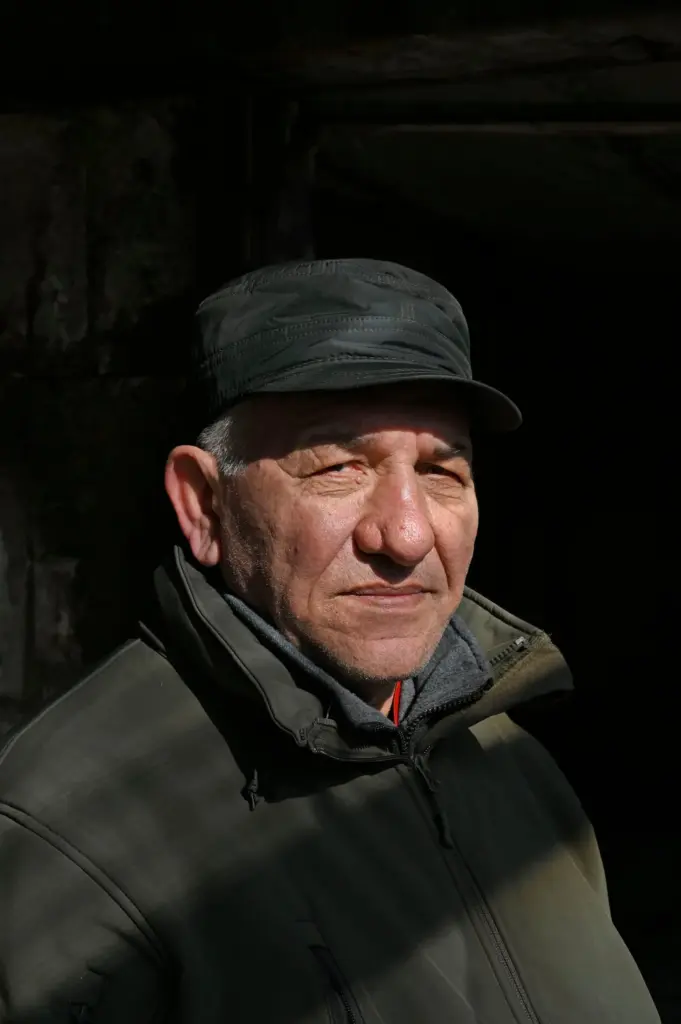
Doctor Volodimer Vdovichenko was another leader of the Chernobyl ghetto resistance. He has spent 30 of his 62 years working as a general practitioner in the exclusion zone. He also enters and leaves in shifts to avoid exceeding the radiation dose. “They looted everything. They entered the Ecocentre, the workers’ houses, and took everything, from computers to toasters,” he recalls in his office, full of papers, books, and prescriptions. “They were poorly uniformed, with some tracksuit items. One of them even told me he didn’t know why they were here, that they were doing maneuvers in Belarus and were ordered to enter.” In his office, there is also a medal of honor from the Government of Ukraine. He doesn’t want to talk about it, but it was awarded to him for hiding hundreds of documents that accredited the military or police past of some of the trapped workers. Instead of making a list, he hid a list. And by doing so, he risked his life. If the Russians had discovered them, they would likely have executed them.
“They kept saying they were looking for Nazis. They called us Nazis,” Liybov recounts. “One day I was secretly using my mobile phone and a soldier caught me, so I threw the phone into some bushes. He asked me what I was doing. I started to cry and he said: ‘Never mind, we’re leaving in three days anyway.’”
On March 31, troops withdrew from Chernobyl due to the Russian Army’s inability to take Kyiv. The next day, Ukraine sent its units. Four years later, they are still there.
***
As he had been warned, a car picked up Olexander Zelentsov, the man who received the call alerting him to a “nothing serious” fire, at his home.
“Every day, when I drove through the forest to the plant, the reactor would appear on the horizon, among the trees. That night I didn’t see it. There was no reactor. The beautiful reactor was gone.” There is almost nostalgia in his tone. Much more in his gaze.
Zelentsov speaks at the headquarters of the Liquidators’ Association in Kyiv, a group that brings together survivors of the cleanup and decontamination efforts that took place for three years after the reactor explosion. He is 75 years old and, as far as he knows, has no health problems. Something unheard of: Zelentsov was one of the first three people to enter the plant after the explosion. “We did it through the pipes. Two colleagues and I put on suits, gas masks, and entered with water up to our waists.” At that moment, the reactor core was exposed, the water contaminated, and constant electrical discharges were occurring. “We had to manually cut the connection to reactor 3. If we didn’t, it would explode.” Zelentsov achieved this with two colleagues, who would later die from radiation. They prevented a detonation that would have elevated the tragedy to inconceivable levels. “It’s possible that if reactor 3 exploded, a chain reaction would have occurred, leading to the explosion of 1 and 2. That would have forced the evacuation of Europe. It would still be uninhabitable today,” he says as if explaining an anecdote. Beside him, Eugene Yonushkievich, 79 years old and then chief operator of the control room, summarizes Olexander Zelentsov’s act. “He saved Europe. This guy sitting here saved Europe.”
Vasili Davidenko was the fire chief and arrived at the plant at the same time as Eugene and Olexander, with whom he shares a table and conversation. “I went up to the roof to look into the reactor and see what the situation was. We immediately realized there was no reactor. If you looked in, you died.” Davidenko remembers seeing pieces of graphite that were part of the reactor’s interior on the plant’s roof. It emitted so much radiation that it glowed. “A colleague touched a piece, and within minutes his hand was ruined, falling apart,” he recalls. “The sensation was like being in a sauna with a very strong smell of asphalt.”
About 80 workers entered the plant that night. Most were looking for Valeri Khodemchuk, a nuclear engineer and the first victim of the catastrophe. He was next to the reactor when it exploded.
He was Zelentsov’s best friend.
“I went in four times.” Before the last time, he ran into Yonushkievich. “I saw him looking very bad, with a very red face,” he recalls. “But he begged me to let him go in one more time.” From that last incursion, in which Zelentsov was on the other side of a wall separating him from the reactor core, he came out vomiting and fainted. Yonushkievich carried him out on his shoulders. He was transferred to a Moscow hospital, where most of the workers who had entered the plant that night began to arrive. “All my hair fell out, pieces of skin. A colleague of mine lost his backside. Literally,” Zelentsov recalls. “But I survived.”
Most of the 80 who entered that night 40 years ago to save Europe did not succeed. Official Soviet-era data speaks of 31 victims. The most reliable estimates from the United Nations Scientific Committee on the Effects of Atomic Radiation (UNSCEAR) foresee 4,000 deaths in the following years.
Valeri Khodemchuk’s body was never found. His widow, Natalia Khodemchuk, passed away last November after a Russian drone hit her home on the 16th floor of an apartment block in Kyiv. She suffered burns to 45% of her body and eventually died in the hospital. Olexander Zelentsov accompanied her until the last moment.
***
“I am proud to be a Chernobylka. And I always will be.” Galina Voloshina’s grandparents were born in the village of Chernobyl, a historic enclave dating back to 1193 where Christians and Jews shared life. “My grandparents’ parents were also from here.” And, in fact, all her relatives as far as she knows.
“I never left. When they evacuated in 1986, I hid with my family, and a few days later we started working as liquidators. My husband died, but I’m still here.” Galina Voloshina is 77 years old, tall, with short platinum blonde hair. She is what is known in Ukraine as a samosely, something like a settler, residents of the created exclusion zone who refused to leave and be relocated to apartments in Kyiv or Moscow. Officially, living in the restricted area is prohibited, but the Ukrainian government turns a blind eye to exceptions, as long as they are not minors.
There are barely any samoselys left. There isn’t even an official figure. About 12 women, according to estimates from those who know the place. As far as is known, all are widows.
Galina Voloshina lives on the outskirts of Chernobyl. A straight road that was once a street and is now a dirt path escorted by semi-ruined houses devoured by trees. At the end, a dazzling, neat, and well-kept house appears, radiating life and with graffiti at its entrance: “People live here.”
Before the catastrophe, Galina was the director of the Chernobyl kindergarten. “This was a holiday village; people came to spend a few days, to swim in the river, to fish. It was a very pleasant village,” she recounts in the living room of her charming house, like a small miracle of dignity surrounded by abandonment and oblivion. “It saddens me greatly that my city is now known worldwide for this. That it has become this…” Several photographs adorn the wall of her living room. In one of them, a young Galina is seen picnicking with her husband and some friends, on a green meadow, the river in the background, and a blue, clear sky that makes the memory of what Chernobyl once was, truly not so long ago, seem unreal.
Read more The naturopath Txumari Alfaro, known for the program ‘La Botica de la abuela’, dies at 73
Since the Russian invasion, the abandonment of the exclusion zone has been joined by militarization. Excluding battlefronts, the Chernobyl area is the territory with the highest presence of Ukrainian troops. Everywhere there are checkpoints, fortifications, turrets, barbed wire… The effect is intimidating, especially at night, when the sirens of air raid alerts pierce the dark and silent isolation.
“Before the Russian invasion, many tourists came. They did tours. Honestly, I can’t understand how anyone prefers to come here rather than go to the Prado Museum,” says Volodimir Verbitskiy, official guide of the area, former nuclear power plant worker, and volunteer in a combat unit aimed at preventing the Russian Army from reappearing in the area. “Today, no one comes. In fact, you are the first to enter here since the war began.” A dilapidated bus in a ditch, with a sign that reads Chernobyl Tours, successfully symbolizes Verbitskiy’s explanation.
The exclusion zone —located in the north of the country, a two-hour drive from Kyiv— is accessed after passing a check point that separates life from emptiness. It’s like crossing a mirror that leads to another reality: from traffic, houses, and neighbors, one passes into exile and silence.
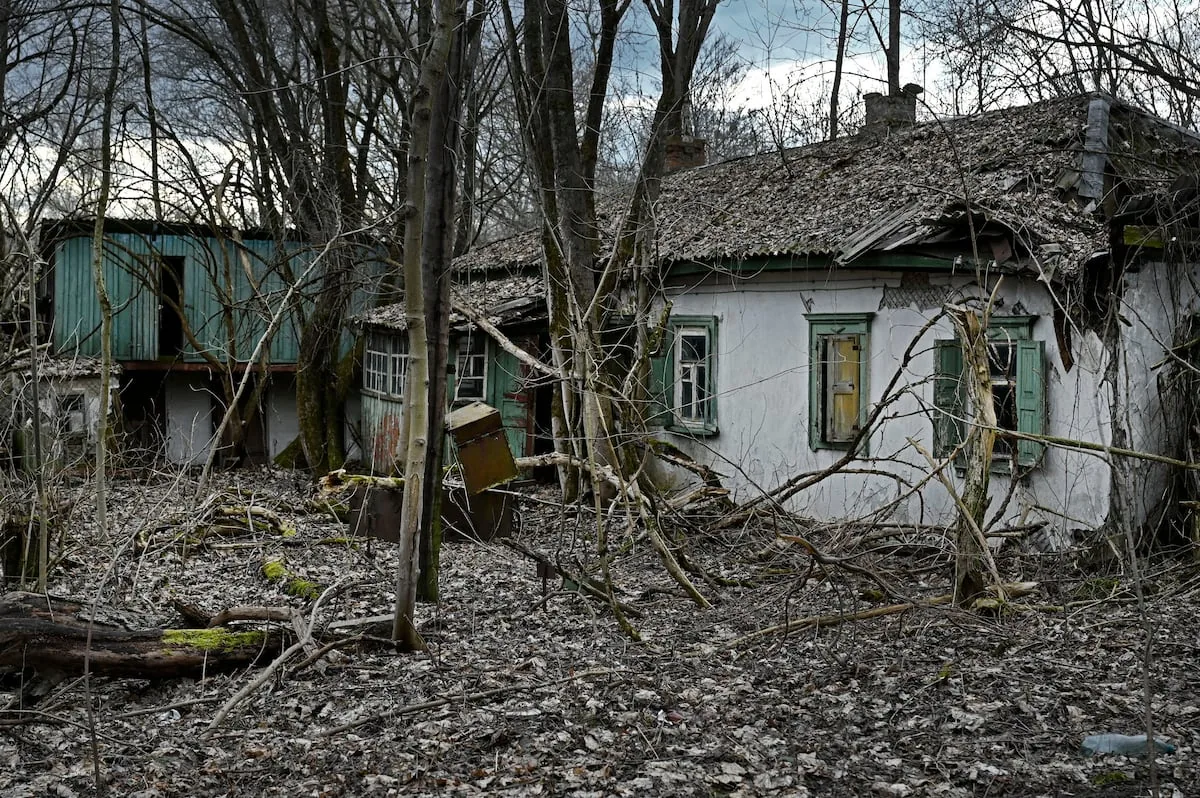
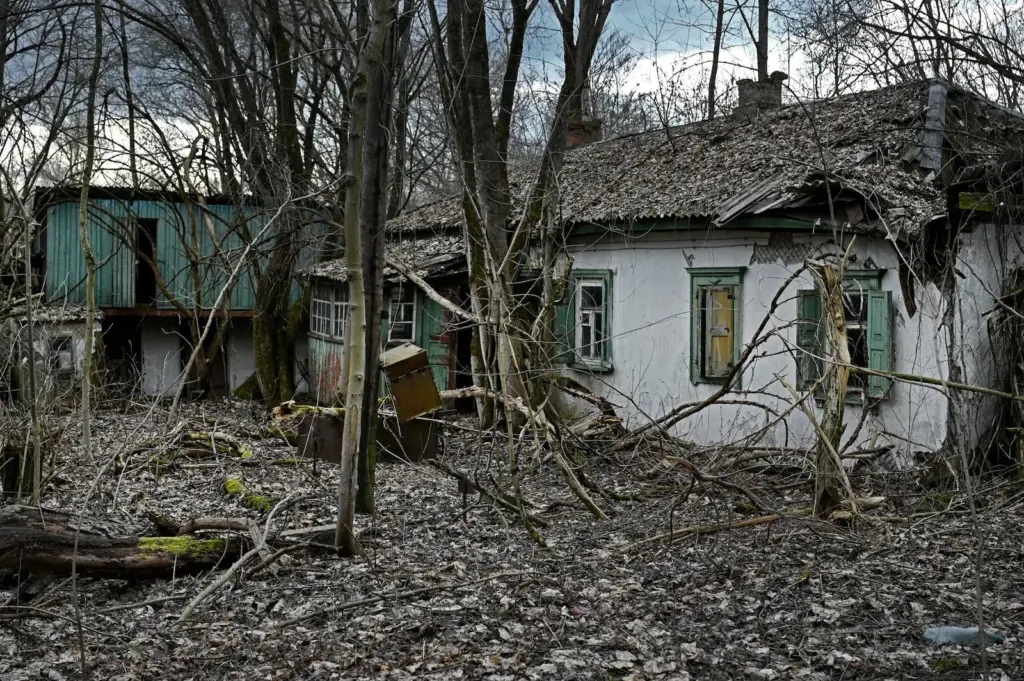
After passing the checkpoint, one proceeds along a road flanked by abandoned houses that leads to the village of Chernobyl. The image of the town is ghostly, metallic, leaden. The sequence of a dystopia, an industrial scenario frozen in time. Most of the houses, gray and sad, are in ruins and swallowed by vegetation. Those that remain appear as spectral apartment blocks where workers completing their 15-day shifts live. There are dirty windows and clothes hanging. Inside, the furniture, beds, curtains, and sheets of the apartments seem to form a small museum of Soviet nostalgia. The pipes throughout the village are visible: the contaminated soil cannot be disturbed. Many of them are surrounded by aluminum insulation. There are two small grocery stores, packs of stray dogs patrolling the streets, and a derelict and broken fire station. At night, everything is dark. Profoundly dark.
From there, Volodimir Verbitskiy, the guide, directs us along a road that crosses the Red Forest towards the nuclear power plant, that forest that Olexander Zelentsov, the liquidator, crossed every day to see the reactor appear among the trees. This stretch —named because cesium and plutonium particles dyed the pines that color— accumulates the highest amounts of radioactive contamination outside the plant. The dosimeter goes wild with beeps, and the small device’s screen indicates 22 microsieverts per hour, a radiation about 200 times higher than normal, though still lower than what a person receives on a long flight or when getting an X-ray. “The problem is in the soil and metals, where radioactive particles accumulate that must be avoided touching or inhaling,” explains Volodimir Verbitskiy. That’s why no one in Ukraine understands why Russian soldiers dug trenches in this forest during the occupation. “I foresee a tough future for those guys,” says Verbitskiy.
Instead of the “beautiful reactor” that Olexander glimpsed every morning, the trees today part to reveal a colossal, shining metal dome. This is the new sarcophagus, an imposing arch-shaped steel structure that rises 108 meters and covers the ill-fated reactor number 4. It was installed in 2016, cost 1.5 billion euros contributed by more than 40 donor countries, and prevents radiation from spreading. “We’re going in there,” Verbitskiy says with a challenging tone.
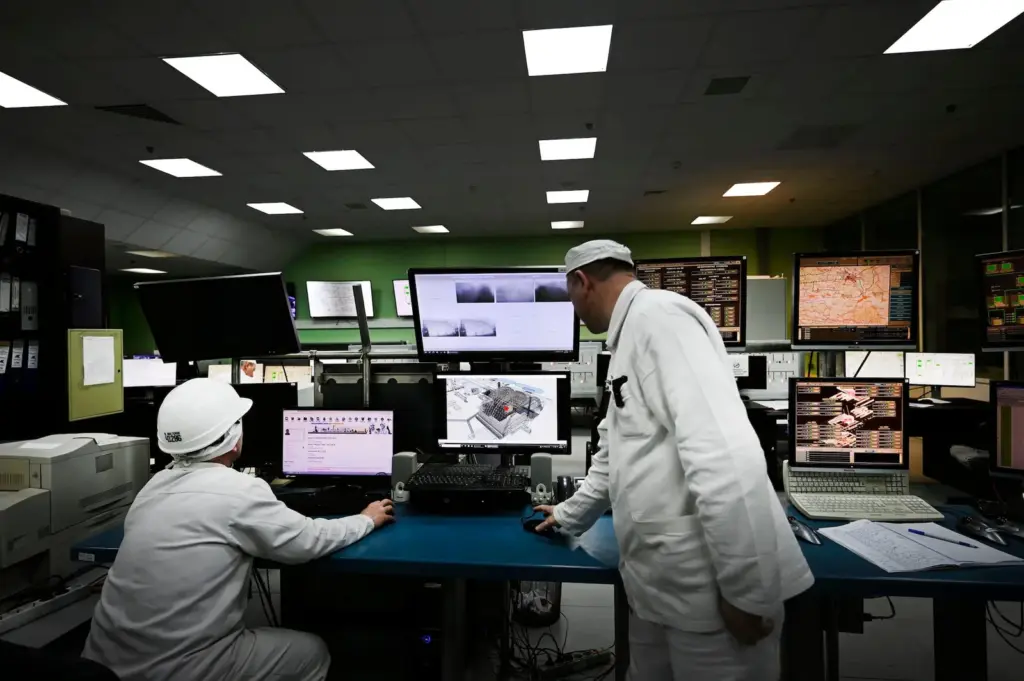
A delegation of five people awaits us at the entrance to the plant. It has been inactive since the accident, but until the decommissioning plan is completed —now interrupted by the war— it requires surveillance and maintenance work. “The most complex task will be to remove and store the more than 200 tons of nuclear fuel from the three remaining reactors. It is one of Europe’s great challenges.” This is explained by Oleksander Hrihorash, head of Civil Protection at the plant and, from this moment, our guide through the facility.
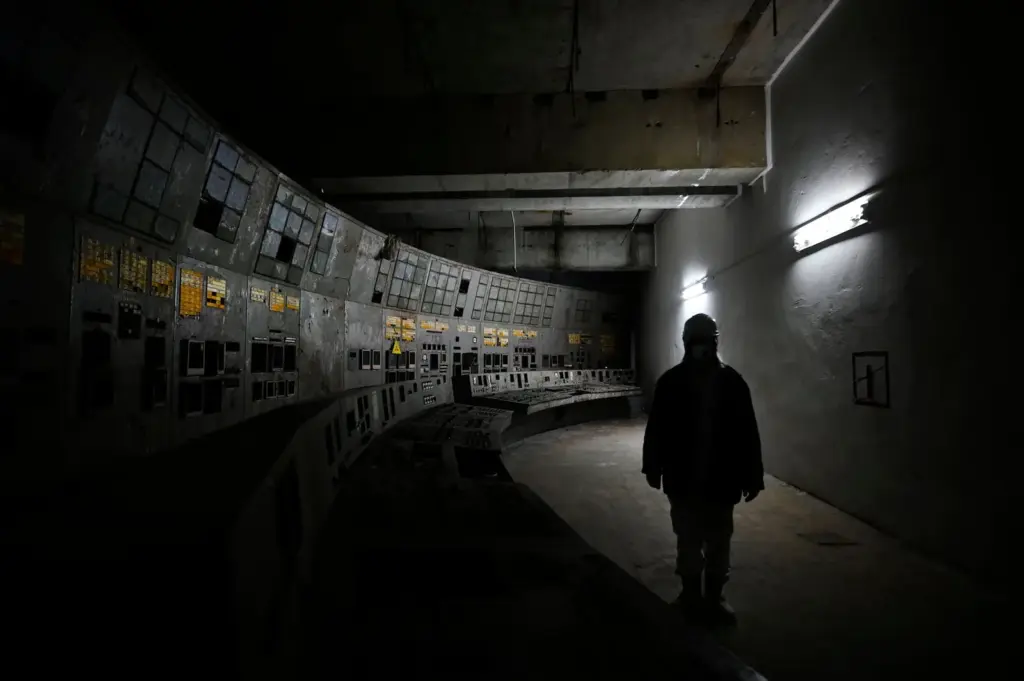
After a body scan that measures our internal contamination level (to compare it with our level at the end of the visit), we access changing rooms where we must undress, put on a white suit, mask, gloves, and helmet. They place a dosimeter on our lapel and lead us down a very long corridor, typical of a suspense film, with golden walls, posters, and telephones frozen in the year 1986. “Operators ran through here after the explosion, to see what had happened,” says Oleksander Zelentsov.
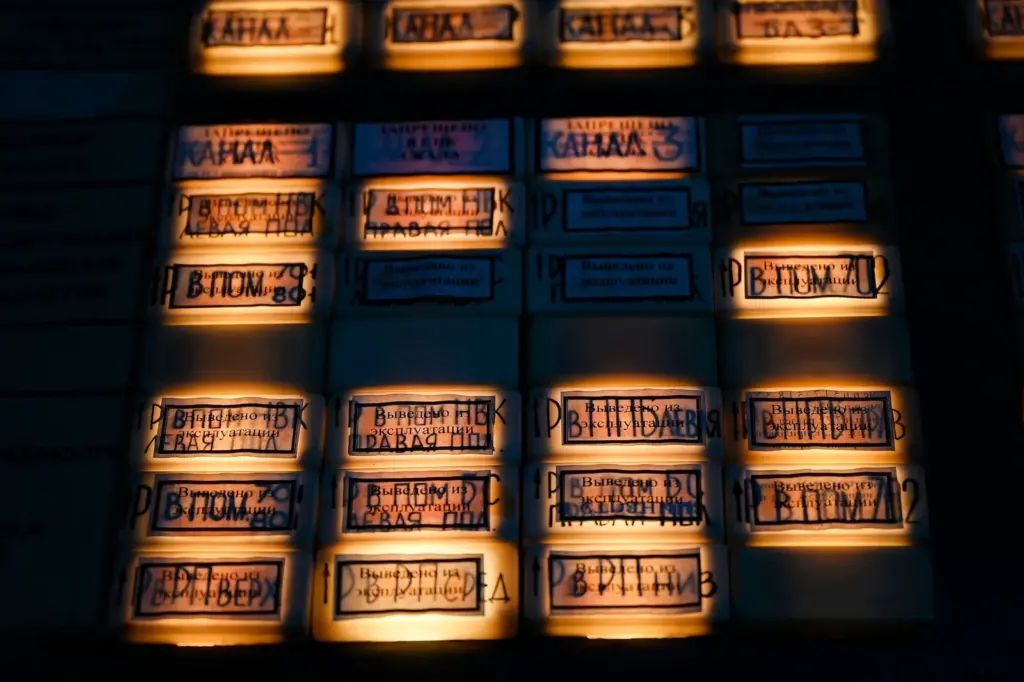
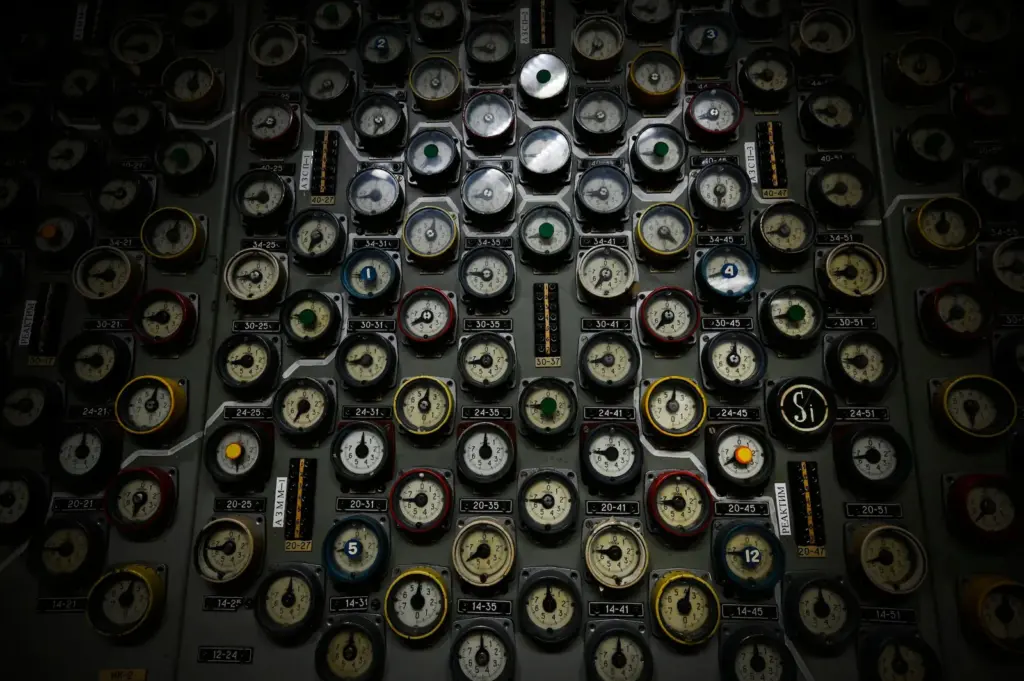
The end of the path leads us to the control room of the vanished reactor 4. It’s like an old movie set trying to simulate the future: hundreds of colored buttons, needle gauges that look like toys, lights, and levers. Everything rusted and aged by radiation. Zelentsov points with chilling precision to the AZ-5 button, used to shut down the reactor, which shift supervisor Alexander Akimov pressed at 1:23:40 AM on April 26, 1986. Four seconds later, the reactor exploded.
To explain the fateful milestone, Zelentsov references the well-known series Chernobyl, which recreates the event. “In reality, it was less cinematic,” he says. “They were carrying out a safety test that had already been done four more times in as many other plants and completed it successfully. At the end, they pressed the button to stop the reactor, and it exploded. I understand that it doesn’t make for an exciting scene, but that’s how it was. The operators never became aware that there was an imminent problem, and when it happened, they didn’t understand what had occurred.” Only months later was it discovered that the shutdown ordered by the button culminated a previous reaction caused by the test, which had pushed the reactor to its limit due to its design. A design abandoned after the accident.
We leave the room and, after several more radiation checks on our hands and shoe soles, we access the entrance to the sarcophagus. It stands imposingly, seeming to hum, to vibrate, as if something titanic were brewing inside. “We’ll only be inside for a few minutes. Don’t touch anything; if something falls to the floor, leave it there,” Zelentsov warns.
In the bowels of what was once reactor 4, the old Soviet concrete sarcophagus appears, built months after the accident. Inside, a few meters away, separated only by that concrete wall, is the so-called elephant’s foot, a kind of latent and isolated nuclear lava capable of irradiating all of Europe with radioactive contamination. The very core. An electrical panel indicates the radiation: if in the Red Forest there were 22 microsieverts per hour, here inside there are 685,000. Just a few hours in this place would pose a serious health risk.
Ten days before the entry of the Russian Army, a drone, a priori destined for the plant’s electrical substation, veered off course and impacted the new sarcophagus. It was April 14, 2022, and it caused a huge hole that made Europe hold its breath for days. “If it had exploded inside, you and I wouldn’t be here talking,” Zelentsov summarizes.
Five minutes later, we leave the sarcophagus.
***
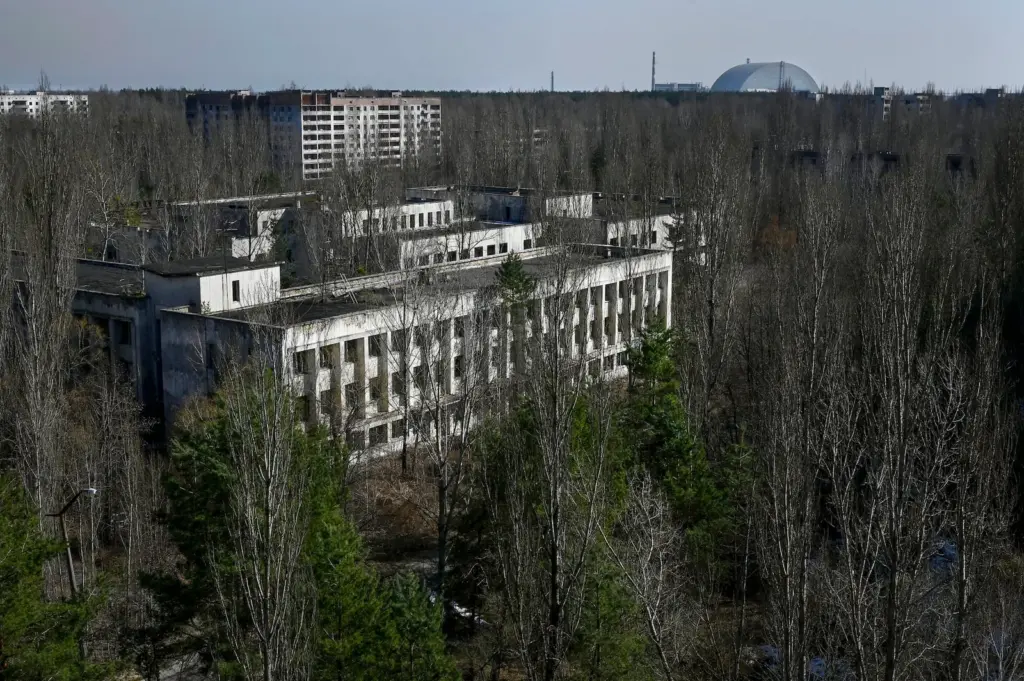
Pripyat is the unquestionable symbol of the catastrophe, the clearest trace of abandonment. Before the accident, it was the largest and most important city in what is now the exclusion zone. It was born and grew with the power plant and developed to over 50,000 inhabitants, almost all of them workers of a plant that can be seen with the naked eye from any elevated window in the town. In a few days, Pripyat went from a city to an emblem.
Volodimir Verbitskiy, the guide, leads us through its streets. He was born and grew up here. He married, had a son, developed his professional career at the nuclear power plant, and, at 25, like the rest of the residents and friends, was evacuated in a caravan of buses. On April 28, 1986, Pripyat became a photograph, a static scene. Frozen as if by a spell, the city emptied in hours, and only the lifeless daily routine remained in place, motionless: furniture, hanging clothes, toys, traffic signs, a Ferris wheel that was about to open, a swimming pool full of calm water. Forty years later, no one has returned to live in this place. The city has been swallowed by nature. Its forms are barely discernible, diluted among trees that grow even inside the buildings. Only from the 16th floor of one of its blocks can we see that, indeed, this forest contains a city, as if it were one of those lost cities found by an explorer traversing the jungle.
Volodimir Verbitskiy shows us a photograph of a crowded restaurant on his tablet screen. Then he lowers the device, and the same scene appears, unrecognizable due to overgrown vegetation and the passage of time. “There’s an idea that Pripyat was an industrial and sad city,” says Verbitskiy. “That’s not true. Pripyat was a place full of life. The average age was 27, the streets were full of children, and our salaries were higher than the USSR average. There were concerts, restaurants, sports centers here… We lived very well.”
We head to what was his house, where he grew up with his parents and later inherited to form his own family. “It’s number 23 on Kurstchova Street,” he says, pointing to the street sign that survives among some branches. “Be careful with the sewers, don’t step on them. That’s where there’s the most radioactivity.”
Verbitskiy enters through a ruined doorway and stands in the middle of what was once the living room, now covered in rubble. “I remembered it being bigger. This is the second or third time I’ve come. I don’t like it,” he confesses, gazing out the window. “I jumped out this way one day when my parents came home and I was with a girl. I shot out half-dressed and with only one sock,” he recounts, laughing. It’s a sorrowful laugh, like the surroundings.
—What do you feel being from a city that no longer exists?
—Some friends say they would prefer it to be destroyed. It hurts to see the corpse.
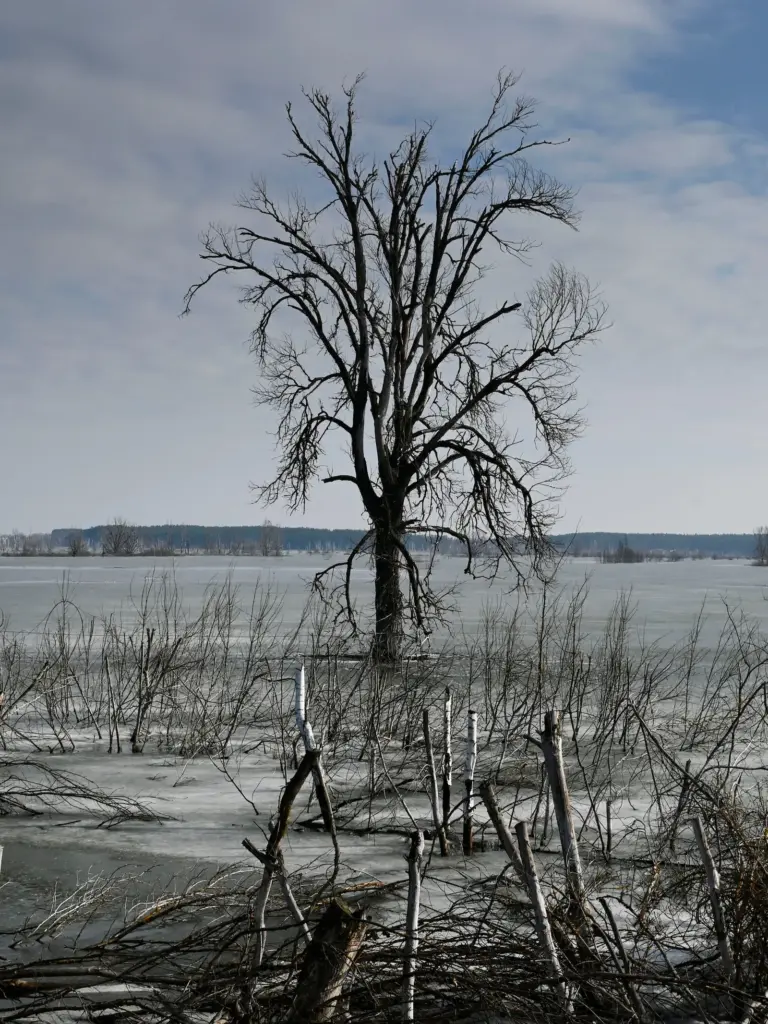
A rabbit the size of a medium dog crosses our path as we leave the ghost city. As we delve deeper into the forest, horses and deer also appear. The exclusion zone has emptied the territory of human presence, and wildlife has proliferated, showing that people are more detrimental than nuclear contamination. At least for animals.
Half an hour’s drive through dense forests and frozen roads leads us to a remote village called Kupovate, consisting of a dozen houses enveloped in an imposing silence. Only one of them is inhabited.
Marusia Zaiornaia is one of the last samosely remaining outside the village of Chernobyl. She lives without any neighbors for tens of kilometers around, isolated in the middle of an endless carpet of trees. To make matters worse, most of these forests are plagued with anti-tank mines that the Russian Army buried before its withdrawal.
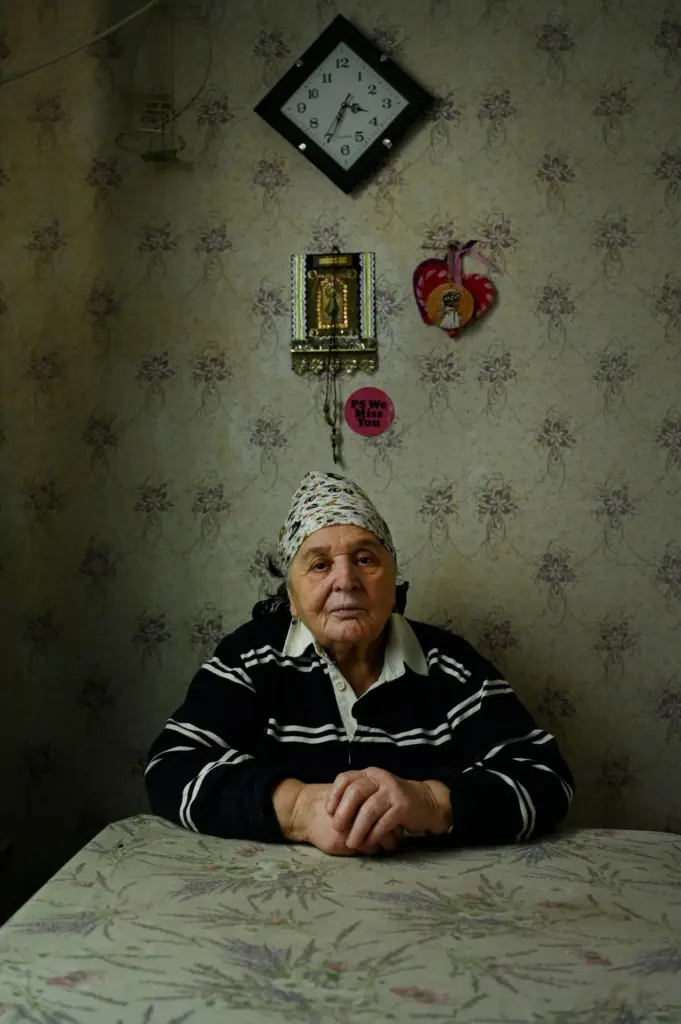
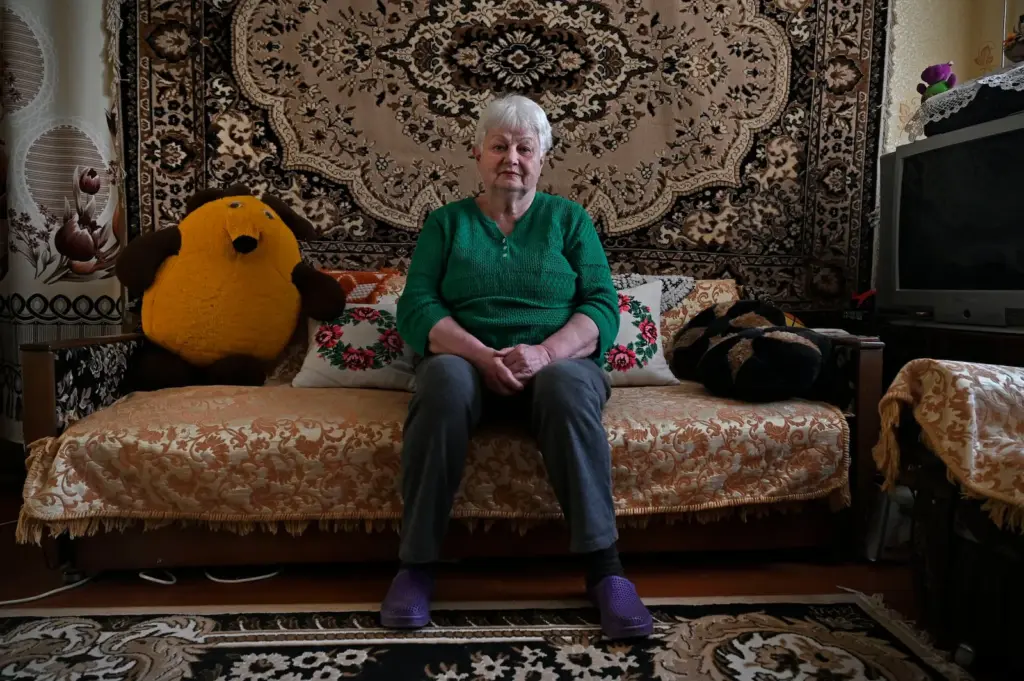
Small, with prominent cheeks and a toothless mouth, she asks us for a few minutes to change the scarf covering her head. She chooses a floral one and offers us food and homemade vodka in her tiny house that looks like a toy, with low ceilings and a blue door. “I am 85 years old, and this has been the hardest winter I’ve spent here. It’s probably been my last.” All her children and grandchildren, who live in Kyiv, insist that she leave the village. She never has. She was evacuated in 1986 and returned a few days later. “I don’t feel alone. I talk to my cats, I tend the land, I chop wood, or I go mushroom picking. This is my home; if I leave, I’ll die.”
It’s an opinion ingrained in the soul of all samoselys. Valentina Kuharenko is 86 years old and lives in another solitary house a few kilometers from Chernobyl. Sitting at her kitchen table, trapped in time, she recounts that the reactor explosion surprised her on April 26, 1986, while fishing in the river. “I was with my husband, and we saw a glow in the distance. We didn’t know that everything had ended there.”
She also insists on offering food and drink. Her tone is melancholic, sighs follow one another. “This will never be what it once was. I remember when they announced the construction of the power plant, we were very happy. We were very happy thanks to it and what it gave us. But then it killed us. It destroyed everything.” Valentina Kuharenko summarizes it in a literally poignant phrase: “Chernobyl was born in 1193 and died in 1986.”
***
The exit from the Chernobyl ghetto is, in reality, the entrance to the Ukrainian ghetto. The country remains suffocated and harassed by Russia, which sends barrages of drones over towns and cities almost every day. Four years later, much of Ukraine tries to normalize the unbearable. When air raid alerts sound in Kyiv, hardly anyone looks at the sky, much less runs for shelter. Chernobyl workers continue to come and go, entering the exclusion zone every 15 days. The area that, 40 years ago, became a ghetto and that, for the past four years, has also had to endure war.
Read more The naturopath Txumari Alfaro, known for the program ‘La Botica de la abuela’, dies at 73