






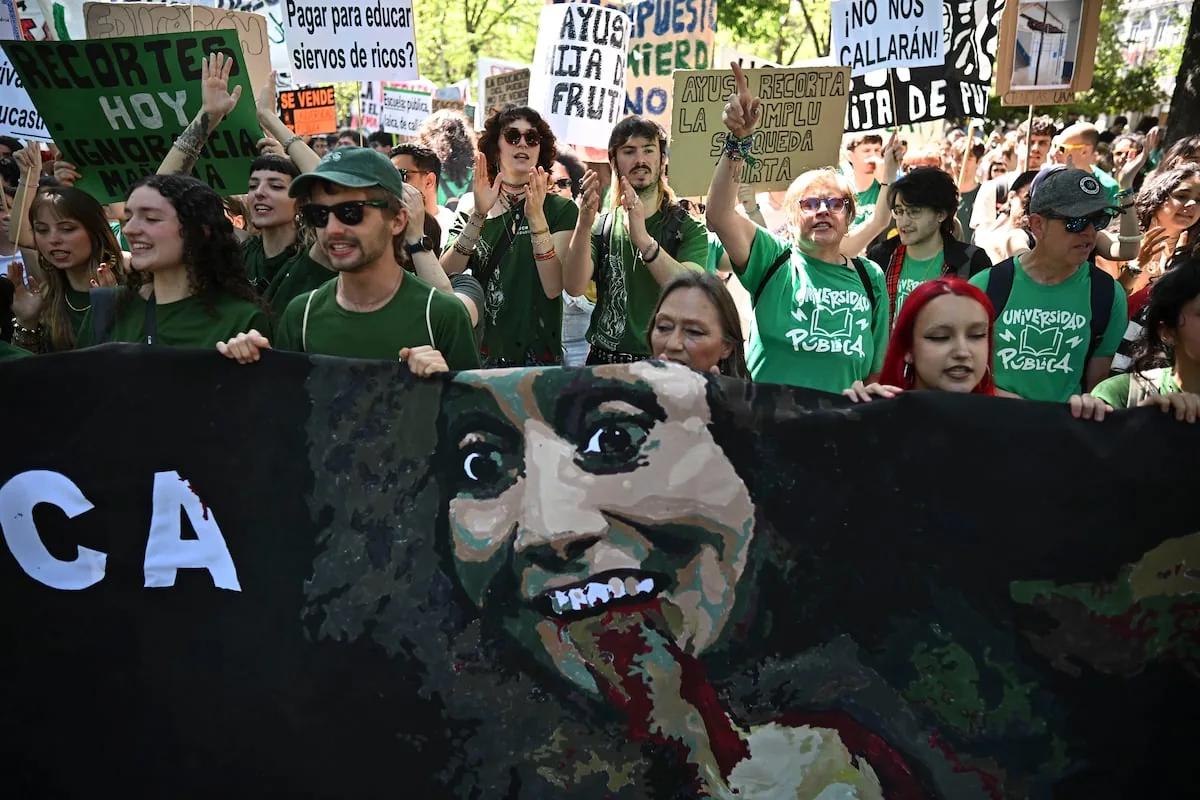
Can you imagine living without public education? Many people from Madrid could ask themselves that question, but it is the teachers who are now inviting them to consider it. Although more than inviting, they are forcing people to think about where the public system in Madrid is heading with the policies of Isabel Díaz Ayuso’s Government. This Sunday, thousands of people, including teachers, families, and students of all educational levels, from early childhood to university, took to the streets to demand that the Community of Madrid put an end to the “institutional abandonment” and “cuts” to the public education system.
Read more The naturopath Txumari Alfaro, known for the program ‘La Botica de la abuela’, dies at 73
The demonstrators, about 50,000 according to the organizers’ estimates, left Atocha at 12:00 PM with signs reading “no education, no future,” “silence is complicity,” and “education is not for sale,” and marched through some of Madrid’s main streets to Sol, where they stood to demand their rights. “The Government of the Community of Madrid subjects all educational levels to situations of underfunding, to dire working conditions, and also deplorable conditions for students, which means that public education in Madrid is currently in serious danger,” denounced Jorge Pérez-Huet, a UCM student and member of the Student Front.
All educational levels participated because teachers understand that the problems of public education in Madrid are transversal. The list of demands is long: chronic lack of resources, overload and institutional abandonment in special education; increasing privatization and reduction of administrative staff; the invisibilization of female workers; low salaries, long working hours and high ratios from 0-3 years to secondary school; lack of internships for Vocational Training students; scarcity of resources leading to the expulsion of students with special educational needs, and also degradation and repression in universities.
The green tide, as the movement for the defense of public education is known, had yellow hues this Sunday, the color representing teachers of the first cycle of Early Childhood Education, who are on an unprecedented indefinite strike that began on April 7. “It was the day to demonstrate the strength of the 0-3 age group,” says Rosa Marín, an Early Childhood teacher and spokesperson for the Labor Platform of Infant Schools (PLEI), who assures that their fight “will not stop” until they manage to improve their working conditions. The feeling among the guild is one of “abandonment,” both by the Ministry of Education and the Madrid City Council, which has its own network of infant schools. Their demands focus on lower ratios and salary increases, in this case, especially in centers managed by the municipal government, where salaries are around the SMI.
High school teachers, for their part, have demanded a reduction in teaching hours, as they had been requesting since the previous academic year. Vocational Training teachers demand greater funding and an increase in places so that no student is forced to pay for a private center due to not finding a spot in public education. And university teachers are not convinced by the new multi-year funding agreement signed by the Ministry of Education with the rectors of public universities.
“There has been talk of an increase of 14.8 billion euros, which, out of context, might seem like a significant rise, but as has already been analyzed in the assemblies for public education, this supposed increase, in addition to counting on funds such as fees that fall on families, would leave us in a situation of precarity and underfunding very similar to the current one,” stated the different convening platforms in a joint statement. “This is nothing more than a new attempt at demobilization by both the government of the Community of Madrid and CRUMA itself [the Conference of Rectors of Public Universities of Madrid],” they point out.
In the midst of this storm affecting public education, the Community of Madrid fuels its “romance” with subsidized private schools, the conveners assure in a statement, “the trend is clear: cut public services to make way for private ones.” “Every year, funding for private and subsidized education increases through various channels while groups in 0-3 and compulsory education or university subjects are closed,” they add. They also recall that spending to finance non-compulsory stages in private schools, such as in high school, vocational training, or the first cycle of early childhood education, has not stopped growing under the Government of Isabel Díaz Ayuso, to the detriment of public centers.
The different groups indicate that they have been preparing for over a year to reach this day of unity across all educational stages in the Community of Madrid. The different groups affirm feeling more “strengthened and coordinated” than ever to defend their rights. “What we demand is a radical change in the Community of Madrid’s policy towards public education; dignified working conditions for all education workers and the construction of a public, free, and quality education for the working class and their children,” concludes Pérez-Huet.