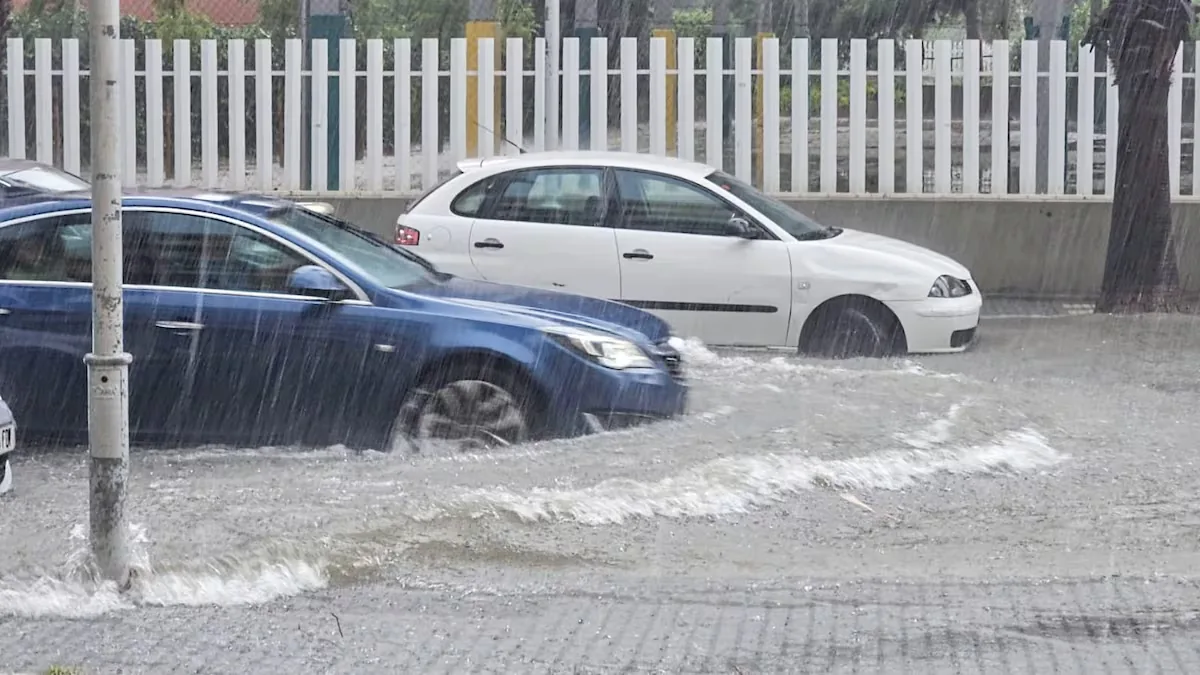
Catalonia wakes up this Wednesday with the forecast of severe storms, torrential rains, and violent weather, so the Generalitat has restricted mobility and suspended educational activities in five counties (Baix Llobregat, Vallès Occidental, Garraf, and Alt and Baix Penedès) where two million people live. The precipitation affected early on the far west of the Pyrenees and the central coastal counties, such as Garraf and Baix Llobregat, with downpours of 35 liters per square meter in Vilanova i la Geltrú or 46 in Sitges, in storm trains passing at full speed. The line, which was over the sea at dawn, then moved to Vallès, Ripollès, and towards Girona. Some trains are running late and some flights have been canceled at Barcelona airport. So far no damage is known, explained the director of Civil Protection, Imma Sole, early on, while meteorologists warn that the storms may reactivate.
Read more What has led to the education crisis?
The rapid passage of precipitation is positive because water causes havoc when storms remain static over a territory. The maps show a very hot Mediterranean Sea and storms entering through the Cantabrian, which will cause rain throughout the day and a sharp drop in temperatures. Meteocat has declared the maximum danger level in Catalonia for the day, 6 out of 6. Civil Protection warns that, in addition to water, hail may fall and there may be strong gusts of wind and bursts, so it asks for “great caution and to avoid being outside.”
🌧️ The rain will increase this night.
⛈️ The most intense showers are expected at the end of the night and during the morning.
📍 This is indicated by the intensity warnings forecast for Wednesday. pic.twitter.com/O0cuUyCxgy— Meteocat (@meteocat) September 8, 2026
The Generalitat agreed to restrict mobility this Wednesday, apply teleworking, and suspend educational, university, and sports activities (the latter outdoors) between 7:00 and 17:00 in the counties of Baix Llobregat, Vallès Occidental, Garraf, and Alt and Baix Penedès due to the forecast of intense rains.
In this situation, Civil Protection sent an Es-Alert message to residents of the affected towns to inform them about these measures. The Generalitat also asks to avoid travel and, as far as possible, to telework.
Read more ‘El Pulso’ from ‘Hoy por Hoy’ live, in EL PAÍS
In Barcelona, Civil Protection has activated the Municipal Emergency Action Plan due to the risk of drainage insufficiency in alert phase. The City Council has asked citizens to check rooftops, lightning rods, drains, and downspouts and not to accumulate garbage. It also calls to disconnect electrical devices and remove objects and outdoor furniture that could be dragged by water.
It also recommends bringing pets inside and having a mobile phone and charger, essential medications, warm clothing, and personal documentation at hand. If driving is necessary, it recommends moderating speed, braking gently, and maintaining a safe distance, as well as not driving through flood-prone or flooded areas.
Judicial activity will also be affected. The governing chamber of the High Court of Justice of Catalonia (TSJC) has agreed to “suspend” trials and procedures, except for on-call services, in a total of 14 judicial districts, which coincide with the towns expected to be most affected by the storm: Martorell, Sant Feliu de Llobregat, Cornellà, Sant Boi de Llobregat, Esplugues de Llobregat, Gavà, El Prat de Llobregat, Terrassa, Sabadell, Rubí, Cerdanyola del Vallès, Vilafranca del Penedès, Vilanova i la Geltrú, and El Vendrell.
Read more Laura Gost explores an overpopulated society in ‘The Price of Being Born’