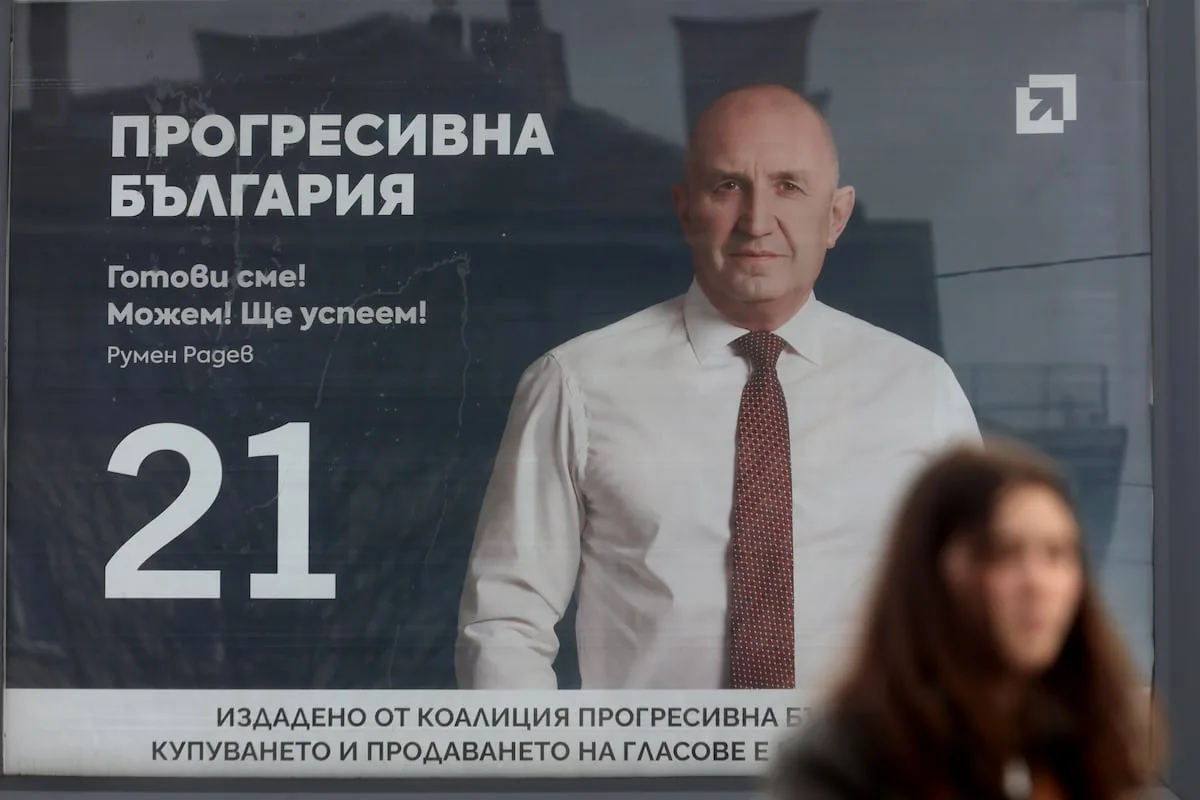









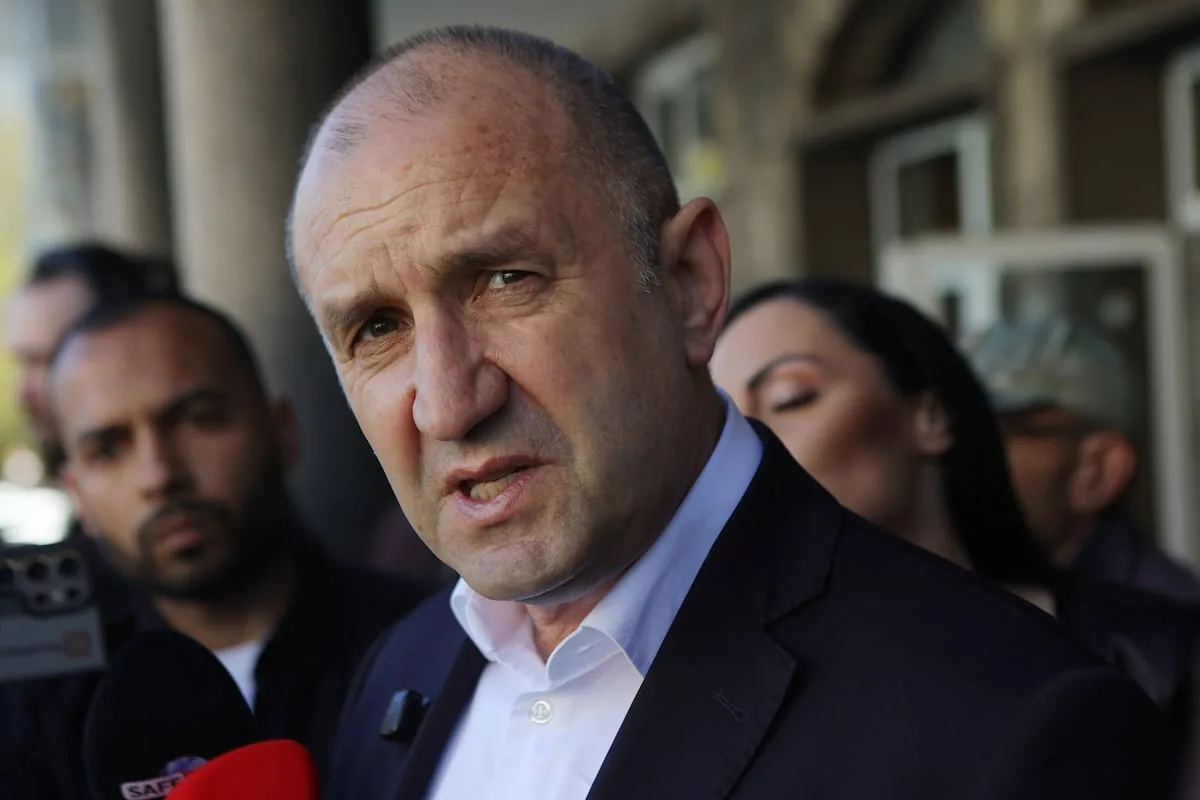
The pro-Russian candidate, former president Rumen Radev, has clearly won Sunday’s snap elections in Bulgaria, the eighth in five years, according to exit polls released at the close of polling stations. However, these predict that he will need a partner to become prime minister and form a stable government to break the recent dynamic in this country of 6.5 million inhabitants that has had the euro as legal tender since last January.
Read more Remco Evenepoel speeds towards Liège, winning the Amstel Gold Race
The left-wing coalition Progressive Bulgaria, led by Radev, 62, and former commander of the Air Force, obtains around 37% of the votes, ahead of the conservative formation Citizens for European Development (GERB), led by Boyko Borisov, three times prime minister since 2009, which is around 16%, always according to exit polls. Voter turnout has been particularly high, much higher than in previous elections.
Radev, who is perceived to have certain similarities to the recently fallen Hungarian Prime Minister Viktor Orbán in his pro-Russian rhetoric, could now negotiate an agreement with the pro-European alliance We Continue the Change-Democratic Bulgaria (PP-DB). Although their positions coincide in the fight against corruption and oligarchy, there are important divergences in foreign policy, such as support for Ukraine against Russia’s invasion.
The former head of state went so far as to suggest that Bulgaria could play a role in relaunching relations with the Kremlin, invoking its Slavic identity and Orthodox religion. Something that, after the euphoria of getting rid of Orbán, is feared in the community capital.
The former head of state condemned Brussels’ sanctions against Russia, argues that military aid to Kyiv prolongs the conflict, and in 2023 already entered into a tense direct confrontation with Ukrainian President Volodymyr Zelenskyy during a meeting held in Sofia. In recent times, he has also denounced a decade-long security agreement signed between Bulgaria and Ukraine.
In fourth place in the elections is the Turkish minority party Movement for Rights and Freedoms (DPS-New Beginning), led by the controversial Delyan Peevski, a powerful oligarch sanctioned for corruption by the United States and the United Kingdom. As the fifth force would be Vazrazhdane (Renaissance), a radical pro-Russian party, with 5.3%. And just barely reaching the threshold to enter Parliament is the Bulgarian Socialist Party.
After casting his vote, Radev focused his message on the fight against endemic corruption that condemns one of the poorest countries in the EU, recently incorporated into the eurozone. He declared that Bulgaria has a “historic opportunity” to break once and for all with what he called the “Peevski-Borissov oligarchic model,” referring to what are, probably, the most prominent political figures in the country in recent years.
For his part, former Prime Minister Kiril Petkov, from We Continue the Change, highlighted the importance of civic responsibility. And Bozhidar Bozhanov, co-leader of Democratic Bulgaria (center-right), voted calling for the dismantling of what he described as a “captured state” and a stronger Bulgaria in a strong Europe.
Read more A vegetation fire forces the evacuation of Montjuïc Castle and suspends the cable car
Youth Vote
For many young people of Generation Z ―those born between 1997 and 2012―, the scrutiny must push for a reformulation of the political landscape after a series of elections that generated hopelessness. However, the expectations of this generation may be thwarted by Radev’s ambition, known for his opposition to the adoption of the euro and his refusal to militarily aid Ukraine in its resistance against Russia.
“We run the risk of sliding into the orbit of illiberal actors,” Alex Petkoff, Commercial Affairs Assistant at the British Council, tells EL PAÍS. “In the changing geopolitical landscape caused by the fall of Viktor Orbán, Bulgaria’s internal instability and strategic positioning make it a possible substitute for the Kremlin,” says this 23-year-old who actively participated in last December’s protests.
Petkoff, who is finishing a master’s degree in security and defense, believes that the repeated inability to form a viable executive has deepened institutional fatigue, which in turn has allowed “the acceptance of totalitarian and anti-institutional narratives and actors.” “These elections are not just about forming a government, but a test of Bulgaria’s democratic resilience, its resistance to ‘malevolent’ foreign influence, and the way to move away from corruption,” he asserts.
The last few weeks have been very intense for Alex Tanev. Between meetings with voters, political debates, and a strong presence on social media, this 22-year-old served as an observer this Sunday in one of “the riskiest polling stations in the Pazardzhik region,” in the center of the country.
At the end of last year, Tanev was among the thousands of young people who demonstrated in the streets to protest against a draft budget they perceived as a new impetus for endemic corruption. Those protests led to the government’s resignation. “Now we will see if we can achieve real political change or if the efforts that culminated in the largest protests since the 1990s will be in vain,” emphasizes this law student. He distrusts Radev as prime minister, although he first hopes to end the “oligarchic regime”: “I hope that the main enemy of the protests, Peevsky and Borisov, will be eliminated in these elections,” he concludes.
The election campaign has been marked by reciprocal accusations between parties about possible fraud, hundreds of arrests, and investigations related to vote buying. At the same time, independent organizations have noted an increase in disinformation with pro-Russian content.
“Social media has become one of the main battlefields. There has been a lot of disinformation from pro-Russian accounts that have sought to erode trust in institutions and amplify anti-European sentiment, often exploiting existing social and economic frustrations,” explains Petkoff, who sees Generation Z voters particularly “exposed to algorithm-driven content, where manipulation is often subtle and persistent.”
Read more A judge orders urgent medical attention for Mexican drug trafficker ‘El Güero’ Palma