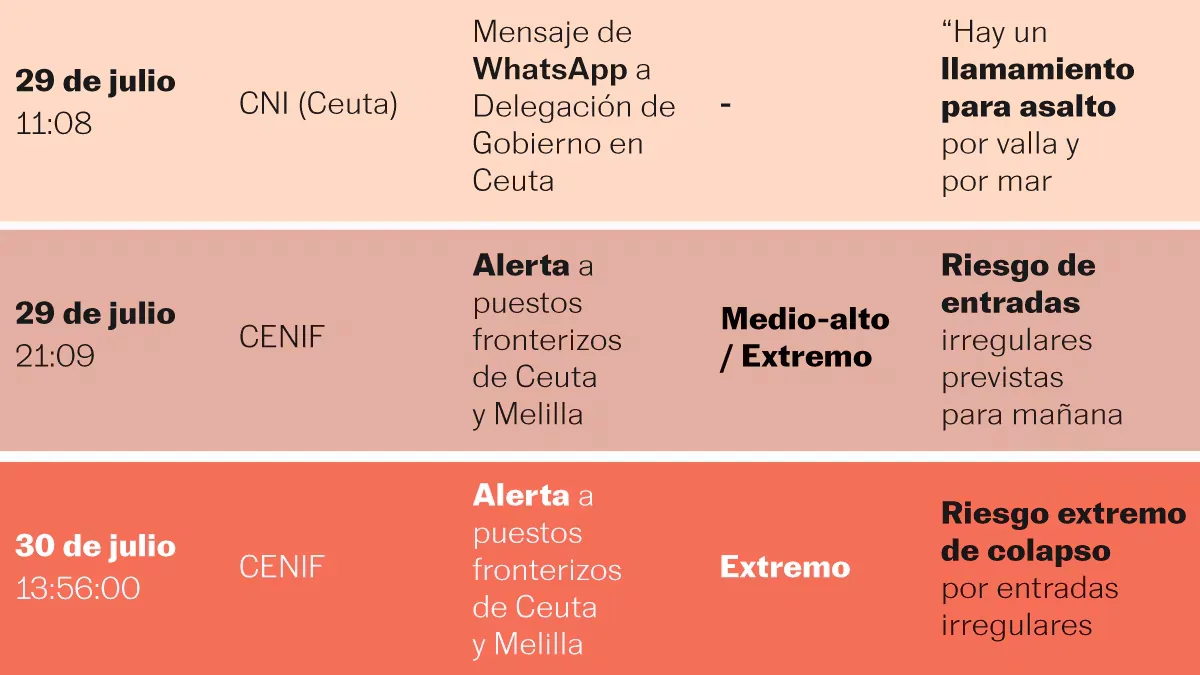
The Government published this Wednesday 40 reports and communications issued between July 1 and 31 about the migratory situation in Ceuta and the massive and irregular entry of between 70,000 and 80,000 people into the city. The documents, declassified one day earlier by the Council of Ministers and published on La Moncloa’s website after five in the afternoon on Wednesday, show that several agencies, including the National Intelligence Center (CNI), warned days before of an increase in arrivals by sea. The CNI, in fact, warned Morocco, the Government Delegation in Ceuta, and the Civil Guard of “calls” in social media groups with 180,000 members the day before the massive entry. However, its assessment never alerted to the magnitude of what would later befall Ceuta. What analysis can be made of the documentary set delivered by the Executive? What type of documents are they? Who are the senders and recipients? And what relevant data do they provide about what was already known about the migratory avalanche?
Read more 30,000 pesos bonus per child in Chile: how to know if you qualify and who can receive it
The documents
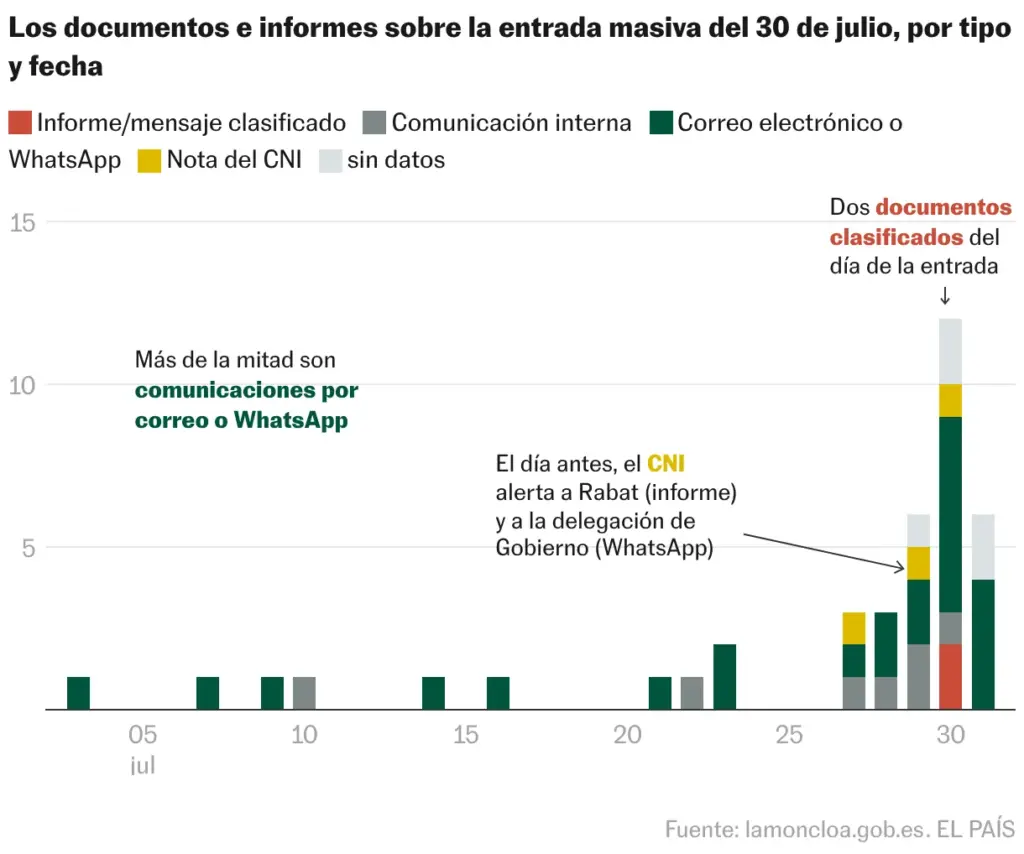
The published files are anonymized and include date and time of sending, scope, dissemination channel, and institutional recipients. They are organized on La Moncloa’s website in two blocks. On one hand, the reports and alerts are further subdivided into two blocks: those sent before the entry (from July 1 to 29) and those issued from the migratory avalanche onwards (from July 30 to 31). Of these 36 files, only seven can be classified as alerts and only one of them was sent before the day of the entry. And, on the other hand, the communications by messaging from the CNI to the Government Delegation and Civil Guard.
From the days prior to the event there are 18 reports and alerts. The first of these documents (an infographic of “attempts and swimming entries to Ceuta” so far this year) was sent at 8:20 by the Maritime Surveillance Coordination Center of Coasts and Borders of the Civil Guard in Spain (Cecorvigmar), via email, to the State Secretariat for Security (SES). Of this type — infographics and “dumps of fence entry attempts” — the Government has published eight. The rest are seven informative and internal notes (one of them urgent) and two communications with updated data on the migratory situation and a letter from the Civil Guard to the Ministry of the Interior requesting reinforcements.
From the days after the entry there are another 18 files. The first, sent to the Armed Forces Intelligence Center (Cifas) by the Army’s Transmission Regiment No. 32, warned on July 30 itself that it was “VERY LIKELY” that throughout that day “a massive irregular migration entry attempt would be made.” The rest of the documents are an infographic with updated data on swimming arrivals that month, eight reports on the evolution of the crisis, three informative notes (two of them alerts about massive entries), and a breakdown from the Civil Guard with its personnel. The last was sent at 14:53 on July 31 by the National Immigration and Borders Center (Cenif) to the Superior Police Headquarters of the Canary Islands: “It is considered necessary to establish a migratory ALERT about possible irregular entries into the territory of the Canary Islands, with special attention to the following boat departure areas: Agadir, Tan-Tan, and El Aaiún.”
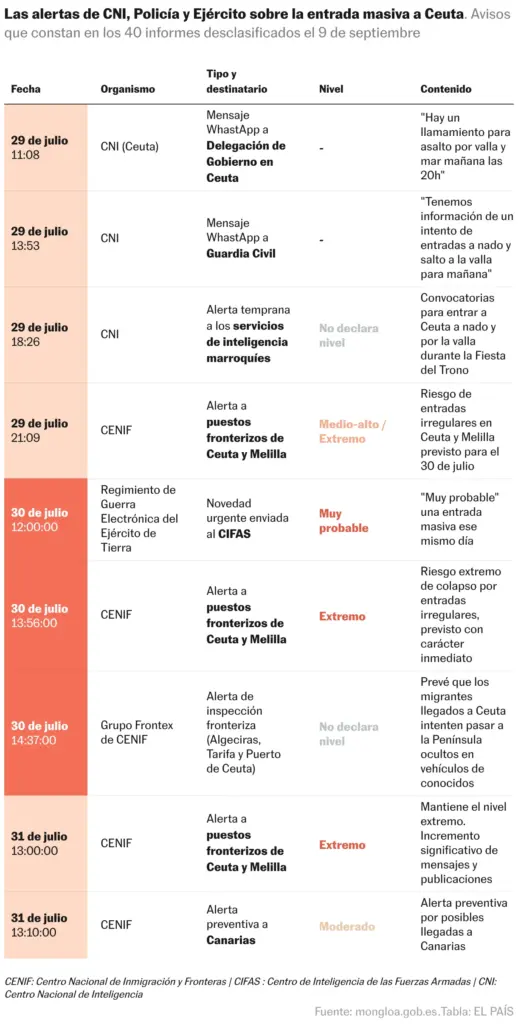
The messages sent by the CNI to the Government Delegation and Civil Guard are only four communications. The first is an exchange of messages on July 27 between the Government Delegation and the CNI to arrange an “urgent meeting” to address the “swimmer issue.” It is followed by one on the 28th and two on the 29th. In these last two, the CNI warns the Delegation and the Civil Guard of a call to cross the border.
The senders and recipients
Part of the interest in the reports lies in the agencies that sent them and those that received them. In total, 30 different entities were involved (10 as senders, 18 as recipients, and two in both categories). The one that produced the most reports was Cecorvigmar, of the Civil Guard, with nine submissions to the SES. Eight were sent before July 29 and one on the 30th. Next is Cenif, of the National Police, with seven (to the SES, to the border posts of Ceuta and Melilla, and one internal communication), the CNI with seven (Government authorities and local authorities of Ceuta, Government Delegation in Ceuta, the Civil Guard, and two Moroccan intelligence services). The Operations and Cyberdefense General Staff sent five; the Civil Guard Information Headquarters (JIGC) produced four.
Regarding the sending channel, the majority (23) were via email or WhatsApp message. Far behind are internal communications (seven), CNI notes (three), and classified messages or reports (two). In the remaining five, the Government did not specify through which medium the file was sent.
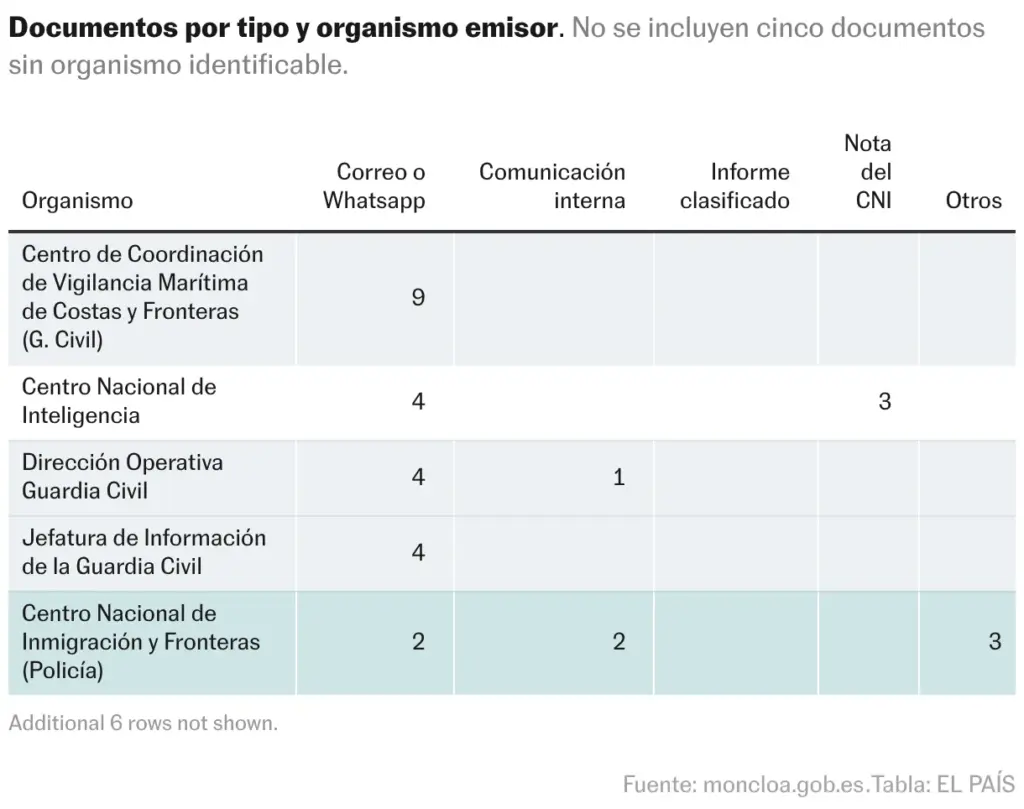
Crossing the content of each file with the competencies of each agency and the date allows knowing information such as, for example, that Cecorvigmar (the one that sent the most documents) only provided infographics and “dumps” with the number of attempts and irregular entries in Ceuta until July 26. Also, the timeline of the seven alerts: of the last five, three occurred within a two and a half hour period on July 30 (at 12:00, 13:56, and 14:37) and the last two in less than 10 minutes on the 31st, between 13:00 and 13:10.
The content of the information
The main key extracted from the declassification is that the CNI warned the Moroccan intelligence services through a call to cross the border. The message said: “In recent days, knowledge has been gained of the planning of several calls to carry out entries into Ceuta, both by swimming and through the fence, taking advantage of the celebration of the Throne Day (…) Your invaluable and continuous collaboration in this matter is appreciated.” The same document attached screenshots of messages and posts from Facebook and WhatsApp groups encouraging Moroccan citizens to cross the border. “Those who want to cross have their last chance at the Throne Day at 8. The authorities will be distracted with the celebration and parades,” appears in one of the CNI transcriptions.
Read more Liverpool turns off the Julián Alvarez effect
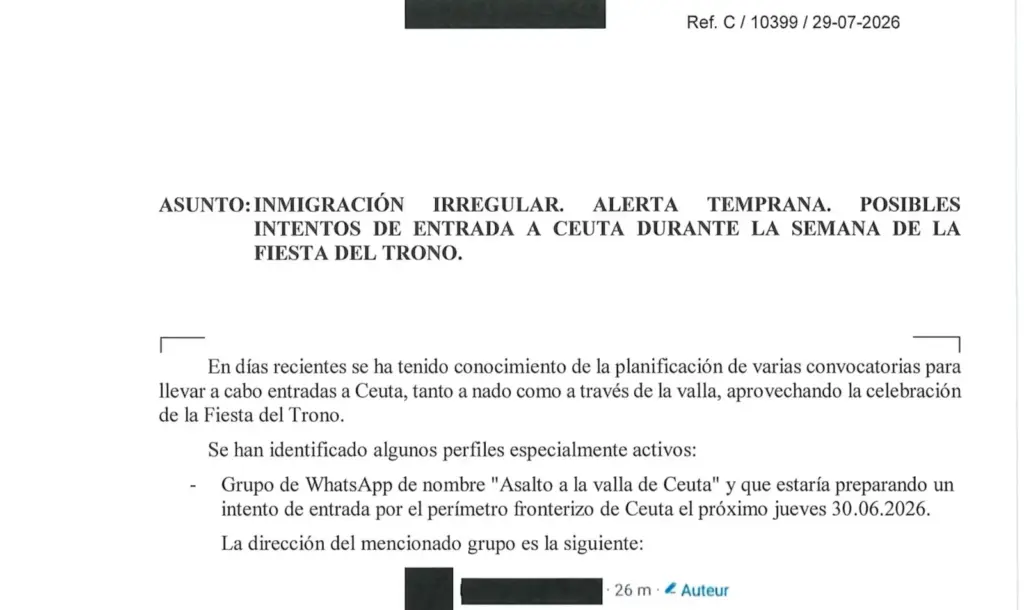
Also relevant are the message exchanges with the Government Delegation and the Civil Guard between the 27th and 31st of that month, in which it is also glimpsed that it warned it had “information of an attempt of swimming entries and fence jumps” in Ceuta on July 30, coinciding with the “Throne Day” in Morocco. Later, after sending that message, it held a conversation at 21:34 with the Government Delegation and the next day, after two-thirty in the afternoon, spoke with a Civil Guard officer for seven minutes and 38 seconds.
On the other hand, the publication of these documents provides a view of the growing migratory tension in the area. For example, the Civil Guard requested the Ministry of the Interior 20 days before the massive entry to “reinforce” the personnel of the Special Group of Underwater Activities and the Provincial Maritime Service of Ceuta “due to the risk of increased irregular access by sea.” The Armed Institute warned through a “dispatch note” that the latest Supreme Court ruling could “generate a call effect towards swimming entries, a modality that already presents a high difficulty for early detection and interception,” so it sent four proposals. Besides reinforcement, it requested “to enhance early detection and coastal surveillance technological systems in both autonomous cities” and “to promote a legislative modification.”
The ruling referred to by the Civil Guard was No. 814/2026, of June 29, which considered that “any person intercepted in waters of Spanish sovereignty or jurisdiction, as well as those who manage to access national territory by sea, may not be subject to rejection at the border.” The Armed Institute estimated in its writing that this ruling “limits the immediate response capacity to this type of irregular access and may favor a progressive substitution of entry attempts by land crossings for maritime modalities, especially by swimming entries from areas close to the border.” This ruling is referenced in other declassified documents sent by other agencies. The Police, in fact, estimated that since the publication of the ruling, “1,240 irregular immigrant entries to Ceuta” had been intercepted.
Two weeks later, another report from the Civil Guard (from the Coordination Authority Against Irregular Immigration) communicated through an internal note to the Maritime Surveillance Coordination Center of Coasts and the RAU with data on swimming entries in Ceuta and Melilla between July 13 and 19. In that document, it warned of a weekly increase. Not only in the number of arrivals but also in those intercepted. That week, the Moroccan Royal Navy stopped 773 attempts (146 more than the previous week). “Last Thursday the 16th, the GRM arrested in Nador one of the most wanted human traffickers,” the note adds.
Added to this are the assessments of JIGC in its July 30 reports on the main hypotheses of why Morocco did not stop the avalanche, which range, in order of probability, from “an operational surprise” to the “connivance of Moroccan authorities as a reaction to recent political events (meeting of the President of the Government of Spain with Algeria) and the aforementioned Supreme Court ruling.”
That same day, the Civil Guard sent another document where it stated that Morocco was expected to deploy a thousand gendarmes and soldiers, but the reality is that they detected passivity “on the part of the Moroccan authorities,” “allowing the arrival of candidates to the border area.” “It is unknown whether this lack of proactivity (at least temporary) is simply circumstantial or obeys specific instructions,” appears in the report, sent at five in the afternoon.
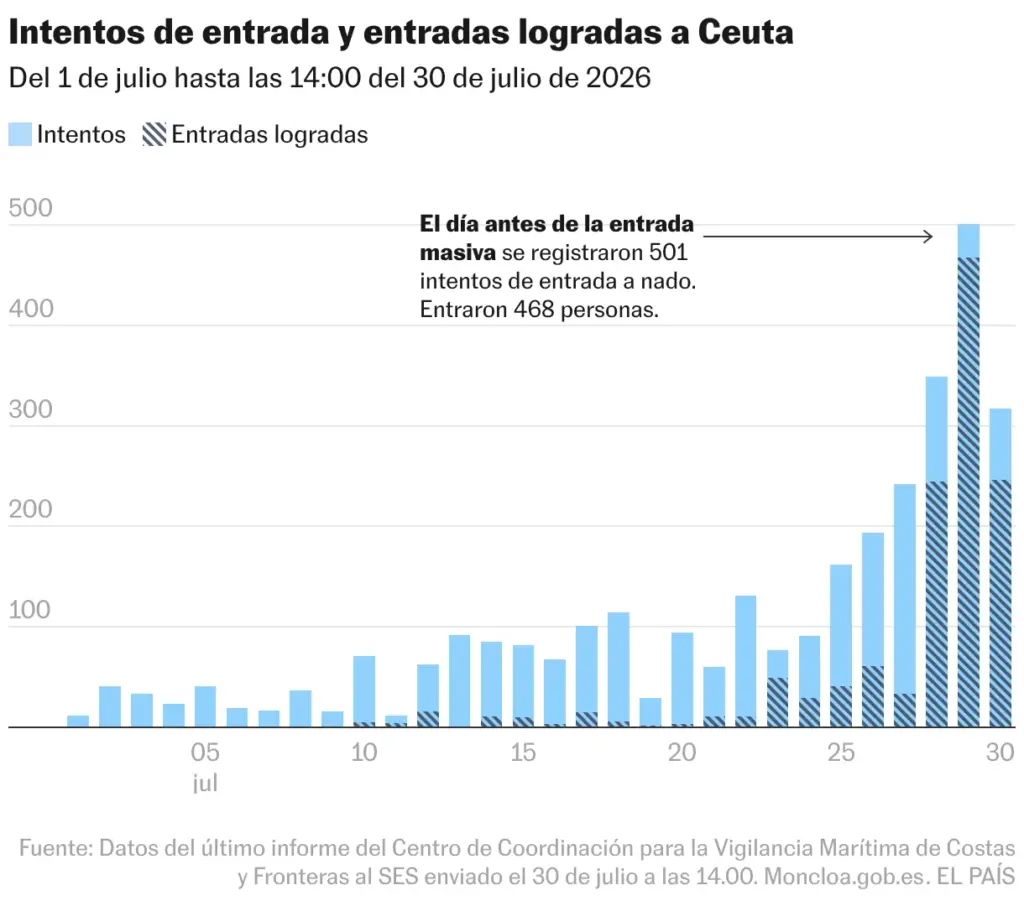
Another important piece of information is the accumulated data of entries so far this year or since July. Crossing this information allows breaking down both arrivals and attempts by day, and the nationality of the immigrants.