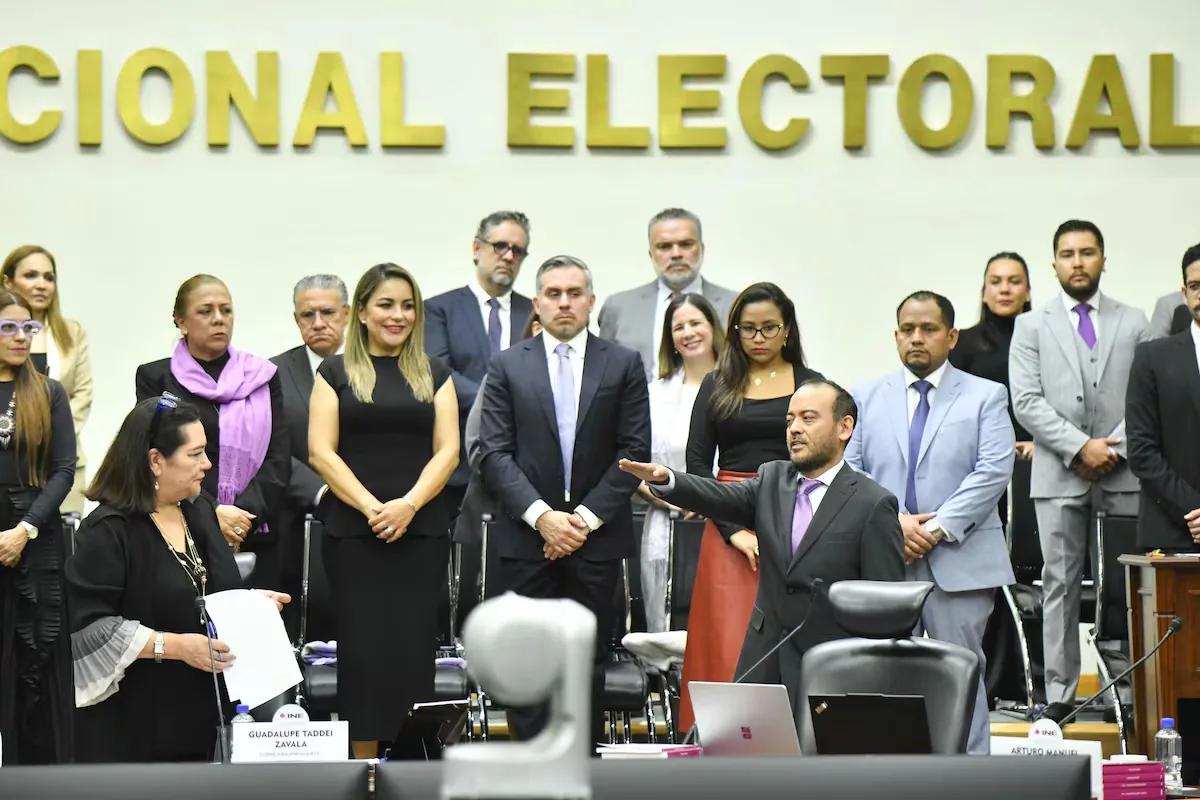
A tense atmosphere hangs over the 2027 electoral process. On day one, opposition parties have laid out their multiple reasons for distrusting the National Electoral Institute, the referee who, as rarely happens, arrives at the starting gun with only one vote of confidence: that of the ruling party. In the formal session that marked the start of the process, representatives from PAN, PRI, MC, Somos, and even PAZ and PVEM – satellite parties of Morena – raised doubts and demands at the table.
Among many concerns are Morena’s early candidate announcements and campaigns in the 17 states renewing their governorships, as well as the flexibility of the INE, led by Guadalupe Taddei, in technical processes that should guarantee no fraud occurs. They have also mentioned the lack of fairness regarding sanctions against opposition parties compared to the inaction towards offenses committed by the ruling party, and the government’s influence on the composition and decisions of the referee, which this Thursday fueled suspicion with the surprising presence of the Secretary of the Interior, Rosa Icela Rodríguez, at the civic ceremony that officially marked the start of the electoral season. The official attended representing President Claudia Sheinbaum, who this morning said with a smile that now that the electoral process begins, she must be more careful with her statements.
Party representatives have challenged two recent decisions approved by a majority of INE councilors: the refusal to regulate and audit the internal processes that Morena launched to select its candidates under the figure of “defense coordinators of the transformation” and the approval of an agreement on the so-called “flat ballots,” that is, electoral ballots appearing without any folds in the ballot boxes during counts, which district councils could validate after the INE refused to consider them null from the start. And a third: the rules that open the door for national servants – officials from the Ministry of Welfare managing social programs – to register as electoral observers.
Especially harsh was the national leader of the PRI, Alejandro Alito Moreno, who decided to register as his party’s representative for this session. The senator demanded responsibility, commitment, and conviction from the INE councilors to prevent the electoral use of social programs and public resources in favor of Morena. “Protecting the elections is the most important thing from this day forward. Therefore, I want to ask all of you, how do you want to be remembered? As those who defended democracy, those who guaranteed balance in this country, those who acted with transparency and responsibility, or those who bowed to power?” he asked them.
In the same tone, Senator Verónica Rodríguez, PAN’s representative, criticized the INE for the lack of a level playing field and recent decisions that, far from guaranteeing fairness and certainty, contribute to distrust. “Mexico needs a strong, autonomous National Electoral Institute, uncomfortable for power, and uncompromising against any attempt to manipulate the popular will. Be worthy of that responsibility, assert your autonomy, defend your independence, apply the law without fear or favoritism, and show Mexico that in front of any power there still exists an institution capable of defending the free will of Mexican women and men!” she demanded of the councilors.
Juan Ignacio Zavala, from Movimiento Ciudadano, criticized that the formal start day of the electoral process came with a grand ceremony, when in fact Morena is already campaigning, with an early pre-campaign that has been imitated by PAN and PRI in several states. “Many electoral authorities, local and federal, have chosen to turn a blind eye to avoid fulfilling the most basic of their duties. It seems we are moving towards an electoral system where the most important thing is to see who has more power to bend the rules and pressure the authority,” he accused.
Marco Baños, a controversial former counselor of the Federal Electoral Institute, now representing the new party Somos, hit the sore spot by warning that the INE is paving the way for a state election. “We are heading to the first election that takes place under constitutional tyranny or constitutionalized authoritarianism. Every piece of electoral inequality deserves serious, rigorous, and decisive treatment by this authority dominated by a majority that has abdicated its constitutional power to arbitrate impartially, an authority that has decided to look the other way while early and illegal campaigns develop or that has decided to leave loopholes for flat ballots or for national servants to sneak in under the figure of electoral observation.”
Read more Milei celebrates Argentina’s lowest inflation rate in over a year: 1.7% monthly in August
It was Baños’s presence, once accused of serving the PRI as an electoral counselor, that gave Morena the cue to respond to the opposition’s accusations. It did so through its national president, Ariadna Montiel, who, like Alito, registered to speak at this session. The Morena leader recalled that in the INE General Council – formerly IFE – electoral frauds were endorsed – like in 2006 – and Andrés Manuel López Obrador and the Fourth Transformation were fought against. “For years, the old regime parties turned the electoral referee into part of their strategies. That is why it does not surprise us that today a former electoral counselor represents a political party.” Montiel gave unconditional support to Taddei’s INE and assured that the disqualification of the referee is an opposition narrative ahead of their imminent defeat. “They lost the people long before losing the elections,” she stated.
Self-criticism and defense
Inside the INE, there are questions about the institute’s ability to guarantee a fair process. Councilors Arturo Castillo and Martín Faz have expressed their resistance to endorsing some decisions approved by a majority block of councilors aligned with the Fourth Transformation. “We are in the perfect scenario for a contested election,” said Arturo Castillo, “the INE seems to have abdicated its function to oversee and arbitrate elections.” According to Castillo, some decisions approved by the majority imply that the institute renounces at least three powers: to ensure political parties adhere to electoral timelines, to prevent governments from interfering in election organization, and to guarantee that only valid votes are counted.
In the same vein, Martín Faz questioned that the current INE is heading into the 2027 process with a structure of officials unilaterally appointed by the presiding councilor, Guadalupe Taddei, without considering the collegiate body. He also criticized the relaxation of controls that in the past closed the door to fraud. “We don’t need to start by saying everything will be fine; we need to commit to doing everything necessary to ensure it is fine, and that requires independence, professionalism, effective controls, and the conviction that political power must submit to elections and elections must never submit to public power.”
Guadalupe Taddei responded by downplaying her colleagues’ accusations and the opposition parties’ warnings regarding “flat ballots,” electoral observers, and passivity towards early pre-campaigns. Taddei asked the INE’s operational structure not to listen to or heed “bad omens” and to focus on delivering good accountability to the public. “We are ready not to be intimidated by absolutely anyone, nor coerced, nor extorted with any kind of threats, positions, accusations,” she pledged.
The first skirmish of 2027 lasted more than three hours, in a debate that foreshadows a tough electoral campaign. After the inaugural session, Ariadna Montiel and Alejandro Moreno left the so-called “horseshoe of democracy,” expanding their disqualifications of their rivals in statements to the press. One of the major absences was the national leader of PAN, Jorge Romero, who preferred to travel to Brussels to file a complaint against Morena in the European Parliament.