









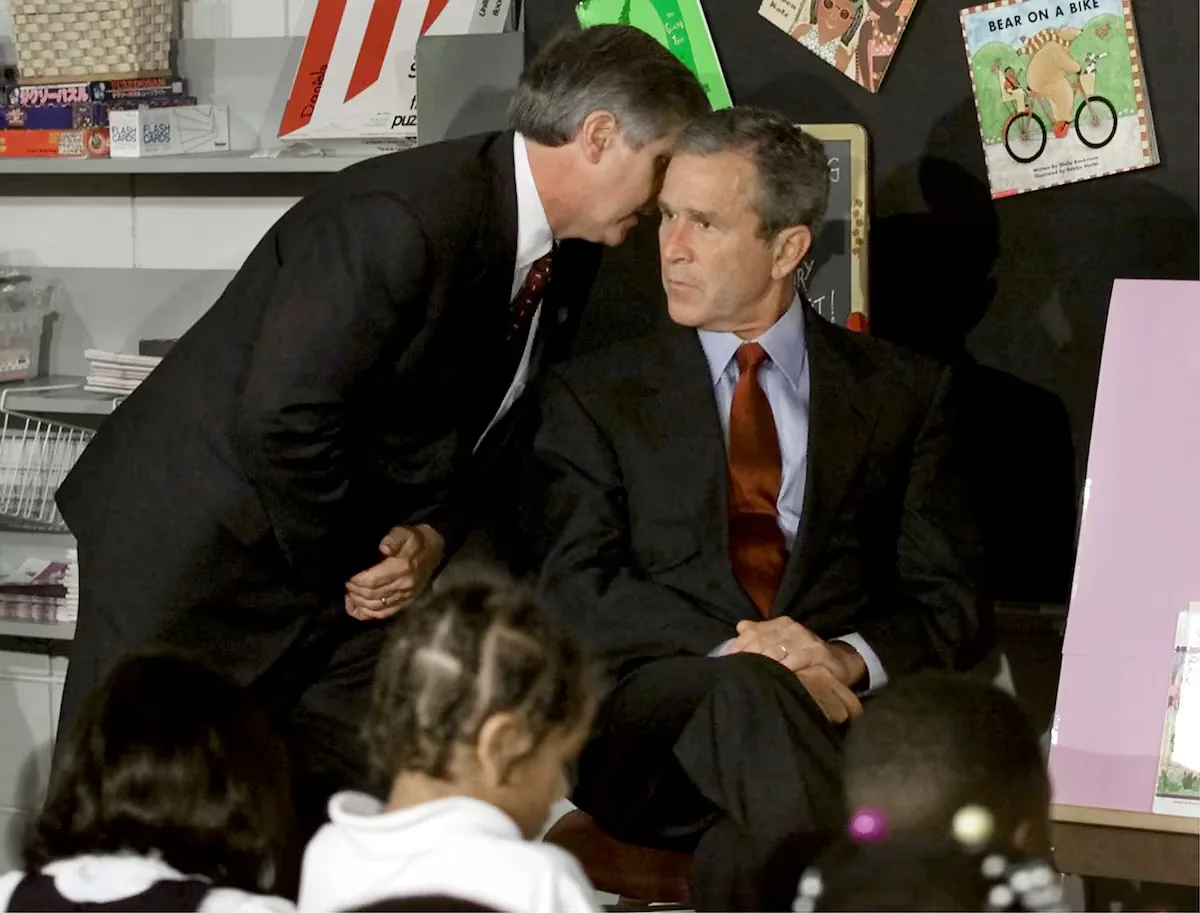
The most exciting thing scheduled at the White House on September 11, 2001 — a “sunny, pleasant” day, as The Washington Post put it on the front page — was a barbecue with Republican congressmen. With the boss, President George W. Bush, traveling in Florida to participate in an event on early childhood education, the atmosphere was relaxed among the staff. So much so that speechwriter Pete Wehner “consciously” thought around 7:30 that “one of the most boring days” of a presidency that had started eight months earlier was beginning.
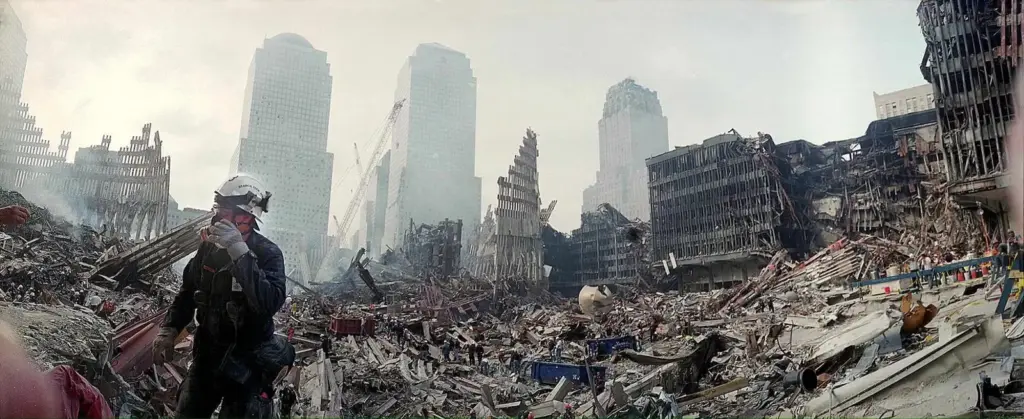
At 8:46, the script changed dramatically when a passenger plane with five hijackers on board crashed into one of the Twin Towers. Seventeen minutes later, another hit the second. By then, the United States had already discovered its vulnerability and the world had changed forever. The “American century” gave way that day, “the darkest day,” to a new era, with contours still unpredictable 25 years later.
An oral history project by the Miller Center at the University of Virginia in Charlottesville allows a glimpse through 80 interviews with members of that Administration (Bush 43’s, to distinguish it from George Bush Sr.’s, Bush 41) at what happened in the White House and other key settings during those hours. It is an archive of thousands of pages (hosted on the center’s website), which presidential historian Russell Riley, a gentleman of exquisite Southern manners, began in 2009 and has condensed into the 600 pages of the book Inside the George W. Bush White House (Inside the George W. Bush White House, untranslated into Spanish), recently published by Oxford University Press.
The result is valuable, the historian points out in the foreword, because it is estimated that “centuries, rather than decades” will pass before the National Archives process the information from that presidency. Also, because the Bush Administration knew how to especially shield itself from leaks.
The section on 9/11 adds up to about 30 pages just on that day; about a hundred if you count the background and what came after, a war on terror still ongoing, with Guantánamo as the great symbol of an open wound. Its reading offers a window into the astonishment and bewilderment with which Bush and his team received the terrible news. Besides the two planes into the Twin Towers, Al Qaeda hijackers crashed another into the Pentagon and a fourth aircraft ended up crashing into a random field in Pennsylvania after passengers thwarted a suicide mission that was headed straight for the Capitol or perhaps the White House. Also, after Vice President Dick Cheney calmly, as spokesman Ari Fleischer recalls in the book, gave the order to “shoot down with whatever it takes” the United Airlines flight.
In total, 2,977 people died in the attacks.
The account also dwells on the improvisation with which the leaders of the world’s foremost power acted on 9/11. The state of the “bunker” to which Cheney and then National Security Advisor Condoleezza Rice — whom the interviewees refer to somewhat disdainfully as Condi — were moved is especially striking. “The place was so outdated and rudimentary that there was concern about the lack of oxygen down there if there were too many people. We asked some people whose presence was not essential for the operation to leave,” says Josh Bolten, who would end up as Chief of Staff. Meanwhile, he adds, “a few brave souls stayed in the unprotected Crisis Room” of the complex, the famous Situation Room. Those people kept “communications open.”
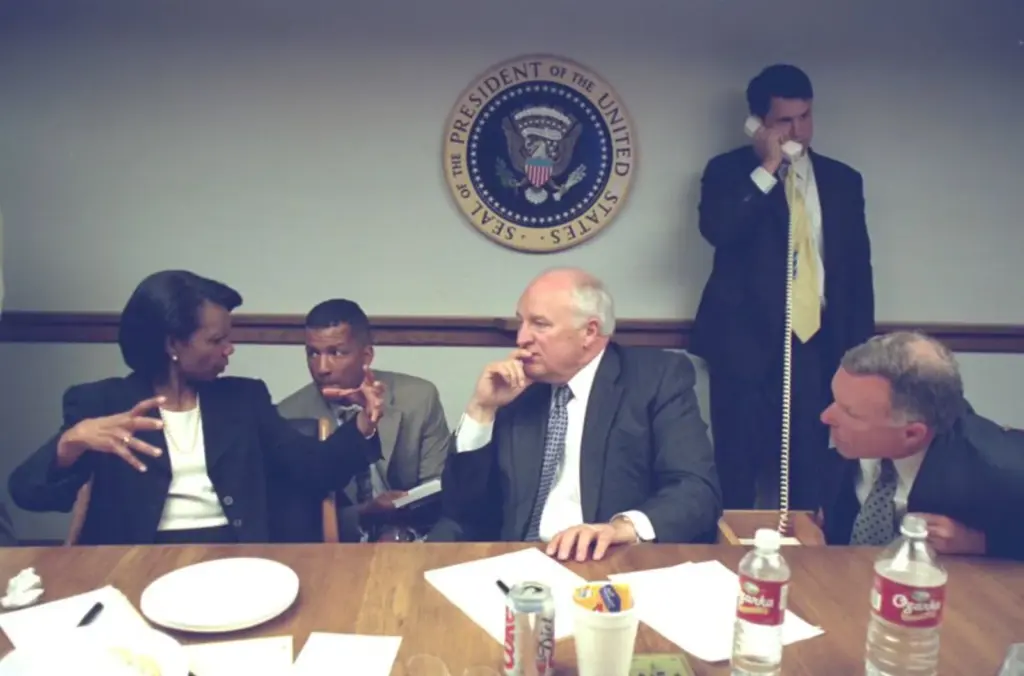
The president spent the first hours aboard Air Force One (AF1), which only had enough fuel to reach Washington, and had to stop to refuel in Louisiana on his way to a military base in Nebraska, which Fleischer thought “looked like something out of the movie WarGames.” “I will never forget it. Upon arrival, we parked next to the president’s Doomsday Plane,” recalls the spokesman, referring to an Army aircraft designed for the eventuality of an emergency as serious as a nuclear attack.
The first thing Bush did upon boarding AF1 in Florida was ask: “Are my wife and daughters safe?” (The First Lady, Laura Bush, was at the Capitol that day and was moved to the bunker). Later, when the rumor was still alive that the presidential plane was the next target and “communications with the outside were terrible and kept cutting out,” he told Rumsfeld, with that genuinely American talent for speaking like in the movies: “We’re at war, guys, we get paid for this.” After the attacks, both the bunker and the presidential plane underwent significant technological upgrades.
“Bush was not going to be a president focused on foreign policy. He came in with three or four priorities and all were domestic. Overnight, his agenda changed,” Riley explained last week to EL PAÍS in his office at the Miller Center, which, based in an elegant Virginian mission, has been dedicated to documenting the presidency since the mid-seventies, when it was founded to “restore trust in the institution after Watergate.” They have completed oral histories on Jimmy Carter, Ronald Reagan, Bush Sr., and Bill Clinton. There is a more modest project underway on Barack Obama and plans to cover Joe Biden. The one on Donald Trump is stalled because one of the program’s rules is that it only starts once the subject of study has left office.
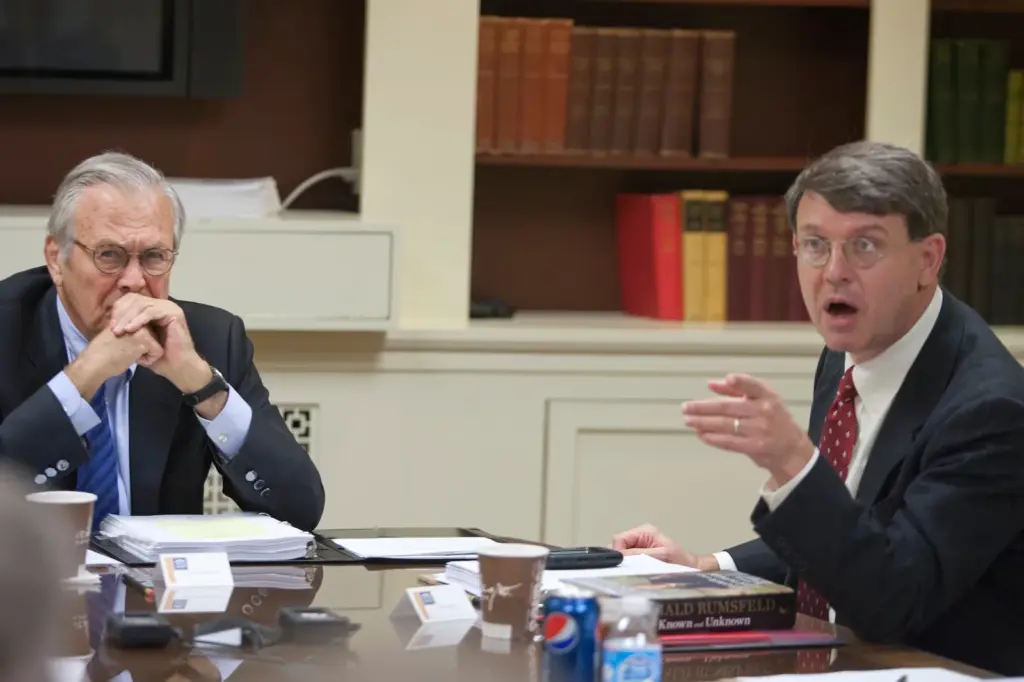
Other rules obey the ethical code that governs the journalistic genre of oral history. The interviews usually last a whole day (or more), and at the Miller they are conducted with the help of other experts and on the condition that those who participate can review their answers and remove any regrets, which gives the result an inevitable aroma of an official version. For that reason, the conversation held with Vice President Dick Cheney has not yet been released: the politician died in 2025, but the family is still combing through the material, Riley says. In the case of Bush 43, he gave permission to his collaborators, but he did not want to be part of it.
One of the most interesting aspects of the book is the light it sheds on the “difficult” relationship between Rumsfeld (1932-2021) and then Secretary of State Colin Powell (1937-2021), who do not spare cross-criticism. And if there is something both, and others, agree on, it is blaming Rice (“she was younger and inexperienced,” Riley warns) for the lack of foresight that allowed the 9/11 attack.
General Michael Hayden, director of the National Security Agency, talks in his interview about how CIA director George Tenet “was going around in the summer of 2001 saying: ‘Hey, they’re coming [the Al Qaeda terrorists],” then clarifies that he did not necessarily mean “here.” “The anticipated threat was against the United States, Americans, or American interests abroad,” Hayden adds.
“I don’t think Condi had any meeting about [Al Qaeda]. We had meetings about everything imaginable, except that,” according to Rumsfeld. In fact, there was “a briefing session completely focused on Al Qaeda,” says Stephen Hadley, deputy National Security Advisor, and a sadly famous “presidential daily briefing” on August 6 in which it was mentioned that Al Qaeda was “ready to attack.”
John Berlinger, legal advisor, recalls, for his part, that that summer “it was concluded that you couldn’t design a policy” regarding the terrorist group “without first deciding a policy for Afghanistan. That we couldn’t decide a policy for Afghanistan without deciding a policy for Pakistan. And that we couldn’t decide a policy for Pakistan without deciding a policy for the India-Pakistan relationship.” For General George Casey, Army Chief of Staff, the resulting mess, perhaps the greatest intelligence failure in U.S. history, “was not so much” that “as a blatant lack of imagination.” “We simply didn’t think some guys would come out of their caves and be capable of inflicting such damage.”
“They wanted us to kill someone”
After the attacks, there was a famous meeting at Camp David, which Rice recalls in her interview: “We spread out that map of Afghanistan and everyone’s face fell. Why would we go to Afghanistan? It’s where the great powers go to die.”
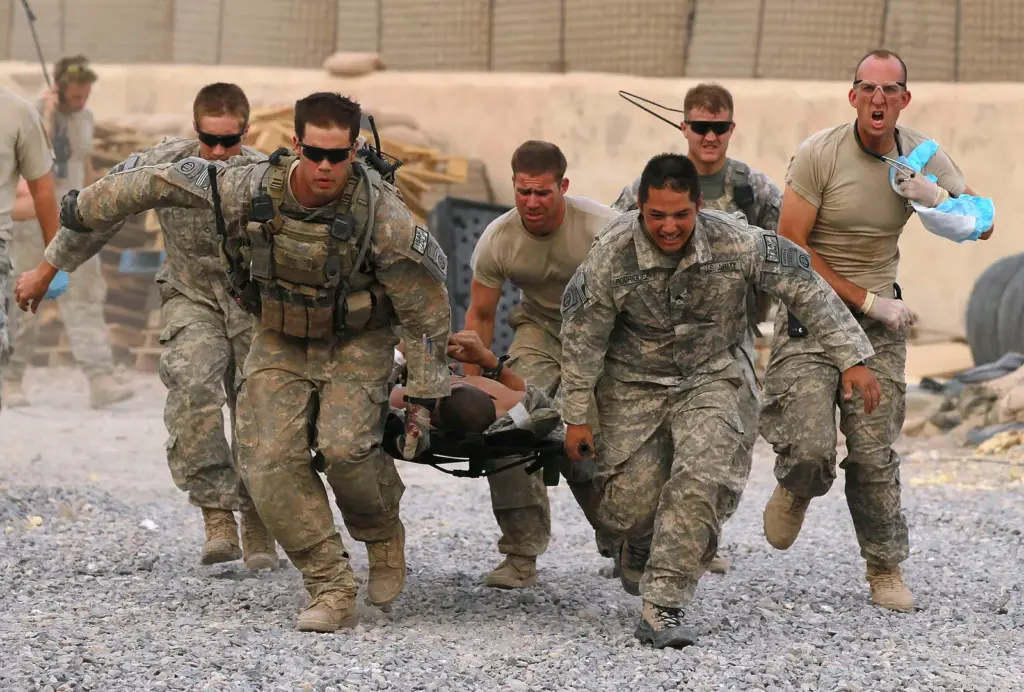
But they went. “Three hundred million people [the U.S. population then] wanted us to kill someone,” says cold-bloodedly Peter Pace, another general.
The oral history also records a conversation between Rumsfeld and General Richard Myers, of the Joint Chiefs of Staff, in which Myers reminds him how he described the possible military options: “Bomb, bomb more, and then deploy a few troops on the ground to blow something up.” To which Rumsfeld replied: “The president made it clear to us. We’re not going to just bomb a piece of sand. (…) We wouldn’t do what Clinton did: launch a couple of cruise missiles at the desert and go home and prosecute Osama bin Laden in absentia.”
The path the Bush Administration took exceeded the contours of its two terms. It was his successor, Obama, who managed to kill Bin Laden, and Biden, the president who ended twenty years of war in Afghanistan in 2021 with a chaotic troop withdrawal, six years and eight months after Obama lied declaring at the end of 2014: “Our combat mission in Afghanistan is ending, and the longest war in American history is approaching a responsible end.”
9/11 also marks the moment, according to the historian, when Bush “takes the reins” of his White House. “People usually say: ‘Oh, Cheney was the president.’ And maybe at first he had some advantage because of his experience [he was already part of the Nixon Administration], but that’s not the impression you get when talking to his collaborators. And everything changes with the attack on the Twin Towers,” warns Riley, who adds that his view of Bush changed with this project.
As part of a reevaluation of a certainly controversial legacy in light of what came after (Trump, about whom Bush maintains a stubborn silence), the historian’s book was received last weekend by The Wall Street Journal with an enthusiastic review, because it offers “an unusual perspective on one of the most misunderstood Administrations in recent history.”
Among what was not known about a day dissected by the Congressional 9/11 Commission, stories stand out like that of Dan Bartlett, presidential advisor, who recalls an employee who “was the only one who lost control aboard AF1.” “We had to keep her away from the president,” he says in his interview. A few pages later, Bartlett recounts that a doctor distributed pill bottles on the plane, since they did not know what awaited them at the White House and given the possibility of an attack with a “chemical or biological component.” The advisor was focused on writing the speech Bush would give later — in which he said: “Terrorist attacks can shake the foundations of our largest buildings, but they cannot shake the foundations of the United States” — and accidentally took the whole bottle “like an idiot.” He thought: “I just killed myself aboard AF1.” But he didn’t tell anyone.
Bush’s advisors describe an atmosphere of psychosis in the White House in the weeks following the attack, during which there was a campaign of anthrax letter mailings and a sniper in the Washington area. Eric Edelman, deputy national security advisor to the vice president, recalls “a period, between October and November 2001,” in which he “was terrified to go to work.” “We knew Al Qaeda liked to attack previous targets again. (…) There was a possibility they would try again,” he says, before warning that “in hindsight,” “it’s very easy to say all that was an overreaction and maybe it was counterproductive that we were flooded with threat reports.”
Torture and harassment
“All that” is the basis of Guantánamo, the war in Afghanistan, the invasion of Iraq, torture, harassment of Muslim communities in the United States, the founding of the Department of Homeland Security that Trump now uses to terrorize immigrants, illegal detentions, or countless judicial errors. There are not many mea culpas in the oral history of Bush’s presidency, but there are justifications like those of then British Prime Minister Tony Blair. “The most important thing to understand about President Bush,” Blair declares in his interview, “is that he was determined that this would never happen again. That was his fundamental premise: it must never happen again.”
“If we had had a good database and knew exactly what Al Qaeda was, what its capabilities were, and things like that, some of these measures [post-9/11] would not have been necessary,” excuses Robert Gates in the book, who would end up as Secretary of Defense.
Riley, the historian, believes that “most people inside the Administration felt that Afghanistan was, in Richard Haass’s words, a necessary war. That no president could have been faithful to his oath to preserve, protect, and defend the Constitution without going after Bin Laden.” A different case, he adds, is the invasion of Iraq, which features one of the most interesting parts of the book and ends with the decision to increase troops on the ground in 2006.
By then, that timid president on foreign affairs at the beginning of the story had already mutated, says Riley, into someone “aware of the weight of history,” who makes decisions “ignoring all the recommendations of his military advisors.”
From reading the testimonies of his allies, the impression remains that if that “sunny, pleasant” September 11, when the most exciting thing planned was a barbecue, was the moment when his eight years in office really began, it was mortally wounded from 2006 onward.
Two years later, Riley sat down for the first time with influential Deputy Chief of Staff Karl Rove and Mark Langdale, president of the George W. Bush Foundation, to convince them of the convenience of starting his interview project, which now serves to illuminate the “darkest day” in recent U.S. history.