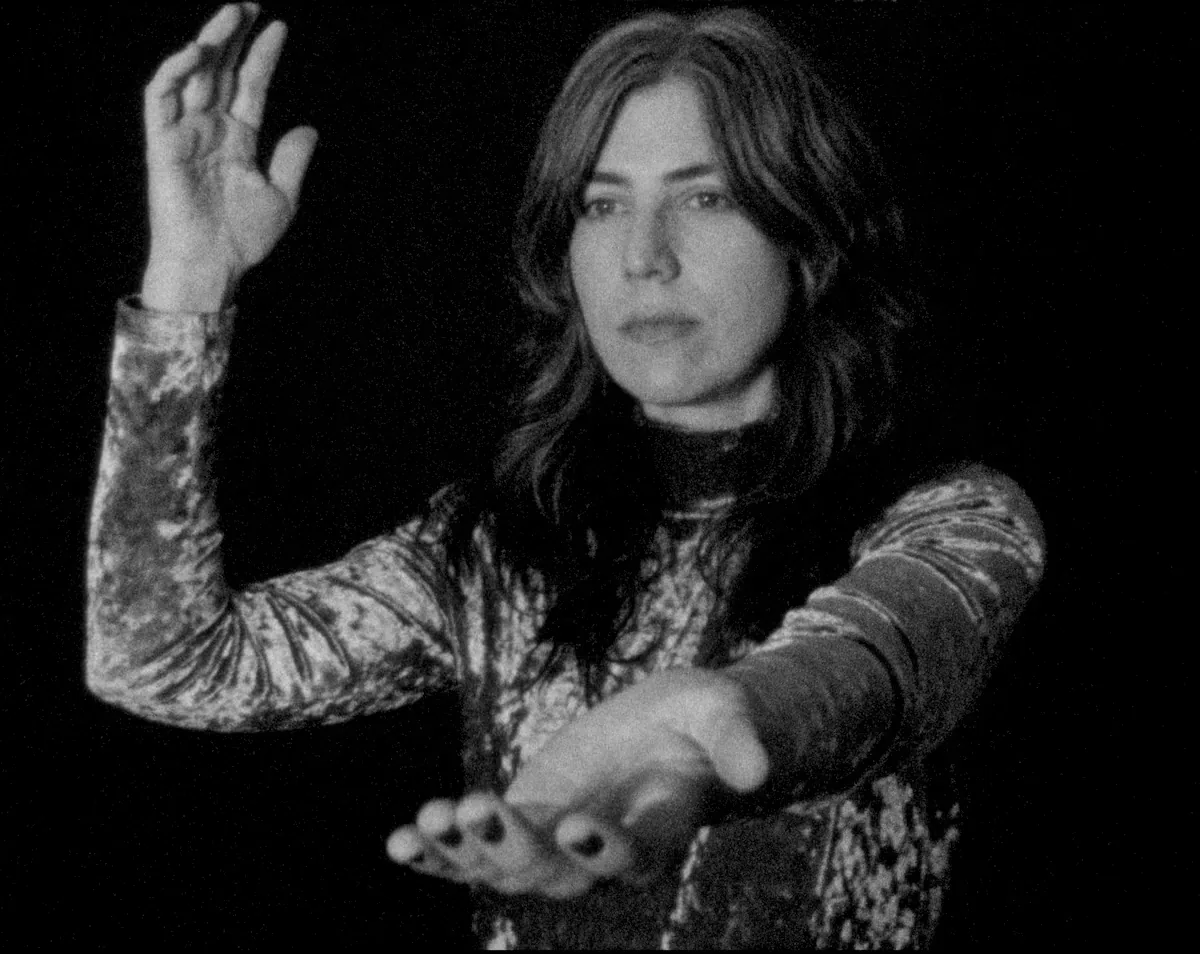
Julia Holter is a music scholar. Since her early years as a musician, her natural curiosity has continuously driven her to explore composition from different perspectives, which in turn presents her with multiple opportunities to evolve her sound, whether consciously or unconsciously. Her mission is not to write songs that get played repeatedly on the radio or reach the popularity charts, but to find new ways to express the emotions that float inside her through sound.
The most recent example of this is the album she released this year, titled Materia. The work is not just a new record or a fresh collection of songs that encapsulate a new era in the composer’s career. It is, instead, an extension of the era she began in 2024 with her album Something in the Room She Moves, considered by experts as her best work to date.
Through a call from Los Angeles, California, the singer explains to EL PAÍS that her need to explore the song Materia from Something in the Room She Moves was what motivated this project. “When I wrote it, I had imagined it with a band or other instruments, but I ended up using a minimalist and stripped-down version. I wanted to show that song in a new light on this record,” she states. The result is two “sequels” to the track, accompanied by other songs that were born during the tour of the album released in 2024.
Another factor that possibly influences her constant musical exploration is that Holter has also ventured into teaching, a profession she had in mind since she was a teenager. She is part of a rotating group of composers who teach at Occidental College in California, and has occasionally taught an annual composition class. She also teaches at CalArts, where she graduated. “I really enjoy working with students one-on-one and chatting with them about art; it’s a wonderful activity,” she explains.
In our conversation, Holter explains more about her relationship with teaching, how it influences her learning of music, and how in Materia one can discover her current vision of love and what happens around her.
Question: How do you continue learning about music and how does that practice translate into new compositions?
Answer: I wish I knew. I feel like I need to do it more. I suppose with each record there are a bunch of new things I’m listening to, or maybe they’re not entirely new, but they inspire me in a different way. I also feel that playing with other people helps me learn new things about music, just like teaching: working with students, seeing what they’re doing, and accompanying them in the creative processes of their projects sometimes helps me reflect on what I do myself. These are factors that, like for any artist, affect my work and transform what I do. I try to come up with ways to change my musical habits, learn new things, and open new neural pathways toward creation and life in general. I don’t always succeed, but I try.
Q: At what point in the creative process do you realize that an idea is good and that a special song can emerge?
A: What usually happens to me is that I have a kind of sensory response to something that is working. It’s not a visual hallucination, but an image of something comes to mind, like a vision, so to speak. It’s not religious, supernatural, or psychedelic — well, maybe a little psychedelic, but without hallucinating — but a mental image presents itself when something works. I have a sensory response, and I think I follow that impulse from my brain, whether it’s a photo, a color, or a shape that I manage to see.
It happened to me with the song Fantasy from the new album Materia, which I struggled with a lot and suddenly came to life. Sometimes it’s something timbral, there’s something in the sound that just works, even if it’s hard to explain why in most cases. It’s a very specific experience of mine, but I bet other people experience it too, like a sensory experience.
Q: Something in the Room She Moves received impressive critical acclaim, and some have called it her most important work to date. How does that project make you feel now? Is there any album you consider the most important to you?
A: I don’t know, they’re all in my heart. Aviary was an obvious labor of love for me; I felt it was the culmination of many things that had interested me over a long period of time. So I always feel that album was very important. But they all have elements of that in different ways. Tragedy was also important at a very different moment in my life. And both Something in the Room She Moves and Materia represent a new stage, a new world in my way of understanding love and the deep love we humans experience.
Read more Why Polo? Poloboya
I feel it reflects a more dimensional quality of love. Many of my previous albums were perhaps more in the realm of ethereal longing for love, while these last two albums explore loss in love, long-term love, and that intense affection where we deal with life and death. Materia takes its name from the root of the word related to the “earth mother”: it’s something heavy, real-life things. It’s the real ground of love, our bodies, and what we really have to deal with, the visceral issues. Maybe my other albums were a bit more dreamlike and ethereal, and this one explores the very presence of love.
Q: A few years ago you gave birth to your first child and are building a family dynamic, does that make you see love that way?
A: Yes, definitely. It’s the love as a mother, as a partner of someone for more than ten years, the love of friends I’ve had for twenty years or more, family love, love for my parents, being an aunt, being a sister… And also the fact of experiencing death in the family and all those things everyone has to go through. Without a doubt, that feeds my music.
Q: How did the idea of making Materia, a companion album to Something in the Room, come about and what drove you to explore that album more deeply?
A: It wasn’t something I had originally planned. I wanted to explore more because the band was very tight and sounding great, and I felt we could play another song. So I wrote Laugh is in the Eyes, and then I thought of another one. We recorded the songs in a day or two, I don’t quite remember. In the end, I dedicated more than a year to it and it became Materia.
I had an interest in exploring the song Materia in a new way. When I originally wrote it, I had imagined it with a band or other instruments, but I ended up using a minimalist and stripped-down version for Something in the Room She Moves. I wanted to show that song in a new light on this record.
Q: Would you say this work functions as an epilogue?
A: I think of it as a sister to Something in the Room She Moves. I consider it comes from a similar place and then takes new directions. What makes Materia special is its spirit, which feels very free and playful. All the performances on the album were done quite quickly; they’re not recordings where I had a lot of time to do tons of takes. It’s very produced, but the performances are very fresh, the emotions are raw, and they don’t feel overdone. I think that’s its great special quality.
Q: Does the current situation in your country affect your art at this moment? Are there things that worry you now that didn’t seem as relevant before?
A: Definitely. I’ve never been very good at addressing political issues explicitly in my work, because I feel politics is always there in the background. I know some people think that’s an excuse, but for me the personal and the political are intrinsically linked in the work.
Still, a song like My Twin on this new album reflects how deeply disturbed I am by my country’s involvement in Gaza, dropping bombs on people mercilessly and coordinating this — obviously along with Israel — being the supplier of all these weapons. This genocide has weighed heavily on me, as on many people here, probably most. Also, there are the immigration raids in the United States, which have been horrible and constant. The total lack of humanity on the part of our government is fascist and deeply disturbing. I don’t quite know how all that filters into my music, aside from trying to be an active citizen and get involved in whatever can be done to stop fascism. But aside from that, I make my music. I think it can be perceived in My Twin: it’s a reflection on why I am here and not in Gaza, why I had the privilege of not having bombs fall on me. It can also be interpreted as the fear of being separated from my parents as a child, being alone in a courtroom and being deported to a country I’ve never been to: “It could be me.” It’s a feeling many people have right now.
Read more Barcelona will subsidize up to 600 euros for the change from gasoline moped to electric