









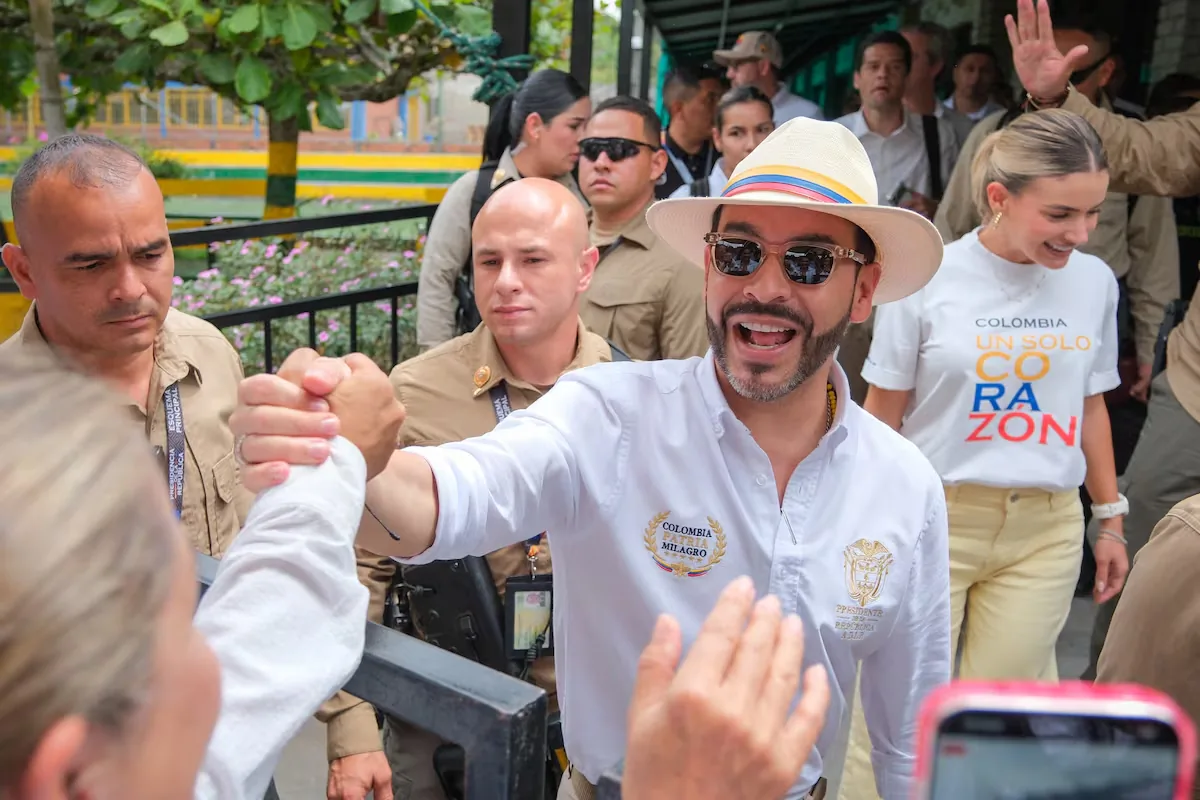
Whether in Barranquilla or Bogotá, the scene is similar since Abelardo de la Espriella began a series of weekly addresses on social media, even before taking office as president of Colombia: an office with an indispensable yellow, blue, and red flag. On some occasions, he speaks directly to the camera from a desk, with a library in the background; on others, he does so standing while reviewing some papers. The president of Colombia has staged his promised return to a tough security stance with the signing of decrees, extraditions, and even the resolutions with which he promoted this week the end of the talks of the “so-called total peace.” He appears comfortable and confident making these announcements, with no one to challenge him. He has also addressed the country on numerous occasions during his travels, from a podium in some of the regions where he has proposed to focus his government. Even when the press is convened, the Executive’s statements, which this week surpassed its first month, usually do not allow questions from journalists.
Read more César Rodríguez Garavito: “An AI with rights can lead to catastrophic results”
De la Espriella seeks to maintain almost absolute control over government communications, as he did in the campaign that brought him to power. Even before taking office on August 7, he ordered his ministers not to give interviews, an instruction that has been followed with few exceptions. A directive from the Presidency states that officials must ask for permission before speaking publicly, without press conferences, unless it is for a strategic and previously authorized topic. Internally, there was even talk of favoring “friendly media.” This strict control of messages, which already prevents Ministries from answering the simplest questions from journalists, reached this week the National Administrative Department of Statistics, DANE, in an even more problematic episode.
DANE, headed by Ricardo Valencia, canceled on Monday, at the last minute, the usual monthly press conference on inflation results. Although it published the data on time and accompanied it with an explanatory video, there was no presentation. The last-minute cancellation occurred under direct instructions from the Presidency, as it went against the famous directive, according to La Silla Vacía. But DANE, unlike other entities, has “technical and professional independence” from the Executive, according to the statistics law, which establishes that it is autonomous in how it delivers information.
“Producers of official statistics will decide, independently and free from any kind of political pressure or interference from other external instances, on the preparation, production, and dissemination of statistics, including the selection of data sources, concepts, definitions, classifications, and methods to be used, as well as the scheduling and content of all forms of dissemination,” states this law, as observers from various perspectives have recalled.
Several former directors of DANE, under different right-wing and left-wing governments, were the first to point this out. “During the last two administrations, press conferences always existed, with the technology of the time,” recalled on her social networks Piedad Urdinola, who led the entity during the leftist Gustavo Petro’s term and is one of the very few officials who remained throughout the four-year period. She warned that the current Presidency is treating DANE as if it were just another ministry, “and that is serious in terms of independence and abandoning much of the statistical culture.”
“During my tenure, press conferences were a technical decision to explain the figures and answer questions,” responded Juan Daniel Oviedo, head of the statistical entity during the conservative Iván Duque’s period (2018-2022). The law does not require holding these meetings, he added, but it does prevent the Presidency from deciding the forms of dissemination. “DANE has a special regime in which it is the director on duty who defines how official statistics are disseminated,” he told Caracol Radio.
Read more Low financial literacy in Colombia, a barrier to boosting personal finance with AI
César Caballero, who led the entity during Álvaro Uribe’s government (2002-2010), also lamented the episode. “One of the functions of the DANE director is to communicate and explain statistics. The void they are going to create will have negative repercussions not only on the strategic communication of the entity but also on the statistical culture and the credibility of the figures,” said the current manager of the firm Cifras y Conceptos. “DANE’s statistics do not belong to the president, nor the government, nor the state. They belong to all Colombian society. We have the right to have them disseminated and explained with transparency and rigor,” he emphasized.
Beyond the particularities of that entity, the uproar illustrates the excessive zeal in officials’ statements. Journalists have encountered the impossibility of follow-up questions, verification, validation, or expanding information, as Ana María Cuesta from Cambio publicly questioned this Thursday. In this tense environment, recent dismissals of critical journalists and cartoonists fuel suspicions. The government intended to inaugurate the figure of a couple of presidential spokespeople, similar to what happens with the White House in the United States. Very soon, the controversial appointment of Carolina Gómez fell through, leaving Miller Soto alone in that role.
Already in office, with up to three daily interventions, Soto has limited himself to recording videos produced under the label “the Government speaks to the nation.” Unlike the United States, he has not convened journalists nor answered questions. One of those videos, on Wednesday, was precisely dedicated to defending the presidential directive. “The purpose is simple; that official information reaches Colombians in an orderly, clear, verifiable, and coherent manner. Because people have the right to know, without ambiguities, what the official version is,” Soto says in the video. “Officials may continue granting interviews, making statements, and participating in the media, but within institutional communication coordinated with the secretary for communications and press,” he maintains.
Alarms have not taken long to activate. The Foundation for Press Freedom, Flip, has urged the government and President De la Espriella himself to translate their public commitment to press freedom into real and verifiable guarantees. “The government must refrain from any direct or indirect pressure that seeks to condition editorial decisions or exclude from public debate those who question its management, practices that may constitute indirect censorship,” it warned this week in a statement. It also urges the government to “eliminate the use of discretionary filters in access to public information,” and points out that the mentioned presidential directive “must be applied with objective, transparent, and non-discriminatory criteria. Coordination and unification of spokespeople cannot become a criterion for authorization.”
Read more The “useless and untimely” trip of Jorge Romero to Europe: “We told him not to go”