









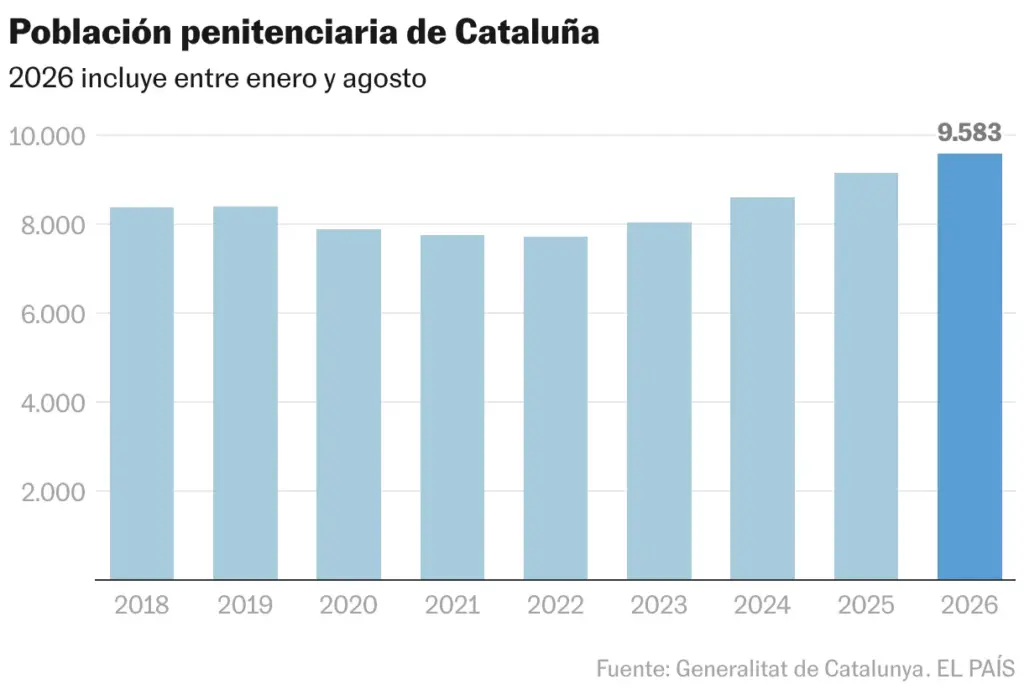
The statistics prepared by the Department of Justice of Catalonia are very clear. The 13 Catalan penitentiary centers have a capacity for 10,014 people and already house 9,583 inmates. The margin is increasingly narrow and the growth of that population shows no signs of stopping: it has been growing since 2022 and the shock plan against multiple recidivism initiated in 2024 has intensified it even more: in Barcelona alone, convictions have increased by 40%.
Read more ‘El Pulso’ de ‘Hoy por Hoy’ live, in EL PAÍS
Last autumn, the Govern announced that it planned to gain 256 new places in 2028 at the Mas d’Enric prison (in El Catllar, Tarragona) with the construction of prefabricated modules, a new formula that allows capacity to be increased much faster, without modifying complex urban planning, endless construction projects, and large investments. This will not be the only step taken in this direction: their plans include the creation of between 600 and 700 express places of this type (including those in Tarragona) in other centers where space is available, although they still avoid announcing where they will be built.
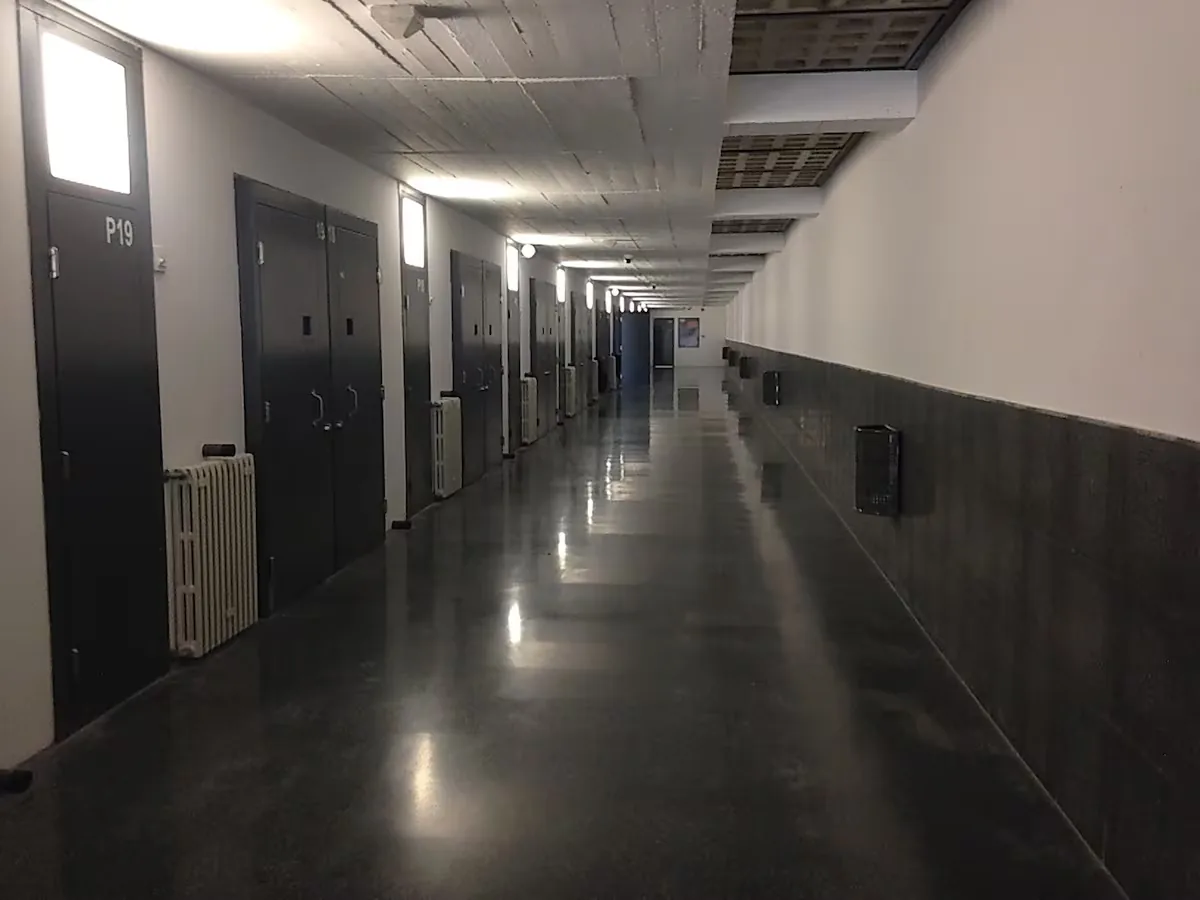
Sources from the conselleria led by Ramon Espadaler consider that the expansion of Mas d’Enric will absorb this “first wave,” but that other avenues to reduce the existing pressure in prisons, as denounced by prison officers, cannot be neglected. The ultimate goal is to avoid “the saturation point” that is close to being reached after the increase of 1,900 inmates in the last four years and to guarantee decent living conditions inside the prisons. That last factor, how inmates spend their day-to-day life, is a debate with many facets that will reach the Parliament starting October 18, when a commission with different speakers will begin working to analyze it.
Deputies will have to address thorny issues such as the use of mechanical restraint measures, the health and welfare of inmates, suicides, and initiatives for prisoner rehabilitation. This working group comes after a letter that various humanitarian entities wrote to Pope Leo XIV in which they specifically denounced the Catalan penitentiary system during his stop at the Brians 1 center during his visit to Spain last June. Experts and prison officers consider that a more spacious infrastructure, with lower population density, can help improve that habitability.
In addition to those prefabricated modules that would increase capacity over the next two years, the Generalitat has two new facilities in the pipeline. One is the open center in the Zona Franca, planned for this year. The other, a women’s prison in the same area, is initially scheduled for 2029. Sources in the penitentiary field warn that the Zona Franca facilities will allow for 800 more places (initially half), but they are mainly intended to house men who currently benefit from the third degree and occupy space in the Trinitat centers, which is slated for closure, and the Wad-ras women’s prison.
Read more The teacher who made Ibero-America and Europe a common home
In any case, for now, this capacity increase coincides with a political shift started years ago aimed at achieving more inmates in semi-liberty, the so-called third degree, which specialists consider the best way to avoid recidivism. This goal was joined by the retirement of the Modelo prison in Barcelona in 2017, with facilities that, after 113 years of history, did not meet the expected conditions in the 21st century. If in 2016 there were 12,376 places throughout Catalonia, now they stand at 10,000 and the trend of reducing the number of inmates has changed to express a continuous increase without pause.
The shock plan against multiple recidivism, which is played out on two different fields — on the street with intensified police action and in the courts, with reinforced resources to speed up trials for minor offenses — adds an element of uncertainty to prison management. The good results that politicians claim it is producing also force dealing with a larger and more fluctuating number of preventive inmates (those awaiting trial or sentencing) pending confirmation of the deterrent effects sought by the reinforced tasks imposed by the Administration, which has managed to unite the Generalitat and the Ministry of Justice.
A conditioned capacity
All this is added to the fact that the 95% occupancy rate reached by Catalan prisons must be taken with some caution. The reality is not that there is still a 5% margin to grow, since the management of entries and exits, the need to make improvements in some cells, or the requirement of certain inmates who need to be alone causes the occupancy percentage not to be the ideal one shown by the statistics. And there is an order that conseller Espadaler has set as a red line: no cell can be occupied by more than two inmates.
It is unknown whether the plans to expand the Tarragona prison in 2028 will come to fruition in form and time. For now, the Department of Justice is still negotiating with the company in charge of constructing the prefabricated modules that have to help contain the growth of inmates.
Read more An Israeli NGO denounces the «elimination project» in the West Bank