









Two managers at one of Madrid’s major public hospitals, Ramón y Cajal, ordered the severity of patients awaiting surgery to be downgraded in order to artificially improve the situation of their waiting lists, according to internal documents accessed by EL PAÍS. The changes were made in the computer system, without personally assessing those patients and behind the backs of the trauma surgeons who had determined the severity of those cases, according to four affected doctors. The reason was to meet the productivity targets required by the regional Health Department, as inferred from the explanation given by one of those managers in an email to an outraged doctor. The hospital denies having committed any irregularity.
Read more In white and with a black backpack: in search of the alleged killer of Claudia Tacoronte in Mexico
Madrid breaks its record for patients awaiting surgery with 114,627 on the waiting list: “I couldn’t take it anymore, I went private and paid 9,000 euros”
The events occurred between February 28 and March 14 of last year, when 57 patients on the surgical waiting list of the Orthopedic Surgery and Traumatology service at Ramón y Cajal were moved from preferential priority (those who must be operated on within 90 days) to normal priority (operation within 180 days). In this way, the managers gained time to achieve the expected result: that patients were operated on within the deadline.
EL PAÍS has accessed documents and emails showing that the alteration was ordered by these two managers and has spoken with four doctors from the service who say they were not consulted. The surgeon who provided this evidence, Luis Alberto Martos, reported what happened to management without receiving a response. Weeks later, the hospital opened disciplinary proceedings against him.
Manipulation of waiting lists is a widespread suspicion in Spanish healthcare because there are electoral incentives (administrations publish this metric monthly online) and also economic incentives (doctors with responsibilities receive productivity bonuses if they meet targets). In Madrid, the case that in 2005 led the region to be expelled for 10 years from the national system for counting surgical waiting lists is well known, when it was discovered that the delay for an operation was counted from the anesthetist visit, instead of the earlier moment when the doctor prescribes the operation. In other words, the timer was started later than it should have been to improve the figures.
On that occasion, the alteration was purely cosmetic, but these changes at Ramón y Cajal negatively affected patients, according to the surgeons, because their severity was falsely downgraded, increasing the wait they had to endure. This is because the decision of who goes to the operating room is not made on a first-come, first-served basis, but by the priority (urgency) of the case.
Martos is a veteran surgeon, 62 years old, at this hospital in the north of the capital on which 600,128 Madrilenians depend. He was outraged when he discovered that the priority of his patients had been changed, after learning about it through a colleague. He suspects that these changes had been made before without anyone noticing, but in this case the alteration affected dozens of patients and there were traces. In the internal documents seen by EL PAÍS, under the section “Observations” the notes of the changes can be read with messages such as “priority change p.i. (by indication) Dr. De la Torre” or “priority change p.o. (by order) from trah (traumatology) and medical direction.” These were the head of that service, Basilio José de la Torre Escuredo, and the hospital’s medical director, Rafael Martínez Fernández.
The doctor who raised the alarm detected on March 14, 2025, the change in the case of a three-year-old girl because she was a patient who concerned her. The red circle (urgent priority) on her file had changed to green (normal). She checked that no one had informed the child’s parents.
“There were medical criteria to operate on her with priority, with high priority,” the doctor comments. “I couldn’t believe it. How had they done it without considering my opinion? It seems indecent to me,” adds this woman, who, like other colleagues, has requested to remain anonymous.

She says she checked in the internal documents that the changes affected patients of 17 doctors. She spoke with most of them and all replied that they had not been informed. She also found out that the modifications had started 15 days earlier, on February 28. Almost all the patients had something in common. Their delay ranged between 80 and 140 days. Those cases previously “priority” and now “normal” no longer failed to meet the goal of being operated on within 90 days.
The doctors explain that these modifications can go unnoticed due to the high workload that makes them live focused on the next patient waiting. Sometimes, they are not the ones who schedule the operations, but the unit heads, who are at an intermediate level, below the head of service.
The doctor sent an email to the head of the service, Escuredo. “Could you explain the reasons that justify it, without consulting the surgeon’s criteria?” she wrote on March 14. The head admitted those alterations and implied that the reason was the efficiency goal agreed with the Health Department: “If they are not operated on within that period, management receives notification from the Department to have them operated on as soon as possible,” he replied in writing. “Keep in mind that the commitment the hospital makes with them is to be operated on within 90 days.”
The head added that he had met with “management and the admissions service” to resolve how preferential patients should be treated and told the doctor: “Avoid as much as possible marking them as preferential, and if you agree with the patient on an approximate date to be operated on and the preoperative study is requested as preferential.” In other words, they could operate on them whenever they wanted, but deceiving the system about the type of priority.
This doctor says she ignored the head and correctly indicated that the girl’s operation was urgent. She operated on her as soon as she got a slot in the operating room. She was a patient with such a sensitive case that she had consulted doctors from the United States: “This girl couldn’t wait because she could lose a leg,” she responds. “All patients were treated as numbers.”
Others were patients who “twisted in pain,” says Martos. The documents show diagnoses such as spinal abnormalities, carpal tunnel syndrome, or dislocation (displacement of the two bones of a joint).
Another doctor says that one of her patients found out about the change because the administrative staff called her by phone to tell her that her case was not preferential. “I invited her to file a complaint, if I mark ‘priority’ it is for a reason. She was in a lot of pain, it was a matter of time before she suffered irreversible joint damage, she couldn’t wait any longer,” she indicates. She managed to find her a slot in the operating room thanks to another patient rejecting surgery, but she acknowledges that not all affected were so lucky. She suspects, like other consulted colleagues, that many did not find out about the priority change. “The serious thing is that the medical criteria were not maintained,” she expresses.
Another surgeon also states that some of his patients suffered this change without his authorization. “I thought it was terrible, no one asked me, I don’t know if whoever did it followed clinical criteria. It was the only time something like this happened to me,” he comments.
Read more Are we all going to die or is it just theater? Arguments against the AI apocalypse
Being listed as a normal patient can mean waits of up to nine months. Those affected could see the change in their citizen folder or mobile app, but according to these doctors, many patients are elderly with degenerative pathology due to age and are people who struggle with technology. Only one or two called to complain.
Disciplinary proceedings
Martos had ongoing conflicts with his boss, who years earlier had sued him, according to him, “for defamatory purposes” with two criminal actions and disciplinary proceedings that, he claims, ended in nothing. When he learned what happened with the waiting list, he flew into a rage. In an email on March 21, he addressed the medical director in an accusatory tone: “This is executed by order of Medical Management (you) and the head of service,” he told him. “Since there is no medical criterion that justifies it, it can only respond to political and economic criteria for the benefit of the members of this Medical Management (you) and their necessary collaborators.” He says he received no response.
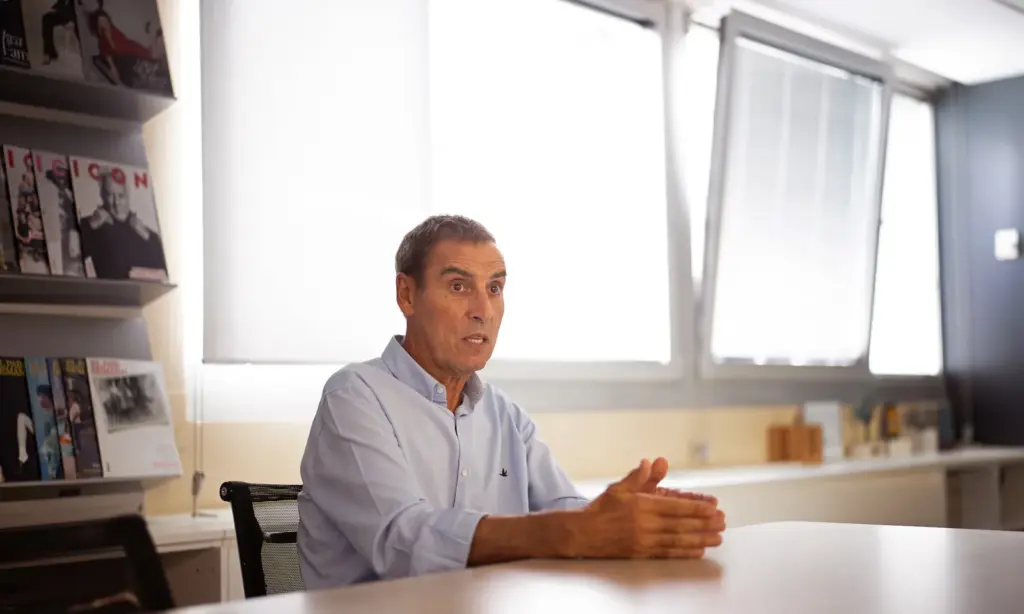
On April 7, he sent a letter to the hospital manager, Carlos Mingo, denouncing what, according to him, he considered an illegality and warned that he expected those managers to be sanctioned. “Otherwise, I will think that you also participate in this fraud, by action or omission, and other lines of complaint will have to be explored.” The doctor responsible for the three-year-old patient also requested an urgent investigation from the manager by email due to a possible illegality.
The regulation governing the management of the waiting list is an order from the Health Department of 2016 according to which surgeons “are responsible for the indication and establishment of the clinical priority” of patients. However, the hospital manager assured the doctor in his response that the management of the list falls to a variety of professionals and bodies. He also tried to close the matter by saying that the incident had been resolved (because the girl had been allowed to be operated on at the date she considered appropriate). After highlighting this, the manager celebrated that “the service is capable of ordering and reorganizing itself for better patient care even in difficult situations.”
He replied more briefly to surgeon Martos, referring him to his section head and head of service to clarify the criteria on the waiting list. But in parallel, another episode had begun that the doctor describes as an “unnatural accusation” against him. The two managers involved requested the manager to open proceedings for “internal conflicts and harassment” which is still ongoing. The instructor has summoned him to attend the statement of his boss, De la Torre, this Wednesday: “They say that I, a subordinate, harass my superiors,” the surgeon says incredulously, who has sought legal defense from Madrid’s largest medical union, Amyts.
The surgeon who operated on the girl reported the facts to the ethics committee of the Medical Association in February this year, a body that responds to this newspaper that it cannot comment while the incident is being investigated due to a duty of confidentiality.
Salary bonus
EL PAÍS has made several attempts to interview the two managers involved. Instead, a hospital spokesperson responded in writing emphasizing the center’s commitment to the proper management of the waiting list, patient care, and compliance with regulations. They added that the management of the list corresponds to each care service according to clinical criteria and the responsibility of the doctors who see those patients. “Neither Medical Management nor the Management directly manage or modify the surgical waiting lists of the services,” they assure. “Therefore, it is not appropriate to attribute to these bodies the making of individual alterations in patients’ medical records.”
Good management of the list influences the productivity bonus of heads of service and members of their teams, according to the Ramón y Cajal 2025 program contract, the document by which the hospital manager and his superiors in the Madrid Health Service set objectives for efficient management. Indicator 28 (out of a total of 63) rewards or penalizes depending on whether there are patients who have exceeded the intervention deadline (90 or 180 days). The productivity bonus of a head of service is around 3,579 euros.
Apparently, these changes did not alter the data that citizens can consult on the Community’s website where the total number of patients on the list and their distribution in five delay ranges (0-30 days, 30-60, 60-90, 90-180, and more than 180) are reported, but it does not detail how many have exceeded the intervention deadline, that is, whether they meet or fail the productivity goal.
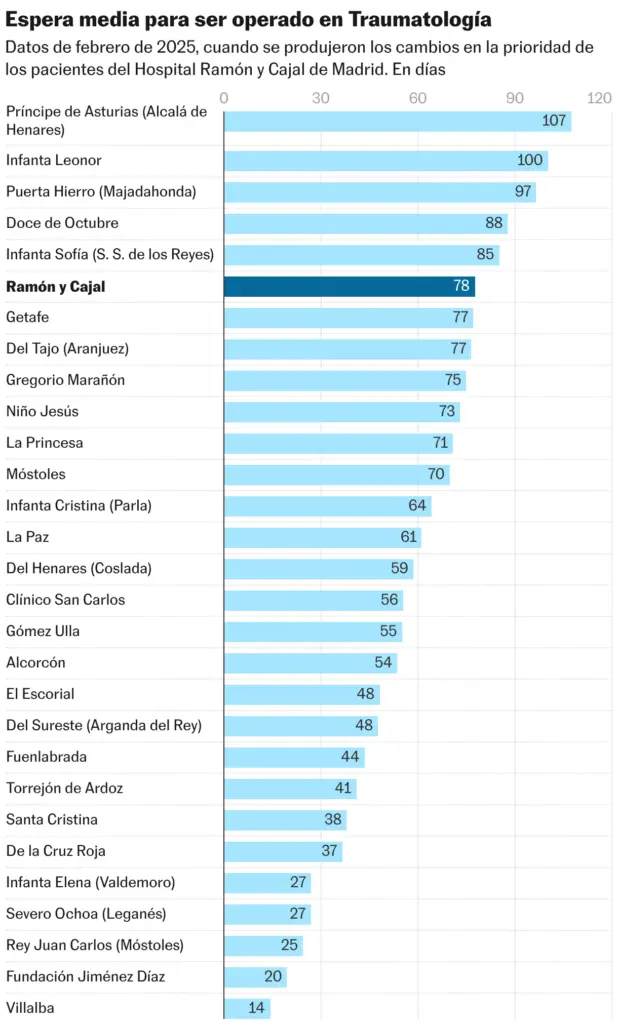
That list shows that traumatology at Ramón y Cajal was in February 2025 one of the worst services of its kind in Madrid. It ranked 23rd out of 28 with an average wait of 77.5 days. Today it is even worse: it has grown to 98.6 days.
Manipulation of lists by various methods is seen as a common problem in Spanish public healthcare. The president of hospital care at Amyts, Javier Ortega, considers that what comes to light is only “the tip of the iceberg.” “Many doctors tend to look the other way when they know about manipulation,” he criticizes. “But you don’t play with the sick.”
Professor José Manuel Freire of the National School of Health-Carlos III Health Institute says that hospital managers have no incentive to pursue these cases and regrets that to know about them an exceptional doctor is needed, “a hero or a martyr.”
Martos has become a pariah. Many colleagues have stopped talking to him. When he operates, silence reigns, despite the fact that operating rooms are relaxed environments. This draws the attention of visitors. “They think we are very diligent,” he says with a smile. On his WhatsApp he has put the following message: “Loneliness is the price of truth.”

Do you have something to tell? Write to the authors at scastrog@elpais.es and fpeinado@elpais.es
Read more The Electoral Board dividedly complies with the Supreme Court’s ruling on the ‘grandchildren law’