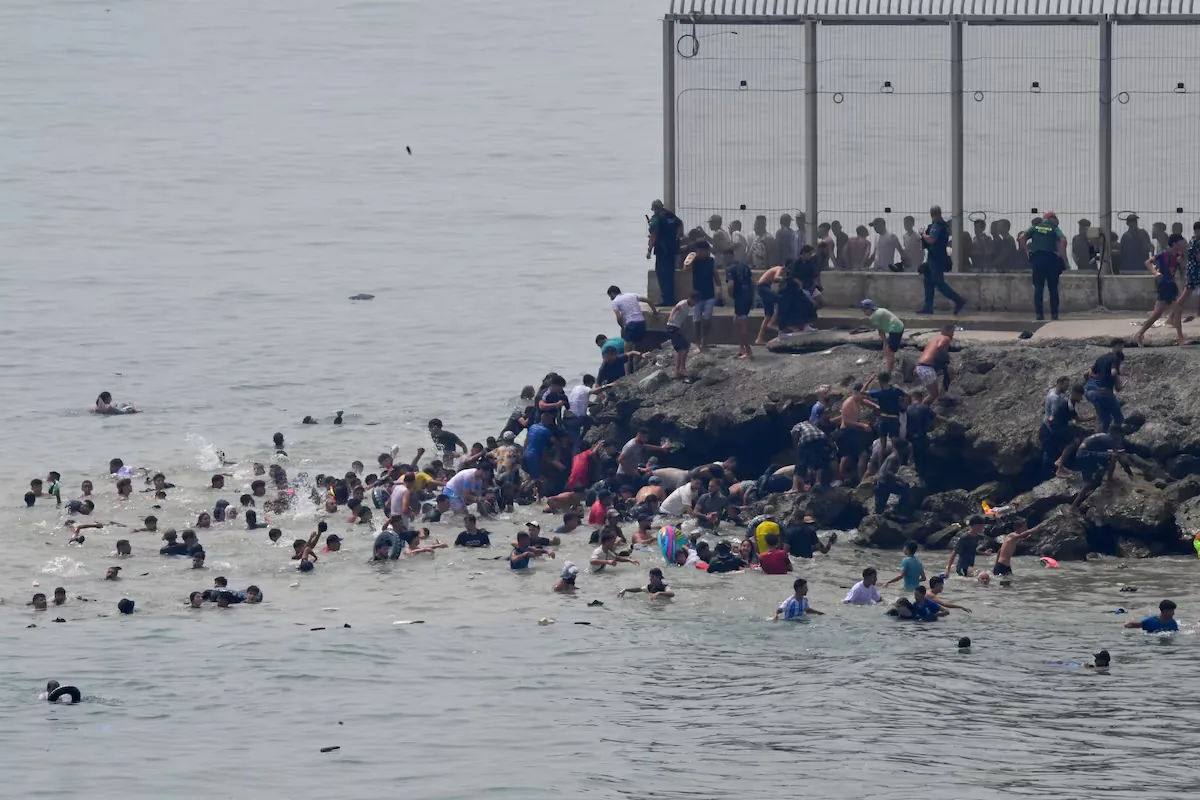










The tone of Juan Jesús Vivas’ interview on El Hormiguero was previewed by its host, Pablo Motos, from the very first minute of the program: “In a moment, the president of Ceuta, Juan Vivas, will be with us, and afterwards we will have laughs with Leo Harlem.” The president of Ceuta once again wielded a harshness on Monday that the public had been little accustomed to until the massive entry on July 31 of more than 70,000 people into the autonomous city. In his interview on the Antena 3 program, which lasted nearly an hour and was followed live by hundreds of his neighbors in Ceuta’s Plaza de los Reyes, Vivas once again pointed to Morocco as the main responsible party for the situation Ceuta is suffering, which “is not a migratory crisis,” but a “full-scale invasion: by its scale, by the method, and by the actor.”
The president of Ceuta, who in recent days has placed himself at the forefront politically and in the media, has insisted repeatedly on the active responsibility of the neighboring country in the crisis the autonomous city is going through: “It is the use of the population and their desire to leave the country to use them as an instrument for political purposes,” he summarized. Vivas emphasized the need to reconfigure the relationship with Rabat, which “has always tried to make things difficult for Ceuta and Melilla.” “Morocco is not a reliable country and it is evident,” he stated before casting doubt on whether the African country is prepared to organize a World Cup.

The other cornerstone around which the discourse upheld by the popular leader revolved throughout the conversation with Motos was the incompetence of the central government. Vivas stressed that from the autonomous city they could not foresee the magnitude of what was going to happen, but that in the days prior they warned La Moncloa about an increase in attempts to enter by swimming and that the Executive turned a deaf ear. He called on the Government to start building infrastructure that would prevent the border from being controlled by the neighboring country.
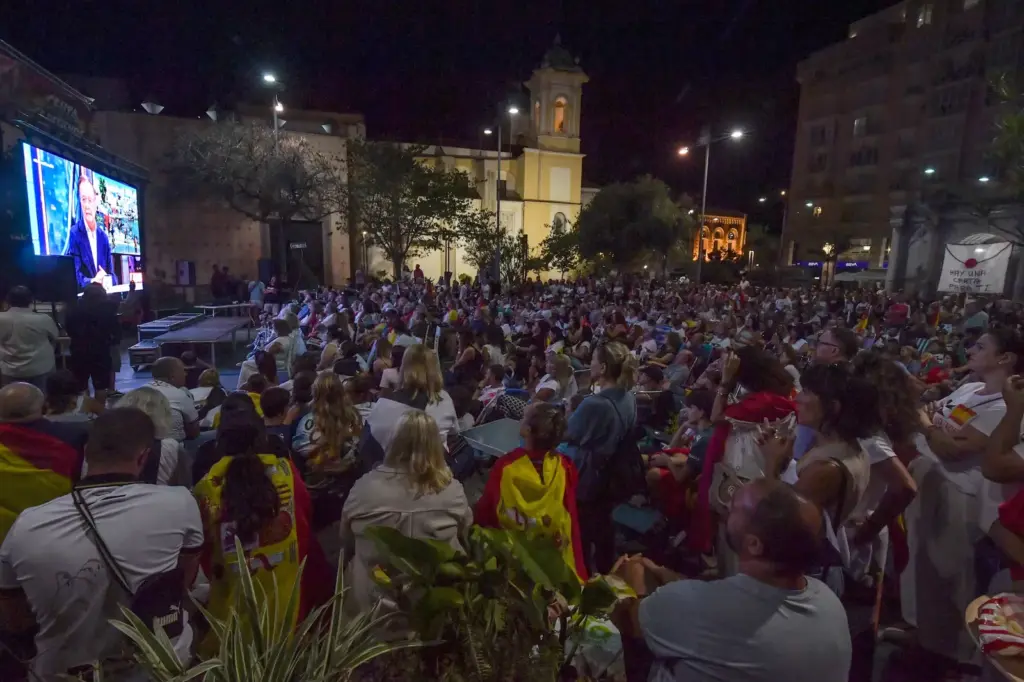
More than 500 kilometers from the set where its president was speaking, and with a strait in between, hundreds of his constituents listened in the central Plaza de los Reyes, where several businessmen funded the installation of a giant television screen to follow the interview. Many brought their own chairs and were dressed with Ceuta and Spanish flags. Before the program began, they held a minute of silence for “the victims who died in Tarajal” because “they were sent deceived” and deserved “the respect that Sánchez’s Government has not given them.”
Closer by was the president of the Government, who on Monday at the same time gave another interview on La Sexta’s program El Intermedio. Vivas was especially harsh with Sánchez: “The precedents disqualify the possibility that I trust Pedro Sánchez to defend Ceuta and Spain,” he stated. That said, in a show of the moderate tone he has been associated with since the migratory crisis of 2021, and although Motos tried, Vivas did not want to speculate about a possible blackmail by the neighboring country of the president of the Government, Pedro Sánchez, after his phone was infected with the Pegasus spyware.
Read more In white and with a black backpack: in search of the alleged killer of Claudia Tacoronte in Mexico
However, he did not lack words for the Minister of the Interior, Fernando Grande-Marlaska, who, he said, promised to stay in the city until the crisis was resolved, but left a few hours later, when most of those who entered returned to Morocco. In this regard, the president of Ceuta pointed out that the initial figures of those who had stayed, which the Executive estimated at about 2,500, are far from reality, and stated that up to 10,000 people remain in Ceuta.
Regarding these, the president of the autonomous city demanded that all necessary measures be implemented for their immediate expulsion, which is possible, according to him, under the European migration pact, since Morocco is considered a safe country from which it is difficult to request asylum. He did acknowledge that an appeal by the applicants could complicate the process, but, with one of the few smiles he allowed himself during the interview, he stated: “I know that the National Court is willing to expedite these procedures.”
Juan Jesús Vivas ended the interview with an almost poetic plea for the land where he was born and now presides, and with a call for solidarity with Ceuta: “The cry of that land, the cry of long live Ceuta will continue to sound in the soul of our people like a strong echo of a long live Spain.” “This program has to serve to appeal to consciences, including that of the Government,” he had said shortly before. Only in the last seconds of his interview did the ant puppets that entertain El Hormiguero appear. Then came the laughs with Leo Harlem.
Read more Are we all going to die or is it just theater? Arguments against the AI apocalypse