









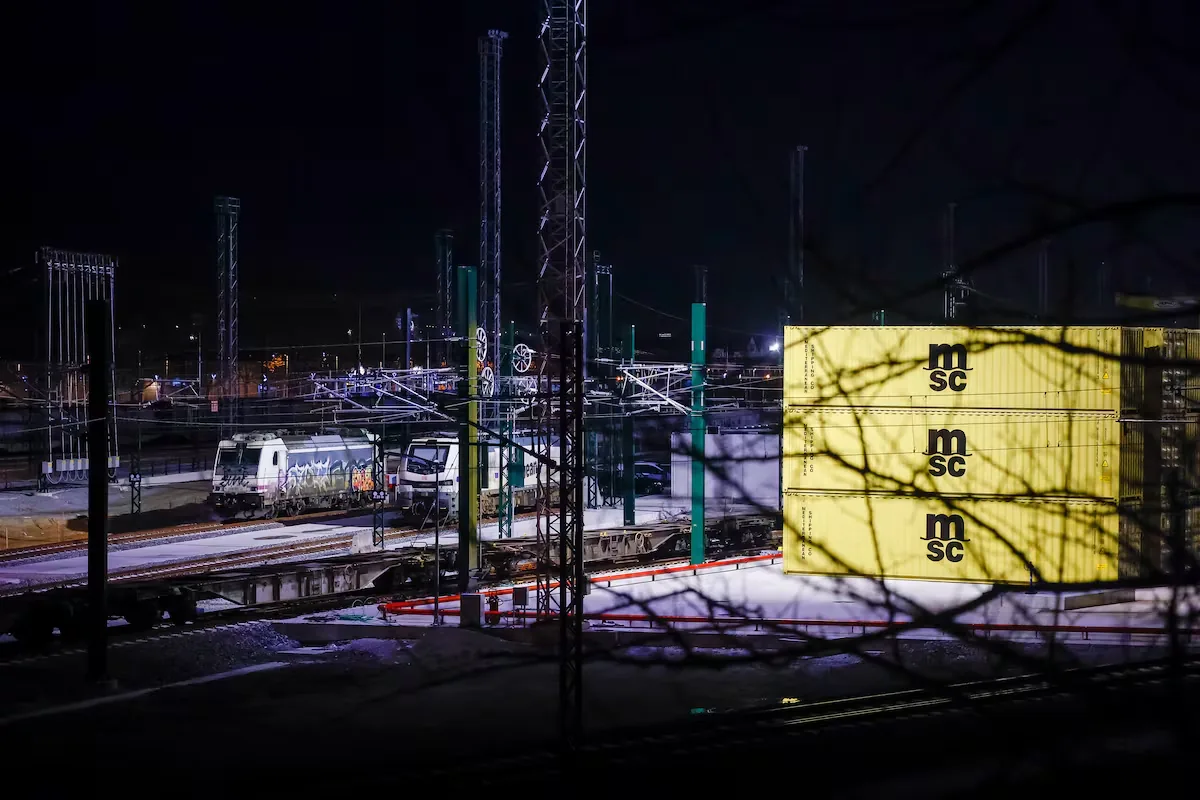
The Government of the Generalitat presented on Tuesday a project to develop, from now until 2031, a network of railway terminals to boost freight transport by train in Catalonia. The proposal involves the construction of four new railway terminals for which 126.96 million euros will be invested.
The government’s goal is to create these multimodal terminals to improve the efficiency of this type of transport. These infrastructures are considered essential to shift part of the traffic currently carried out by truck to rail. The strategy notes that currently only 2.6% of freight transport is done by rail and the minimum target set by the Spanish Government is to reach a 10% share. This is a minimum goal, as the European Union aims for it to be 30% by 2030.
The Generalitat’s proposal identifies four strategic railway terminals: Empordà-Vilamalla, Penedès, Ebre, and Lleida. Added to these are the rail-port terminals La Llagosta, managed by Adif, and the ports of Barcelona and Tarragona. Portbou appears, on the other hand, as a support terminal for the strategic terminal system.
The public company CIMALSA (Centrales e Infraestructuras para la Movilidad y las Actividades Logísticas) has analyzed the suitability of the four strategic railway terminals. A report from this company argues that these terminals have proven demand from certain economic sectors in the territory. The Government links the Empordà-Vilamalla terminal to freight related to the meat sector, fresh products, and automobiles. For Penedès, the strategy identifies the wine sector, cars, and the possibility of creating a future rail highway. The Ebre terminal is related to wood and the agri-food sector, while Lleida is associated with feed, cereals, and agri-food activity.
In the case of Portbou, the implementation of the European gauge is proposed both within the terminal and on the general interest railway network that provides access to it. The strategy states that this action would strengthen Portbou’s role, open new opportunities for freight traffic, and reinforce the entire network.
Read more Found in Teruel the first diplodocus outside North America
In addition to the four strategic terminals, the document analyzes other intermodal locations and projects, including LOGIS Montblanc, LOGIS DUM, the Llobregat riverbed area, Girona, Calaf, Valls, CIM Vallès, Manlleu-Osona, and Sallent-LOGIS Bages.
In 2023, road transport accounted for 97.4% of goods in Catalonia, with 335.1 million tons, compared to 2.6% by rail, equivalent to 9.1 million tons.
The strategy does not delve deeply into the management model and opens the possibility that the management of these terminals may also include the private sector. Furthermore, coordination will be needed not only with the Generalitat but also with administrations and entities linked to transport and infrastructure, including CIMALSA, FGC, and Ifercat, as well as ADIF, the Ministry of Transport, and the European Union.
The economic timeline of the strategy extends until 2031. Spending is concentrated especially between 2028 and 2030, and the total investment is 126.96 million euros.
Read more Cell therapies and early diagnosis: keys in the current approach to lymphoma