





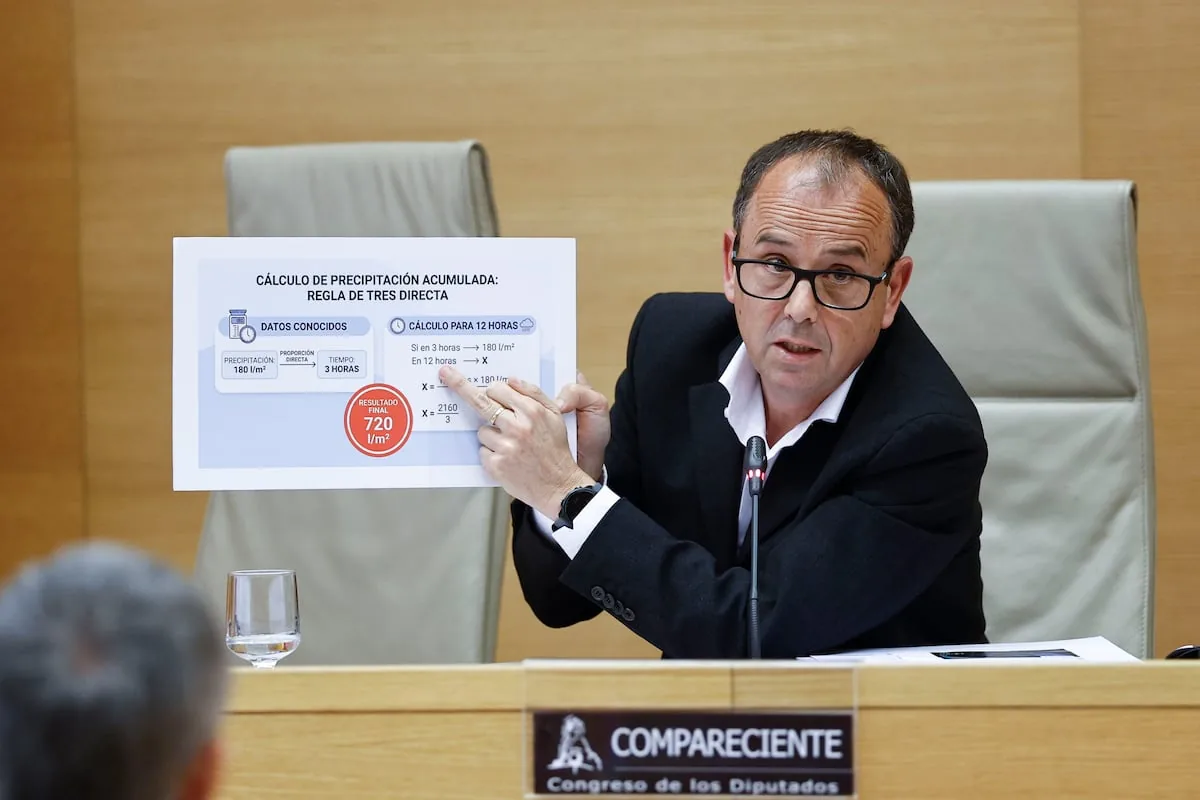
The head of Climatology of the Spanish Meteorological Agency (Aemet) in the Valencian Community, José Ángel Núñez, was clear when asked about the Valencian Government’s reaction to the 2024 DANA, which caused 230 deaths due to floods: “Managing an emergency reactively when the water is in the riverbeds, when it is already in the ravines, is like trying to cure cancer when there is already metastasis.” Núñez appeared this Monday to testify before the congressional investigation committee on the management of the crisis derived from the DANA.
Read more The minimalist Skechers that combine with any look and triumph this spring for less than 40 euros
The technician has already testified before the judge of Catarroja, who is investigating the cause of the floods, about how Aemet warned of the storm days before the event and the delay at Cecopi (Integrated Operational Coordination Center) in sending a mass alert to mobile phones. That message reached devices after eight o’clock, when at least 156 people had already died and another 37 were in an unsalvageable situation, according to an investigation by this newspaper. “Measures must be taken before it starts to rain, which is what has always been done,” insisted the technician.
Núñez reviewed the events of that day, Aemet’s work, and the Valencian Government’s accusation against the agency for not warning in time about the seriousness of the matter. “The first special note was published on Friday, the 25th, and a description of the meteorological phenomenon was already made,” said the technician, adding that the media echoed the warnings. “On Aemet’s Twitter, information was being posted that we were going to have a cold drop (…) indicating that the situation we were going to have was very serious,” he argued.
The head of Climatology also stated that he constantly informed throughout the morning of the DANA day. To prove it, Núñez took out his mobile phone during the session and played an audio of an interview he gave at 12:00 to the local television station À Punt. This is what was heard: “These are precipitations that form in the interior mountain range. We are seeing that practically on the coast, the rains are very weak, while there are areas in the interior mountain range that accumulate more than 200 liters per square meter (…) [This] makes us have to be more vigilant because in areas where it doesn’t rain, very swollen rivers, ramblas, and ravines can arrive, and even if we are in an area without rain, we should not be overconfident because this cold drop situation (…) is the most dangerous, precisely because it is where the water runs, dragging cars.”
Read more We tested the best ultrasonic insect repellents to get rid of bites in summer
A description of what happened hours later in some towns in the province. At least 60% of the victims died in buildings (50 in ground-floor flats, 33 in houses, 39 in garages, and 12 in residences), according to data cross-referenced by this newspaper. “We don’t have a public television, we are not a media outlet, we don’t have the mayors’ phone numbers, we don’t have the authority to alert,” Núñez alleged in response to questions from the deputies.
For this expert, there was “a lack of decision-making” at the Cecopi meeting and he stated that “at five [in the afternoon, when it started] it was clear that half of the province of Valencia was flooded and no one was making decisions.” When the Cecopi meeting began, a dozen people had already died as a result of the DANA, and 29 representatives from municipal, regional, and state institutions were discussing how to address the situation. Salomé Pradas, then Minister of Justice and Interior of the Generalitat and head of Emergencies (she was the one who convened Cecopi), was the highest-ranking leader from the beginning, as the now former president Carlos Mazón was extending his after-dinner conversation at the Valencian restaurant.
Núñez exchanged several messages with colleagues during that meeting, in which he participated remotely. At 17:26 he wrote: “Critical situation. Forata reservoir almost overflowing. They are thinking of evacuating, because the discharge will be very fast. The Júcar Hydrographic Confederation is going to declare emergency scenario 2.” He also recorded one of the interventions at 19:15 where the sending of the mobile alert was debated. The audio was published a few weeks later and debunked one of Pradas’ lies about the management of that day, as until then the former minister maintained that she had learned of the existence of that alert system at eight in the evening. Regarding the leak, Núñez said, a Valencian conseller insulted him, accusing him of being a “Sanchista spy meteorologist.”
Read more Colombian Yuvelis Natalia Moreno Blanco wins the Goldman Prize at 25 for opposing ‘fracking’