

EL PAÍS offers the América Futura section openly for its daily and global informative contribution on sustainable development. If you want to support our journalism, subscribe here.
Read more Storms, hail and wind gusts arrive in the northeastern peninsula
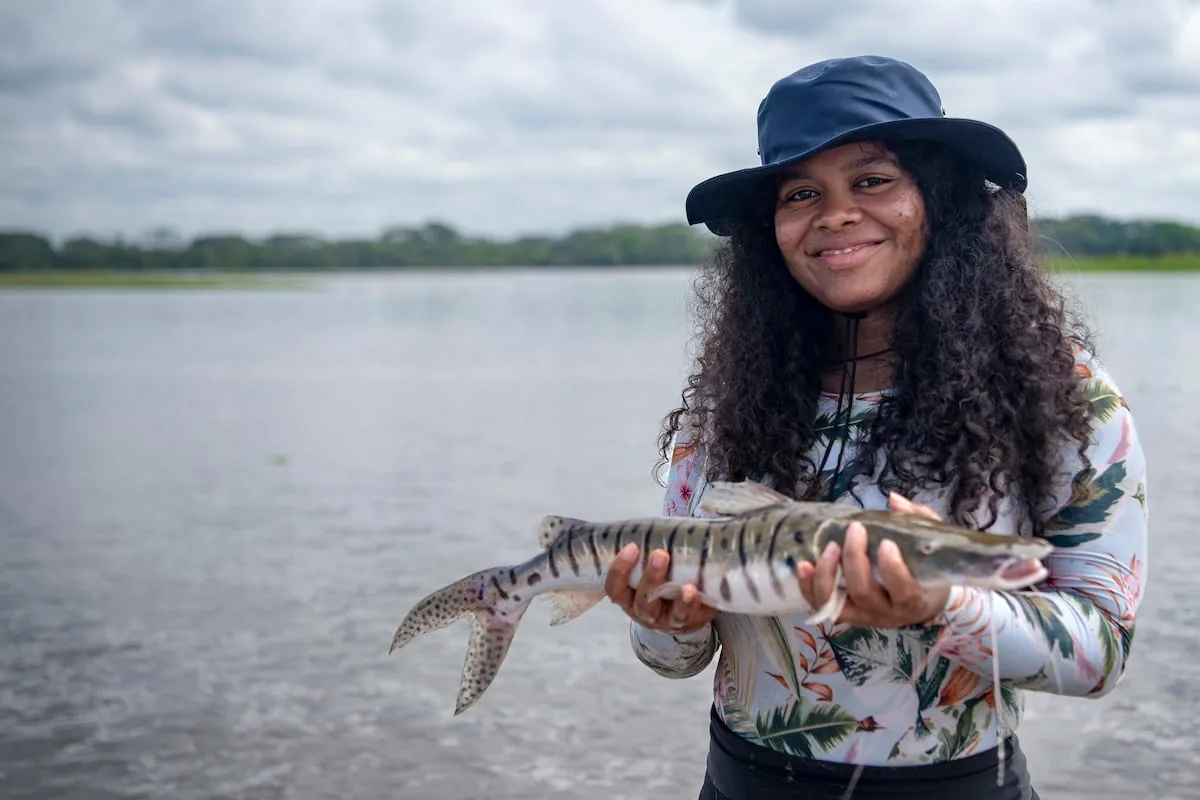
Yuvelis Natalia Moreno Blanco (25 years old, Puerto Wilches) has a certainty about herself. “I am a daughter of the Magdalena River,” she says. She knew it since she was born, a descendant of three generations of fishermen, and she repeats it now, as one of the six winners of the 2026 Goldman Prize, one of the most prestigious international awards for environmental defenders. She knew it from the first time, at 18, she learned that they wanted to do fracking in her municipality, and she confirmed it the several times she has been threatened with death. “I have identified with the details surrounding the river, with its pollution, with the droughts, with the fish.” With the terror that the river, her territory, would become a sacrifice zone to maintain the energy of others. Fracking is a technique that injects a liquid mixture at high pressure into rocks to fracture them and thus extract gas or oil.
“I’ve always said it: fracking exploded in our faces,” she says, referring to how, in 2019, they learned that the government of then-Colombian president, Iván Duque, announced two pilot projects in Puerto Wilches, Santander, led by Ecopetrol, the majority state-owned oil company. Kalé and Platero were their names. “Many of us found out from the news that appeared in a very important national media outlet, saying that fracking ‘is happening no matter what’.”
Her activism awakened, but so did her curiosity. “I not only investigated the technique, but also how in other countries, like the United States and Argentina, fracking broke the social fabric.” She attended meetings held by the Colombia Free of Fracking Alliance in the municipality with some friends and, later, co-founded Aguawil, a youth organization in defense of water and territory. They became what she calls “a network of trainers,” to ensure that the more than 30,000 residents of Puerto Wilches knew what fracking was about.
“We started in a bubble because we thought that, since we were from the municipality, nothing could happen to us here. We are children of this land,” insists the young woman from San Francisco, United States, where the award ceremony will take place. “We went to the first meeting without fear, there were many of us. By the second, many fewer participated.”
On December 12, 2020, with other organizations, they held a large march against fracking in Puerto Wilches. A massive one. On the 24th of that month, just days later, right at midnight, the contracts for the fracking pilot projects in the municipality were signed. After a month, in January 2021, Moreno was invited to participate in a public hearing against fracking in the Colombian Congress. And although she had already been told that “she was a guerrilla” or “to be careful, that they could kill her,” from then on the threats materialized. She was 19 years old.
Men on motorcycles parked in front of her house to warn her to keep quiet. First without weapons and then with them. “As youth, we began to face the harshness that our parents, grandmothers, and grandfathers had fled from so much. To face the harshness of what it means to defend life,” she says.
Moreno had to leave Puerto Wilches. First to the neighboring municipality, Barrancabermeja, Colombia’s largest oil port; then to Bogotá and, in 2022, leaving her river behind, to France. “They took away my right to live there. This being exiled and not knowing when to return is the hardest part. No one around me speaks Spanish and I don’t know any French. I feel very alone and everyone assumes I’m fine because I’m in another country,” is the testimony she gave to the Truth Commission that emerged from the peace agreement with the FARC when she was still in France. In 2025, the Special Jurisdiction for Peace (JEP) recognized the Magdalena River as an official victim of the armed conflict in the country.
After a year in Europe, during which she continued to speak about the risks of fracking, she returned to Puerto Wilches. “It was wonderful,” she recalls. The pilot projects had been suspended, a Constitutional Court ruling had recognized that there was no right to prior consultation, and she landed in a country with a new government, that of Gustavo Petro, who has maintained his stance against fracking. “But I also found a Middle Magdalena that continues to be violent, where social leaders continue to be persecuted.” In Colombia, the country with the most murdered environmental and land defenders, the threats do not cease. “I already make jokes,” she says, accepting the dark humor of what is to come. “This is my cell phone number; here I receive transfers, messages, and threats.” “Yes,” she accepts, “imagine how one ends up normalizing that kind of thing.”
She wants the Goldman Prize — one that in Colombia only Francia Márquez, the current vice president of the country, has won — to “embrace those who, like me, suffer the horror of war and continue to believe in an energy transition beyond fossil fuels.” She knows that the next presidential elections in May could change her outlook: that of her struggle, that of fracking, and that of the river that identifies her. “It saddens me greatly that, to this day, fracking is still being discussed as a possibility in the country,” she comments. “Talking about fracking is not just talking about a technique, but about how life itself is fractured.”