





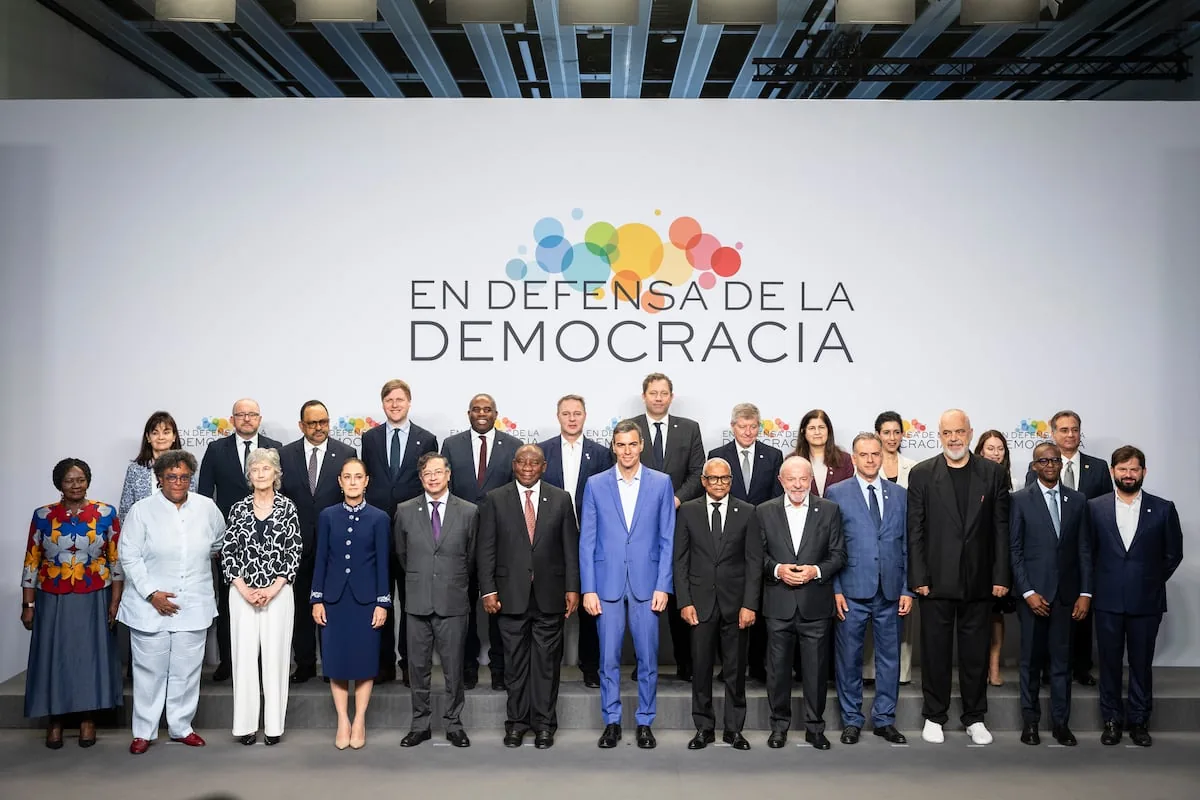
The Government of Mexico, led by Claudia Sheinbaum, finally decided to join the bloc of progressive political currents promoted by Pedro Sánchez, from Spain, and Lula da Silva, from Brazil. The one that has just taken place in Barcelona is not a specifically Ibero-American alliance, since in addition to leaders from Portugal, Colombia, Uruguay and Chile, Cyril Ramaphosa from South Africa, Minnesota Governor Tim Waltz and even representatives of the left from the Baltic countries intervened there.
Read more Higher prices at the April Fair 2026: what it will cost to enjoy the whole week this year
The so-called Global Progressive Mobilization, which promoted the last summit in Defense of Democracy in Barcelona, goes beyond the call of Ibero-American progressivism. In fact, the alliance would not seek so much to interact with forums with little capacity for cohesion at the moment, such as the Ibero-American ones or Celac, but rather to advance from the Brics or the Global South, without neglecting the presence of democratic American and European lefts. Three well-known opponents of Donald Trump in the United States, Hillary Clinton, Bernie Sanders and Zohran Mamdani, sent messages to the summit.
President Sheinbaum’s decision to join these networks, although downplayed in the official discourse of Morena and the 4T, could indeed mark a relevant diplomatic shift. The reluctance to an alliance with the Ibero-American progressive pole, on the part of Andrés Manuel López Obrador’s government, was evident for three reasons: the tense relationship with Pedro Sánchez’s government over the request for historical forgiveness for the conquest; Amlo’s discomfort with criticism of Bolivarian autocracies, frequent in these forums; and the frictions that this geopolitical flank produces with the United States, especially after Donald Trump’s return to the White House in 2024.
The greatest proof of that reluctance was López Obrador’s withdrawal from the diplomatic persuasion orchestrated by Spain, Brazil, Colombia and Chile, and their progressive governments, in favor of recognizing Nicolás Maduro’s electoral fraud in 2024. In the last years of Amlo’s government and in Claudia’s first, whenever the topic of Ibero-American progressivism was invoked in a morning conference at the National Palace, both presidents managed to include Bolivarian autocracies within that current.
At the last Barcelona summit, no mistake was made, and all the leaders present there were democratically elected. Although it had a clearly anti-conservative orientation, with quite explicit allusions to Donald Trump, Viktor Orbán and the leaders of the new Latin American right-wing, the progressive forum demanded a democratic change in Venezuela, based on a new electoral process, reiterating the position of Sánchez, Lula, Sheinbaum, Petro, Orsi and Boric at the beginning of the year, after the armed action by the United States in Caracas.
The repeated calls for peace and respect for the sovereignty of nations were focused on Israel’s military interventions in Gaza and the United States’ in Iran, but did not exclude Russia’s invasion of Ukraine. Both Pedro Sánchez and Antonio Costa, former Prime Minister of Portugal and current President of the European Council, reiterated in Barcelona that the warmongering trend contrary to the multilateral system did not begin with Israel’s attack on Gaza in 2023 but the previous year, with Russia’s invasion of Ukraine. In Barcelona, Costa condemned the latest attack by the Russian army in Odesa on April 16.
Read more The new Gaza flotilla attempts to block a ship with alleged military supplies for Israel
The progressive bloc, like Pope Leo XIV, is right when it denounces that the erosion of democracies is advancing from the new hegemonic powers of the planet. Orbán’s defeat in Hungary served as an incentive on the eve of the Barcelona meeting. However, in recent years, the advance of the new right-wing in Bulgaria, Austria, Poland and the Netherlands is incontrovertible. Sánchez’s reiterated thesis that the global neoconservative wave has come to an end is nothing more than optimistic advertising.
From the Latin American side, the comforting argument is held that Brazil, Mexico and Colombia contain more than 60% of the regional population. However, that evidence is not enough to decide in multilateral forums such as the Ibero-American, Inter-American or Celac. The formula of this summit, precisely because it deliberately departs from regional enclaves, can work, at least for the moment.
It was also said in Barcelona that Cuba is a sovereign country, that it has the right to self-govern and that constant threats of intervention and the energy blockade of the island are inadmissible under international law. What was not said is that the extreme vulnerability reached in Cuba, after the interruption of oil subsidies from Venezuela and Mexico, is a consequence of the adoption of an unproductive and dependent model by the island’s leadership.
The official Cuban press and the media that defend immobility on the island recognized, of course, the progressive summit’s rejection of US pressure against the island, but not the call for dialogue between Havana and Washington, which has taken place in recent months. Miguel Díaz-Canel’s government prefers, from a media perspective, the scenario of Cuba on the verge of being invaded by the United States over that of a difficult negotiation, in which the United States offers energy coverage in exchange for economic openness and the release of political prisoners.
Read more The rise of Sant Andreu reopens the conflict over the turf of the Narcís Sala stadium