


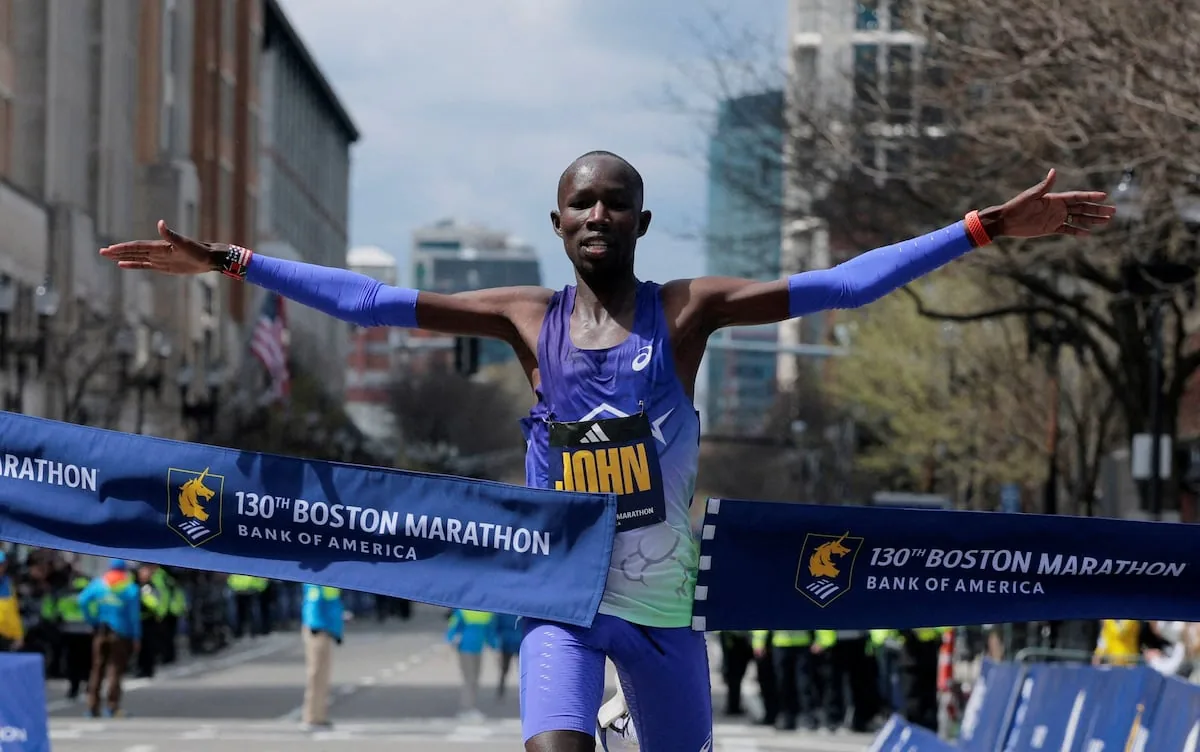
The crowd roars in Boston on Patriots’ Day as John Korir, who doesn’t run but flies, pushed by a tailwind towards the finish line on Boylston Street, next to Copley Square, where the public library, dating from 1895, stands firm. The Kenyan, who had already won here last year, as in Valencia just four months ago, or in Chicago, already in 2024, had pulled away past the 30-kilometer mark. The race, the mother of all marathons, reaching its 130th edition, entered the Newton hills. The beginning of an unprecedented display in the world’s oldest marathon. A split from kilometer 30 to 40 in 28m 10s. An acceleration that broke all predictions and even allowed him to go under two hours and two minutes (2h 1m 52s) to improve the course record, held by Geoffrey Mutai (2h 3m 2s) since 2011, by more than a minute.
Korir confirms himself as one of the most solid marathon runners of the moment and recalls last year’s triumph, when he embraced his brother Wesley, champion in the same marathon in 2012, at the finish line. The only two brothers to have repeated victory in Boston. The favorable wind lightened the legs of the favorites, and both the second-place finisher, Felix Shimbu, and the third, Benson Kipruto, managed to beat Mutai’s old mark. Korir, who knew the course well, took advantage of the famous incline known as Heartbreak Hill to drop his rivals in a second half remarkably faster than the first (1h 2s vs 1h 1m 50s) and took home 150,000 dollars for the win and another 50,000 for the record. But beyond the financial reward, a victory in Boston is a milestone, a lifelong success.
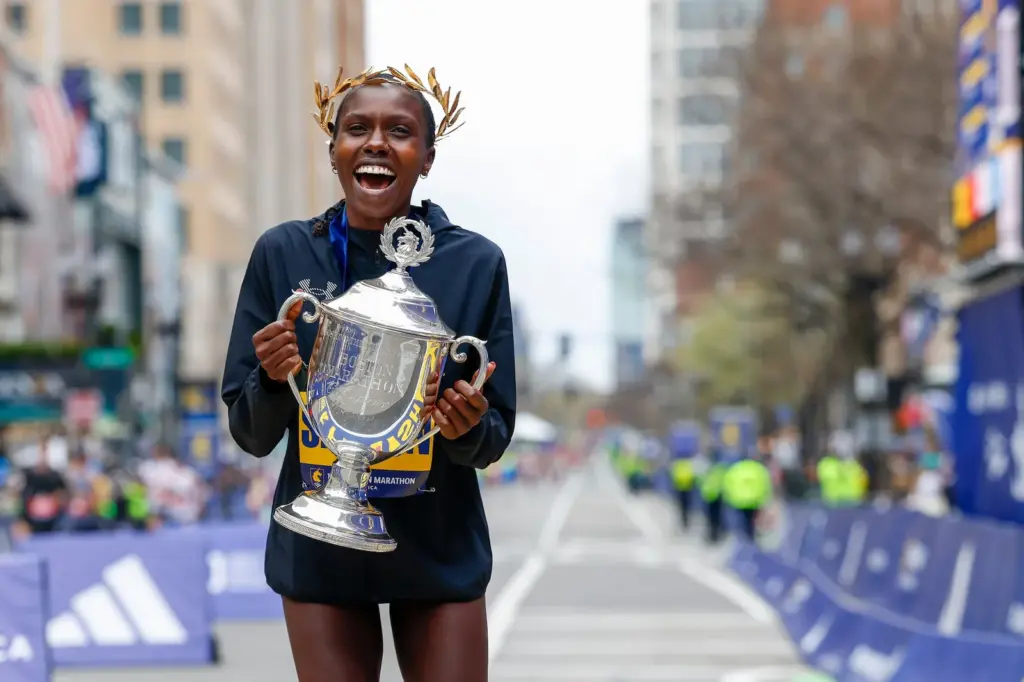
There is no other marathon like this, so classic, so renowned, that every year captures the attention of half the world on the third Wednesday of April. And on Patriots’ Day, meanwhile, behind Korir, Sharon Lokedi, another Kenyan, also pulled away solo, running mile 24 in 4m 36s, to revalidate her 2025 triumph (2h 18m 51s, the second best time in history).
Boston is celebrating, and on the sidelines, as African athletes flash past, soldiers, dressed in uniform and heavy boots, walk with their bibs pinned to their camouflage jackets. The city celebrates 130 years of the race, inaugurated as ‘The American Marathon’ a year after its debut at the 1896 Athens Olympic Games. The first edition gathered 15 participants, and by 2026, nearly 30,000 runners from 137 countries run from Hopkinton to Boylston Street in one of the destinations every marathon runner aspires to.
Read more The Barcelona summit: what was said and what wasn’t
Boston is the oldest marathon, and in addition to its 130 editions, it also celebrates 60 years since the first woman ran, Bobby Gibb, an American who didn’t get a bib but ventured to the start and managed to reach the finish line in 124th place out of 450. This demonstrated that the argument for prohibiting female participation, on the grounds that they were not physiologically prepared to run the 26.2 miles (42.195km), was as absurd as the famous photograph, years later, of the race director trying to push Kathrine Switzer off the course in 1967, who managed to get a bib by the trick of registering with her full surname but only the initial of her first name.
Bobby Gibb learned about the race in 1964, when a family member spoke of the marathon during a meal. Two weeks later, the young woman traveled to Boston, saw the spectacle, and felt the urge to run it. The next day, she grabbed some nurse’s shoes and started jogging. An ankle sprain prevented her from trying in 1965, but on April 19, 1966, on a sunny morning, after having traveled by bus for four days from San Diego to Boston, she put on a one-piece swimsuit, her brother’s pants, and size 38 Adidas children’s shoes. Bobby, who was 23, hid her blonde hair under the hood of a sweatshirt and concealed herself behind a hedge. When the start gun fired, she joined the group. It didn’t take long for them to discover her. But the runners praised her, and journalists began to comment on radio broadcasts that there was a woman. Halfway through the race, Wellesley College students came out to cheer her on, and today, 60 years later, it remains the loudest point of the marathon. Bobby Gibb reached the finish line after overcoming the pain of a blister on her foot and was able to finish in under three and a half hours. Women were not allowed to run until 1972.
That’s why the Boston Marathon is also Bobby Gibb’s marathon. As it is, furthermore, the race that rose again after an attack that detonated a device at the finish line in 2013, leaving four dead and 282 injured. Or the race where runners greeted Spencer, a Golden retriever who was never absent from mile 3 of the course. Or the storm race that, in 2018, with the favorites drenched, elevated Japan’s Yuki Kawauchi and Des Linden, the first American woman to win in Boston in 33 years. Or the race that always ended, one way or another, at the Eliot Lounge, the pub where Globe or Herald writers and runners went, knowing that with their medal, they received a beer thanks to Tommy Leonard, an athletics enthusiast who created a famous race, the Falmouth Road Race, between two bars. A lot of history in 130 editions (only suspended in 2020 due to the pandemic).
Read more Higher prices at the April Fair 2026: what it will cost to enjoy the whole week this year