









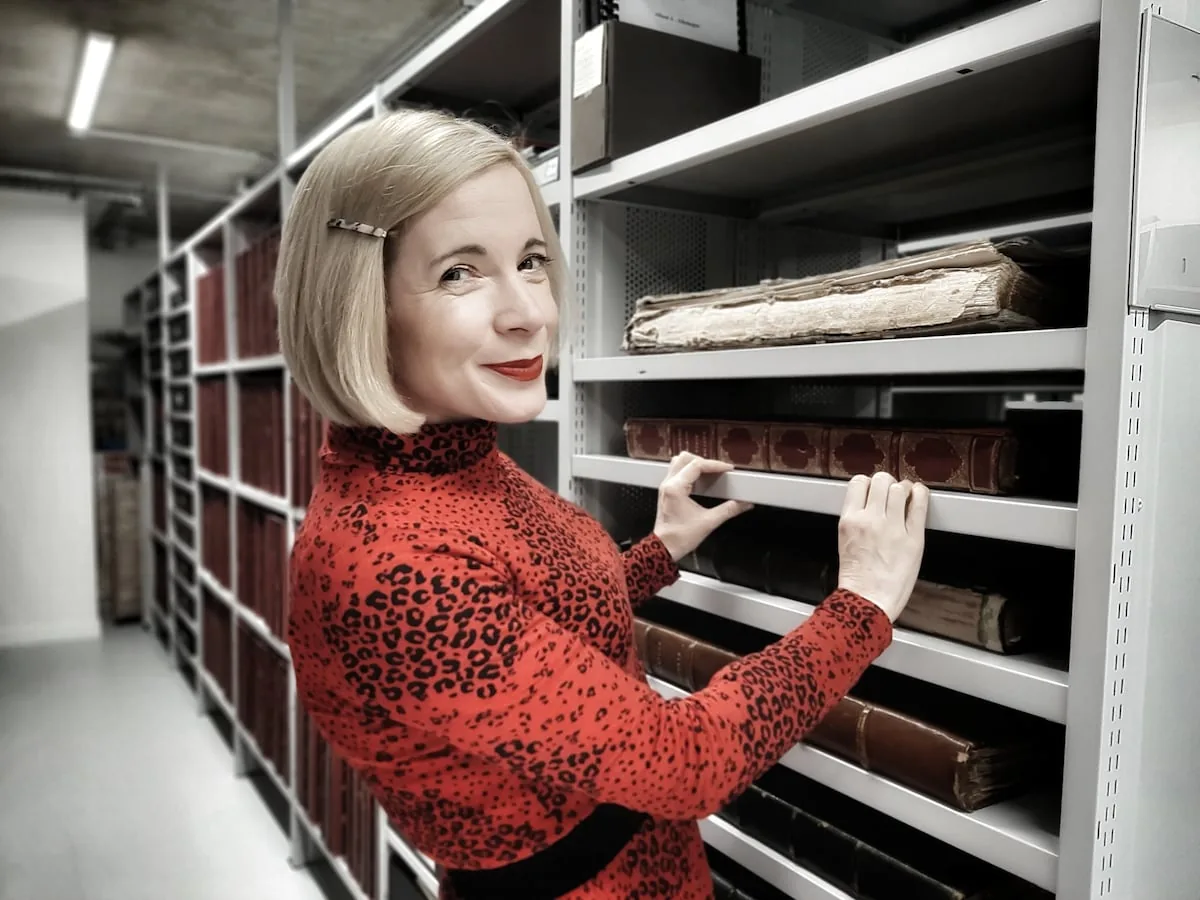
Lucy Worsley (Reading, 52 years old) has spent a couple of decades sneaking into British homes’ televisions disguised as Anne Boleyn, Elizabeth I, or an 18th-century courtesan. Her successful BBC documentaries have revived the history of the United Kingdom in an accessible and provocative way. A History graduate from Oxford, author of 19 books, chief curator for 21 years of the Historic Royal Palaces (the palaces that are part of the national heritage), her permanent smile, her childlike mischief, with that bob always pinned to one side, have served to camouflage a combative feminism when approaching History.
Read more The transformation of Mercadona’s fish market, a 130 million change
She insisted on titling her documentary series about Henry VIII’s wives Six Wives. She refused to include the monarch’s name in the title. The protagonists had to be them. Two Cambridge students were inspired by that work to create the musical Six, a global phenomenon that reinvents these women as pop divas and feminist icons.
Worsley has now written a delightful book, If Walls Could Talk: An Intimate History of the Home (Capitán Swing), based on a previous documentary of hers, where she recounts how the bedroom, kitchen, or bathroom have conditioned our lives.
Question. The history of small things. What is fascinating about delving into daily life?
Answer. I am the type of historian obsessed with small details. I’m not saying that foreign policy or constitutional matters are not important, but I like the minimal aspects of daily life, which, when added up, can give you a complete picture of the cultural and social characteristics of an era. For years I have been in charge of the historic house museums in this country. And when visitors came to Hampton Court [the palace occupied by Henry VIII and his unfortunate wives] they didn’t ask about Reformation politics or Baroque aesthetics, but about things like where they washed their socks, where they relieved themselves, or where they cooked.
Q. We take luxuries or habits like sleeping in our own bedroom or having our own bathroom for granted.
A. Privacy is an aspect very much determined by your own culture. Today in Europe it seems essential to us, but just over a hundred years ago you could have been sharing a bed with your co-workers. Every time I talk about this topic, the history of the home and its furnishings, someone always comes to tell me that they grew up in a house that didn’t have a bathroom, or that they washed clothes in the kitchen. Not that much time has really passed since all that.
Q. Clarify something for me. When historians say that our ancestors were not very different from us, I can’t help but think that today a toothache plunges us into misery.
A. We can perfectly identify with Catherine of Aragon’s feelings when she suffered Henry VIII’s infidelity and he left her for a new wife. But it is true that some things are totally different, like the constant presence of God in day-to-day affairs. Or like hygiene. I always say, when asked what era of the past I would like to visit, any time after the invention of anesthesia.
Q. But in other things perhaps they were better, or more resigned…
A. Communal life, in some ways, was more respectful than today. Today the rich and the poor inhabit isolated worlds. In the past, they were forced into greater contact with each other. One could even argue that in the 16th century the obligation of the rich to care for the poor was stronger. They believed in that idea of the Great Chain of Being, in which from God to the king, through bishops, dukes, small landowners, or peasants, everyone knew where they fit in. It may sound absurd to us, who aspire to social mobility, but it gave them the security of knowing their place in the world.
When they ask me what era of the past I would like to visit, I say any time after the invention of anesthesia”
Q. Defend the figure of Henry VIII, that king who beheaded wives…
A. He created the Navy, legislated against the use of firearms, invented inflation by devaluing the currency, had ambitions for England that no previous monarch had. And yet, he has gone down in history for all the melodrama of his personal life and for his sexual desire. And for his personal failure, being unable to secure a succession. That failure, however, strengthened the country. Mary reigned, then Elizabeth, then Edward. Everything ended up working out well, because institutions were activated, realizing that they had to provide the stability that the king had not been able to provide. Parliament was strengthened and the legal profession underwent changes.
Q. And yet, in the popular imagination, his wives continue to fascinate.
A. They are thought of almost like a hand of cards. Six cards. All with the same value. And that’s not true. He was married to Catherine of Aragon for twenty years. To Catherine Howard, barely one. To Anne of Cleves, barely a few months. They don’t represent the same thing. But the story is so attractive that each has become an archetype. Catherine of Aragon was the tragic one. Anne Boleyn, the sexy one. Jane Seymour, the kind one. Anne, the ugly one. Katharine Howard, the promiscuous one. These are stereotypes that say a lot about our own culture, and they were really forged in the 19th century, during the Victorian era.
Q. You have also studied Queen Victoria in depth. And there the myth lies in the unconditional and passionate love she felt for her husband, Prince Albert.
Read more The investigation that was stillborn due to the power of Los Pancetas in Ayuso’s PP
A. If it were possible to ask Queen Victoria if she loved her husband Albert, she would answer yes without hesitation. But that’s because those were the values and principles of the time. I think she repressed herself to do what society then thought was right. And at the same time, I can’t help but feel sorry for Albert, because in that same world, a husband was obliged to have total control over his wife. And although he tried, it’s complicated to control a queen.
Queens, for reasons related to their gender and individual characteristics, governed in a more consensual way”
Q. Elizabeth I, Victoria, Elizabeth II… one would say they are remembered as good reigns.
A. Of course. The United Kingdom has always fared better with queens than with kings. Each of them has represented a period of great stability and consensual government. Queens, for reasons related to their gender and individual characteristics, governed in a more consensual way, with less posturing, with less warlike ardor like Henry VIII’s. England was never an absolute monarchy; there was always a certain duality in power. And this idea fits better with a woman on the throne.
Q. Your popularity largely stems from your impartiality. It’s difficult to know what Lucy Worsley thinks about contemporary times and politics.
A. I am interested in contemporary history, of course. And I have no qualms about pointing out that feminism is very important to me. But I don’t want people to know which party I vote for. I want the History I tell to be like a big tent where everyone feels welcome. And my only message, always, is to ask people to think twice about things. Because sometimes they are more complex than they seem.
In the 18th century, in an agricultural society, all family members worked. When the possibility of working in a factory and earning a salary arises, it becomes a sign of refinement for your wife not to work and to take care of the home”
In the 18th century, in an agricultural society, all family members worked. When the possibility of working in a factory and earning a salary arises, it becomes a sign of refinement for your wife not to work and to take care of the home
Q. Like the Victorian era, praised and vilified.
A. Exactly. It was an era of great energy and expansion, of great achievements and rapacious conquests, and at the same time an exaltation of conservative values. It was a time when women were confined to a domestic role. And this stemmed from the industrial revolution. In the 18th century, in an agricultural society, all family members worked. When the possibility of working in a factory and earning a salary arises, it becomes a sign of refinement for your wife not to work and to take care of the home.
Q. Recently, the National Gallery in London held a major exhibition dedicated to Artemisia Gentileschi, the great Baroque painter forgotten for so long. Do we need to rescue the forgotten history of women?
A. In that sense, I feel a bit torn. I understand that, in part, it’s a matter of justice. But in recent years, the history of women has gained a lot of momentum, and sometimes it has led to an elementary and simplistic version where everything was wonderful. And that’s not the case. Women are like men. Brilliant, sometimes. Terrible, at other times. Sometimes strong, sometimes weak. Sometimes intelligent, sometimes stupid. I don’t think women should always be rescued from the shadows, but at the same time, I think we still have a lot of rescuing to do.
Q. Especially when it comes to great murderers. Your series on Victorian England’s female criminals is quite a discovery.
A. I was tired of all those crime stories where the first scene is a naked woman, brutally murdered and sexy at the same time. I loved the idea of turning the script around and telling the story of all those women who were in control of the situation and turned out to be very interesting. In a Victorian court, in the 19th century, the stand was the only place where a woman could freely say things like “My husband raped me,” “I was desperate and my children were starving,” or “This man did terrible things he should never have done.”
Read more The betrayal of the Bárcenas’ driver: “He was like one of the family”