








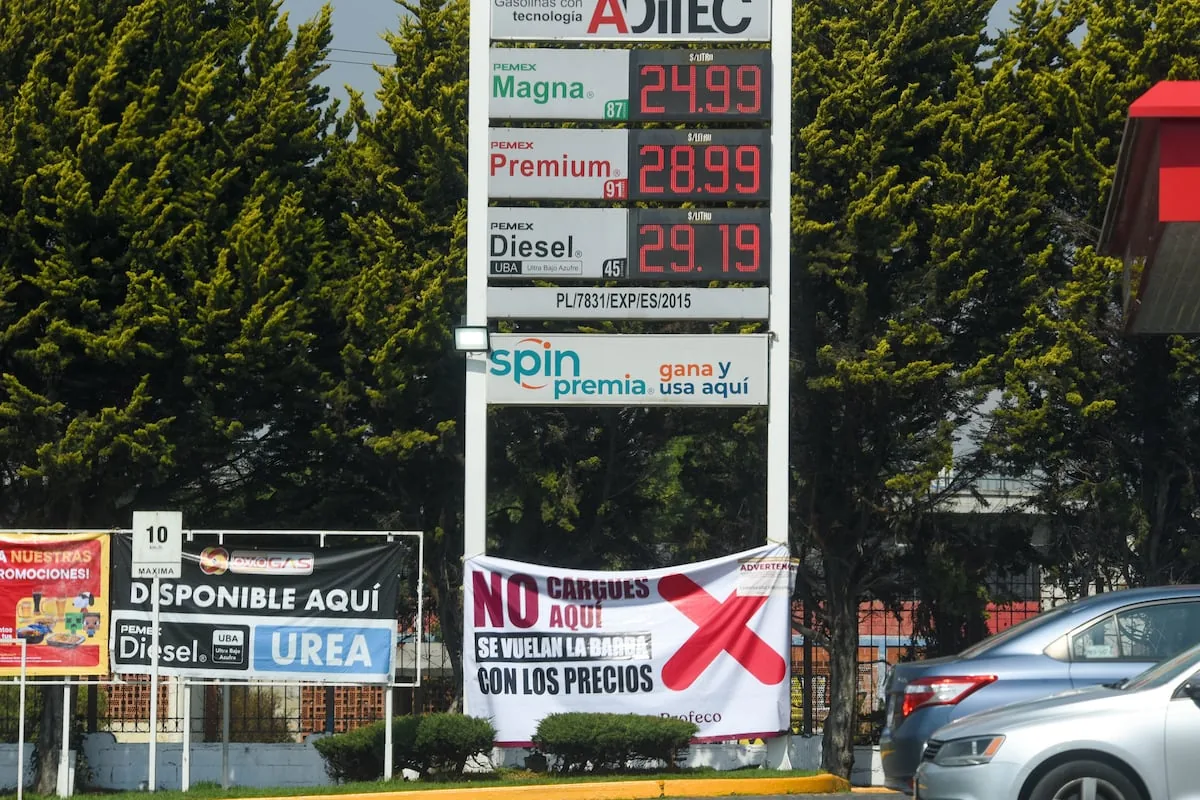
The containment of diesel prices, fundamental for the costs of the Mexican economy, is beginning to show signs of tension, with specific supply failures at distribution terminals and erosion of profit margins for distributors. In her attempt to anchor inflation, Mexican president Claudia Sheinbaum will meet again this Tuesday with gasoline business owners to ask them to keep fuel prices stable, even though stations are starting to report losses, while the conflict in the Middle East —which has made energy more expensive— continues without a clear resolution date.
Read more A spring essential that never fails: the most versatile Levi’s polo shirt, now with up to 38% off
Sheinbaum has reiterated that the federal Government, along with the Tax Administration Service (SAT), will audit stations that sell above the price agreed upon in the various meetings held with private entities in recent weeks. She has also indicated that they will seek to further reduce the price of diesel, with the aim of placing it below 28 pesos per liter.
The Federal Consumer Protection Agency (Profeco) has indicated that 65% of stations sell diesel around that level or below 28.50 pesos per liter. The rest are above, which has led to the placement of banners to identify establishments with higher costs. After reaching levels close to 110 dollars per barrel, the price of Mexican oil has retreated to around 88 dollars, in line with international markets. The Government believes that this drop should be reflected in final prices. However, voices within the sector recall that costly purchases have already been made.
Furthermore, crude oil rose again at the beginning of the week, to nearly 90 dollars per barrel, amid doubts about an unstable ceasefire between the United States, Israel, and Iran, leading analysts to anticipate new scenarios of price volatility.
“We have identified that some stations are operating at a loss, due to the deficit in their operating costs, which is high. They are no longer getting the margins. Especially in the rural part of the country,” states Ricardo Quiroz, president of the Mexican Association of Service Station Suppliers (AMPES). The guild considers that maintaining prices through agreements “is an unsustainable measure” that will not solve the underlying problem.
A source from the gasoline sector, who requested anonymity, indicated that some Pemex storage and dispatch terminals have asked their clients to go to other loading points due to cuts, particularly in diesel. The newspaper Reforma reported that terminals in Mazatlán, Guanajuato, Jalisco, and Tamaulipas have informed their buyers that they have limited stock.
“It’s not widespread,” the source clarifies to EL PAÍS, although they consider it a relevant sign in a context marked by expensive imports, the appreciation of the peso, and operational problems in refineries. Loading at facilities further away from the stations also increases distribution costs, they add. According to the person, some stations have stopped selling diesel to contain their costs. They also warn that although the distributors participating in negotiations with the Government mostly have the financial strength to face cuts, the duration of the measure will be key for operations. Publicly, business owners have ratified the agreements with the Government, although they have asked for their profits to be observed.
Alejandro Montufar, general director of PetroIntelligence, a data firm in the gasoline sector, explains that they have detected that Pemex is relocating some dispatches, although he says this decision could be due to commercial strategies rather than supply problems. “Pemex is not communicating shortages; it is informing that dispatches will be relocated,” he points out. Petróleos Mexicanos did not respond to a request for information.
Montufar also notes that regional demand has decreased. “High prices do not stop mobility, but they force companies and consumers to adjust their budgets,” he states. At the close of last week, wholesale prices dropped to 26.14 pesos per liter, in line with the fall in crude oil. However, this adjustment will take at least two weeks to reach the consumer, until stocks purchased at higher prices are exhausted, the analyst adds.
“With that price level, the implicit margins of 1.86 pesos per liter are not enough to operate,” he adds. “We have observed service stations in El Bajío that are suspending diesel sales.”
Fuel cost is crucial for the logistics sector. A study by Numaris, a satellite tracking and artificial intelligence company applied to transportation, estimates that diesel accounts for up to 35% of a fleet’s expenses. And land transport moves nearly 80% of goods in the country.
The Government has sacrificed part of the collection of the Special Tax on Production and Services (IEPS) to contain the rise in fuel prices. On Friday, the Ministry of Finance cut tax incentives for regular gasoline and diesel for the week of April 18-24 and completely eliminated support for premium gasoline, while the president celebrated the drop in crude oil prices.
Read more The truth is that it escapes us