







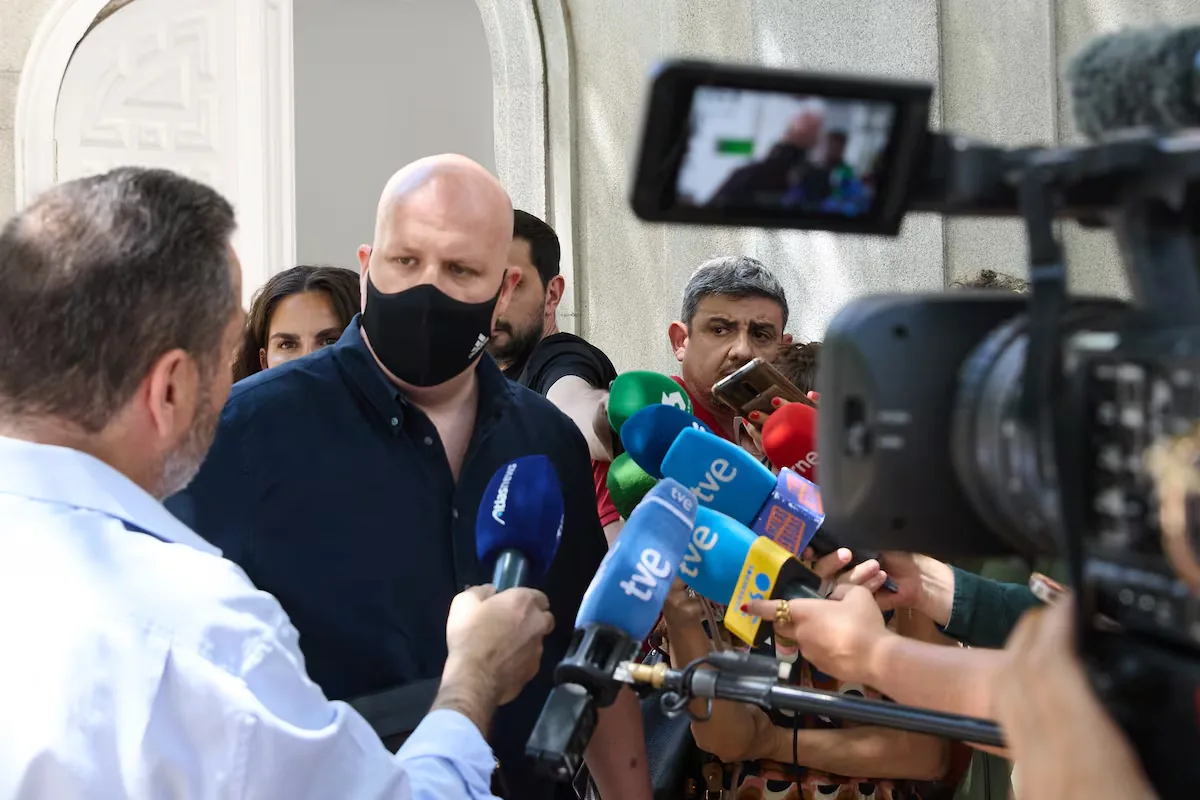
Judge José Luis Calama has taken the first step to send Álvaro Romillo, the cryptocurrency businessman who confessed to having given 100,000 euros to Alvise Pérez to finance his campaign for the European Parliament, to trial for the crimes of fraud, money laundering, and criminal organization. Calama, head of the Investigative Court number 4 of the National Court, has concluded the investigation of a case that has lasted more than a year and has charged Romillo and nine other people for allegedly defrauding more than 3,000 investors through the Madeira Invest Club (MIC) platform. The money allegedly scammed by the now accused amounts to 185 million euros. The judge, in an order dated this Monday, has summoned the parties to notify them within 10 days of the opening of the oral trial.
Read more ‘La mesa de Hora 25’, in EL PAÍS | Program of September 15, 2026
The businessman has been in provisional detention since November 6, after the Civil Guard arrested him suspecting there could be a risk of flight just before his judicial statement.
“The resolution represents a decisive procedural step in a case that formally began in October 2024 and which, due to the number of affected parties, the economic volume investigated, the connection with certain politicians and prominent businessmen, as well as the complexity of the corporate and financial network examined, has become one of the most publicly impactful fraud proceedings in recent years,” says the Aránguez Abogados law firm, which filed the first fraud complaint against Romillo’s network.
The National Court charged Romillo, also known as Cryptospain, at the end of last year for setting up a hierarchical structure in which he, from the top and “driven by profit,” used his digital platform MIC as a “private club” offering high returns on a wide range of investments: real estate, luxury vehicles, recreational boats, whiskey, gold, cryptocurrencies, and digital artworks for which he promised repurchase within a set period with pre-established profits.
According to the judicial investigation, MIC was an instrument of fraud and concealment of the obtained profits. Calama, in the order where he charged Romillo and his accomplices, detailed that the organization’s objective was to systematically appropriate the money invested through the Madeirainvest.com portal, which “appeared to be a safe and profitable investment platform.” Romillo, Calama highlighted in that document, exercised direct control over operations: he coordinated the fundraising, manipulated the information disseminated by the website, and distributed the illicit profits among the other members of the organization.
Romillo managed social networks like TikTok or YouTube, posting videos where he advertised financial products, cryptocurrencies, tax evasion, or national and international tax aspects. Within his marketing strategy, Calama also pointed out, he organized mass events with famous guests. In one of them, held at the Hipódromo de la Zarzuela (Madrid), the MEP Alvise Pérez participated.
The crime attributed by the Court to the accused is mass fraud, of the pyramid type, in which they channeled “all the capital received to other companies designed to divert it, that is, the business model offered was based on fraud.”
Read more Patricio Guzmán dies, the master of Chilean documentary
This is how Calama describes the role of its leader: “The behavior of Álvaro Romillo Castillo was deceptive and his intent regarding the capital transferred by the buyers was from the start purely captative.” The corporate network Romillo designed is labyrinthine: 52 companies, 106 bank accounts, real estate and boats, all distributed across at least 15 jurisdictions.
Alvise Pérez and the financing agreements
The case broke out in the media in September 2024. Three weeks after Romillo shut down his platform, leaving thousands of investors in limbo, he submitted a document to the State Attorney General’s Office admitting to having paid 100,000 euros in cash to Alvise Pérez so that he would finance the campaign of his party Se Acabó La Fiesta (SALF) for that year’s European elections, in which he finally obtained three deputies with more than 800,000 votes. In response, the public prosecutor sent a complaint for illegal financing against Alvise to the Supreme Court, as he is protected by parliamentary immunity due to his position as MEP.
Until the closure of Romillo’s alleged investment business, Alvise Pérez had been a defender and political sponsor of the project. The truth is that there was an interest behind it, according to an exchange of messages between both. “With a good collaboration agreement, your projects could reach many more people and I could safely and comfortably finance my campaign without the problem of state persecution,” appears in the document Romillo sent to the Prosecutor’s Office.
These communications suggest that Alvise proposed an agreement: in exchange for promoting Romillo’s allegedly fraudulent businesses, he guaranteed opaque financing for his campaign for the European elections on June 9, 2024. The cryptocurrency businessman revealed to the public prosecutor in that document that the now MEP confessed he needed between 300,000 and 360,000 euros for his electoral campaign in “funds that do not require control by the Court of Auditors.” But Romillo only gave him 100,000 in exchange for Alvise promoting his project among thousands of his followers on social networks.
The Prosecutor’s Office also has audios exchanged between the MEP and Romillo in which the former warned him in September 2024 that the Civil Guard was investigating him due to a complaint before the CNMV. Finally, this May the European Parliament lifted Alvise’s immunity for alleged irregular financing of his party, and this July the Supreme Court already requested from the Court of Auditors and Alvise’s party all information about its financing.