







What would Capote’s swans be like today? Those rich and idle women who gathered at La Côte Basque, the famous New York restaurant, moved among the immense fortunes of their families, almost all generated by prosaic industries such as construction, pharmaceuticals, or stock market investments, and the world of art and culture, where money precisely allowed them to hide that, the money, making it useful and even beautiful. The incursions of that high society into pop culture were then seen as an eccentricity reserved only for those who understood that the codes of low and high culture would eventually merge.
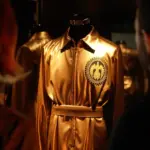
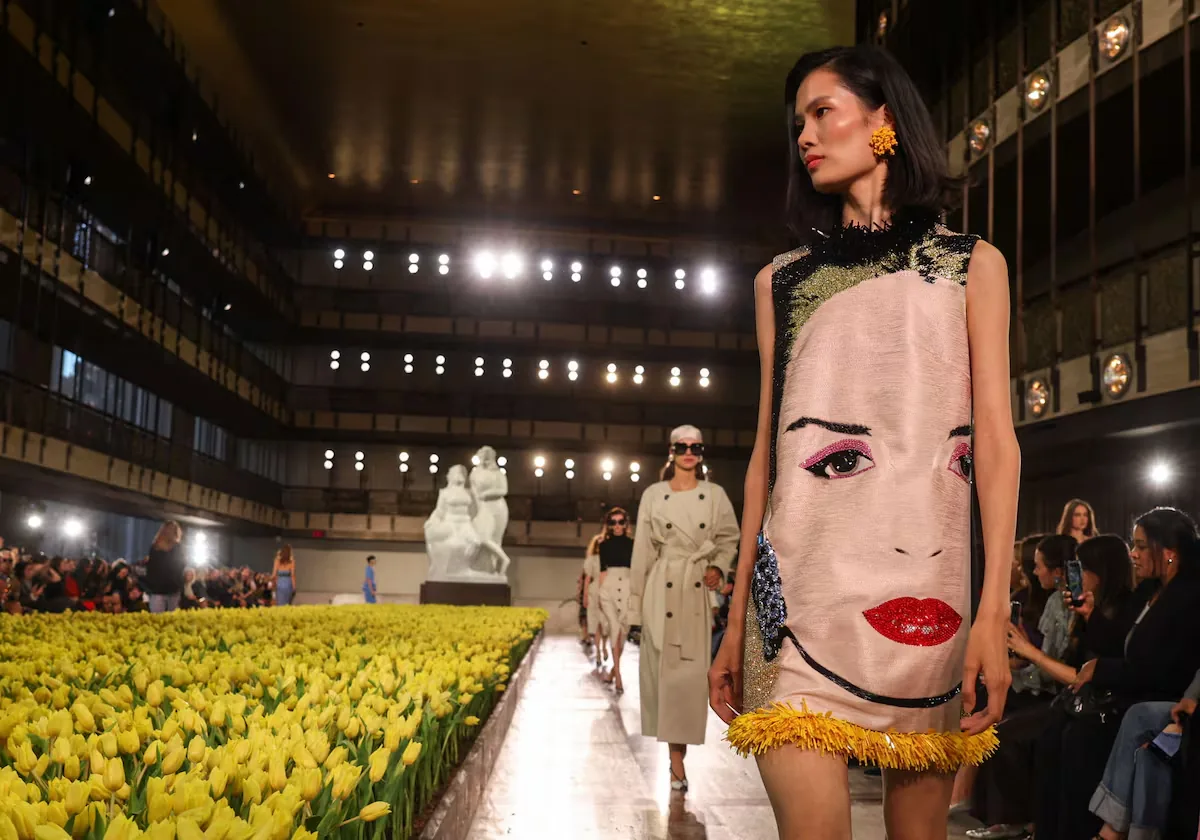
This Tuesday, the portrait of Carolina Herrera signed by Andy Warhol, the man who managed to unite the women of the Upper East Side with alternative art, hung on the facade of the David H. Koch Center, the home of the New York City Ballet, where the brand was celebrating its 45th anniversary. On May 27, 1981, Carolina Herrera, socialite before designer, presented her first collection at the Metropolitan Club in Manhattan. She knew well what her clients wanted because they were her own friends, the so-called ladies who lunch, the swans, the most cultured and free women of high society.
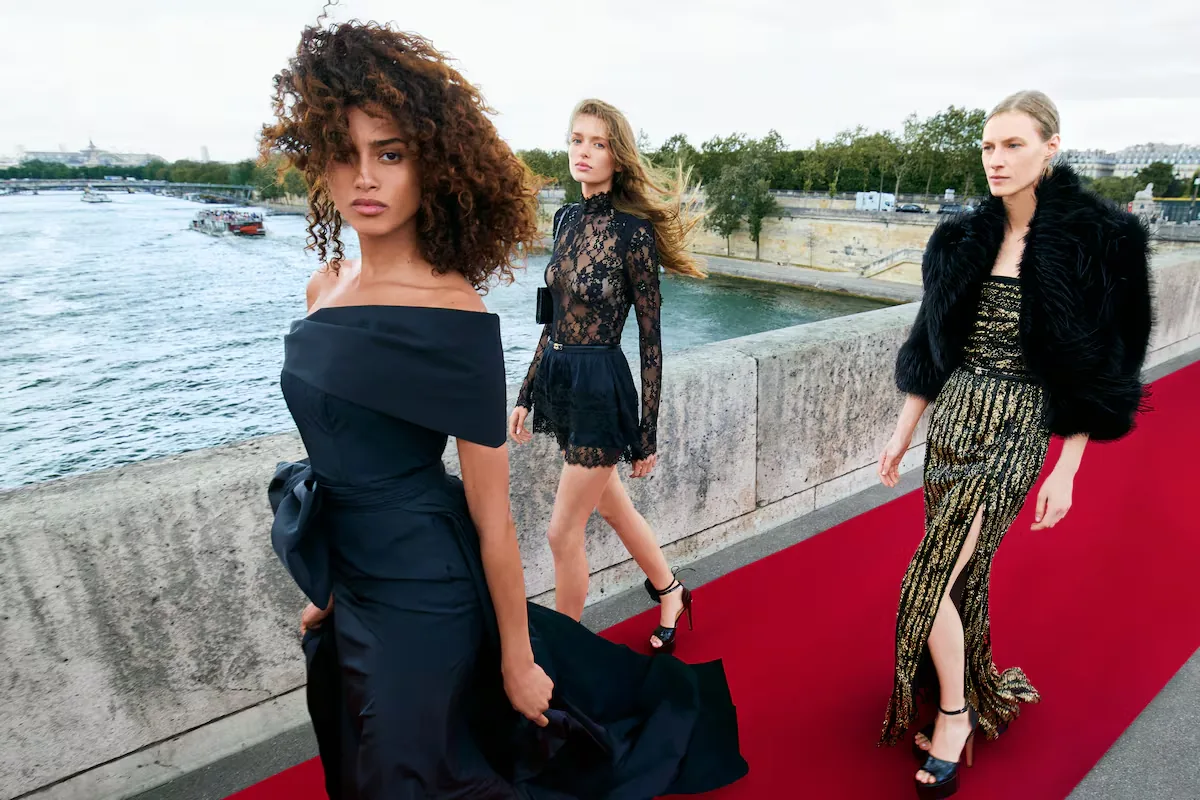
“I love the idea of the ladies who lunch,” explains Wes Gordon, Carolina Herrera’s designer for seven years. “I wanted to start from that idea and ask myself what that woman is like today.” To do this, the designer takes the house codes, the polka dots, the ruffles, the white shirt, the flares, the playfulness, the boldness, and the elegance and brings them to 2026. Jeans, trench coats, tweed, knit suits, or white shirts reinvented as dresses are Gordon’s proposal for the day. At night, the Herrera woman wears metallic lace or crochet with contrasting flowers, organza and very light gazar, flares and ruffles, flowers and polka dots and bows, creating a classic silhouette with modern movement: the body feels free, in 2026 you get to places by subway faster than by car, and getting in and out of a taxi requires some skill.
“This collection was really born from New York. In recent seasons we have presented in Madrid, Mexico City, and Rio de Janeiro, so for the 45th anniversary, I loved the idea of making New York our destination and celebrating the city that has been Herrera’s home since 1981,” explains Gordon. The David H. Koch Center, a New York emblem, was the chosen space to recreate Central Park with nearly 30,000 tulips. In reality, the tulips were 28,800, although at the start of the show the number changed: 28,798 yellow tulips. Two were missing, taken by Wes Gordon’s children, Henry and Georgia. The flowers will be donated to New York’s public parks.
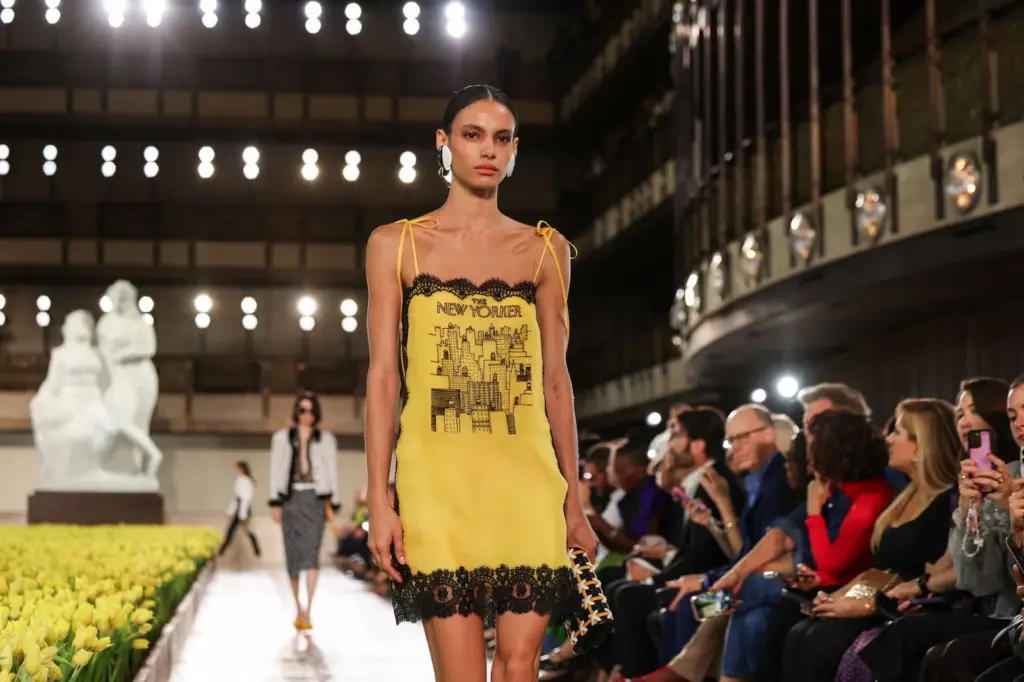
The place and the decor were not the only allusions to the city. The collaboration with The New Yorker, Condé Nast’s most prestigious magazine and the only one not controlled by Anna Wintour, was reflected in a yellow dress and a white chiffon top. On them, you could see the cover of the May 27, 1981 issue, a Manhattan skyline by Lonni Sue Johnson that was published the same day as Carolina Herrera’s first show in the Big Apple.
Read more El Prat airport secures 1.7 billion for improvements, without the controversial runway expansion
The brand has also collaborated with the Andy Warhol Foundation for the Visual Arts, which licensed the portrait of Carolina Herrera to be used in the collection. As Gordon explains: “the portrait appears on a mini dress and hand-embroidered accessories, so it becomes part of the garments rather than just a reference.”
The celebration of craftsmanship and the house’s savoir faire also claims the city: “We have one of the last workshops left in New York, and this season everyone has given their best. So, although 45 years give us a lot to look back on, in the end the collection feels very alive, very joyful, and very New York,” says Gordon.
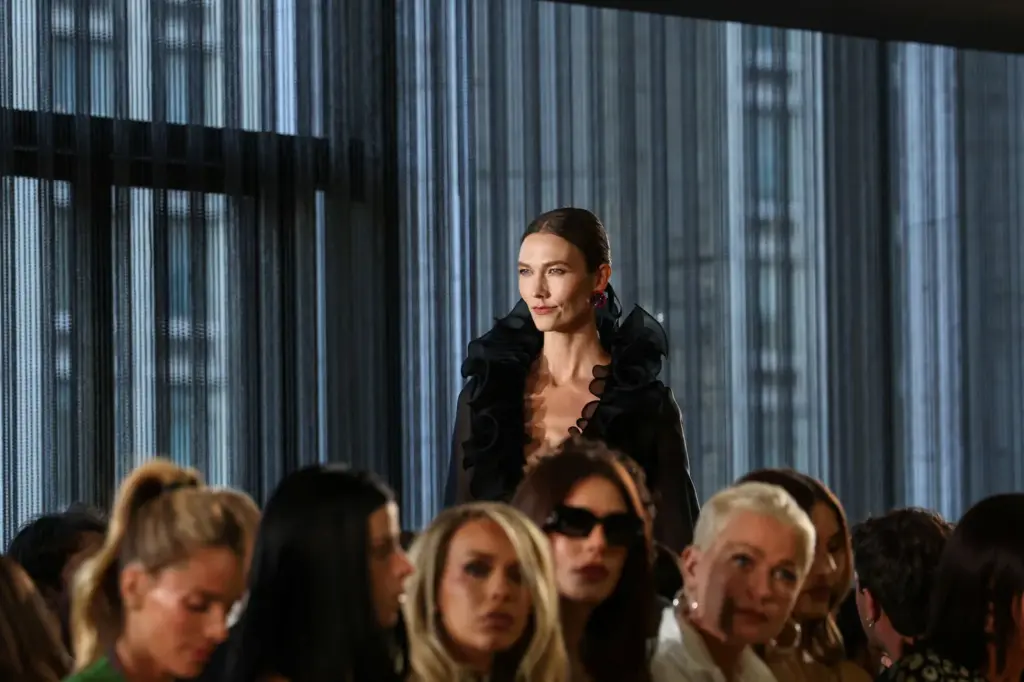
The show was closed by Karlie Kloss, the face of Good Girl for a decade, the perfume that turned the high-heeled shoe into one of the brand’s most recognizable objects. This nod is not innocent: fashion serves as a showcase for a business whose main engine is perfumery. Carolina Herrera ranks among the top ten global fragrance brands, along with Rabanne and Jean Paul Gaultier, all part of the Puig group, and Good Girl became the number one women’s perfume line worldwide in 2024. The brand, owned by Puig since 1995, which experienced a great boost in 2025, continues to grow double digits in 2026. Puig, which does not break down Herrera’s sales, invoiced 5.042 billion euros last year, and although fashion represents less than 5% of Puig’s total business, it recognizes its strategic role as the generator of the universe and desire that then feed the perfume business.
About 700 guests, including this newspaper, were able to see in the front row perhaps one of New York’s greatest icons, writer Fran Lebowitz. With her antagonist uniform to the Herrera universe, wearing jeans, a tailored jacket, and cowboy boots, she sat next to Pamela Anderson. Actor Ed Westwick, who played Chuck Bass in Gossip Girl, the series that parodied New York’s rich kids, posed near singer Bad Gyal. The mix of high society, high culture, and pop culture that defined Carolina Herrera remains alive in 2026 in the hands of Wes Gordon, who after the show, along with Mrs. Herrera, received a group of guests in a recreation of Mortimer’s, a place that in the 80s and 90s united fashion, art, society, and the familiarity of a private club. Going to Mortimer’s, explains Carolina Herrera, “was always a night to remember.” Mortimer’s closed in 1998, and for one night, turned into Herrera’s, it came back to life with its white and black balloons, with Manhattan’s elite, celebrities, dry martinis, and of course, its hamburgers. Is there a more New York mix?
Read more An uncontrollable fire in Tuéjar affects the Alto Turia Biosphere Reserve