








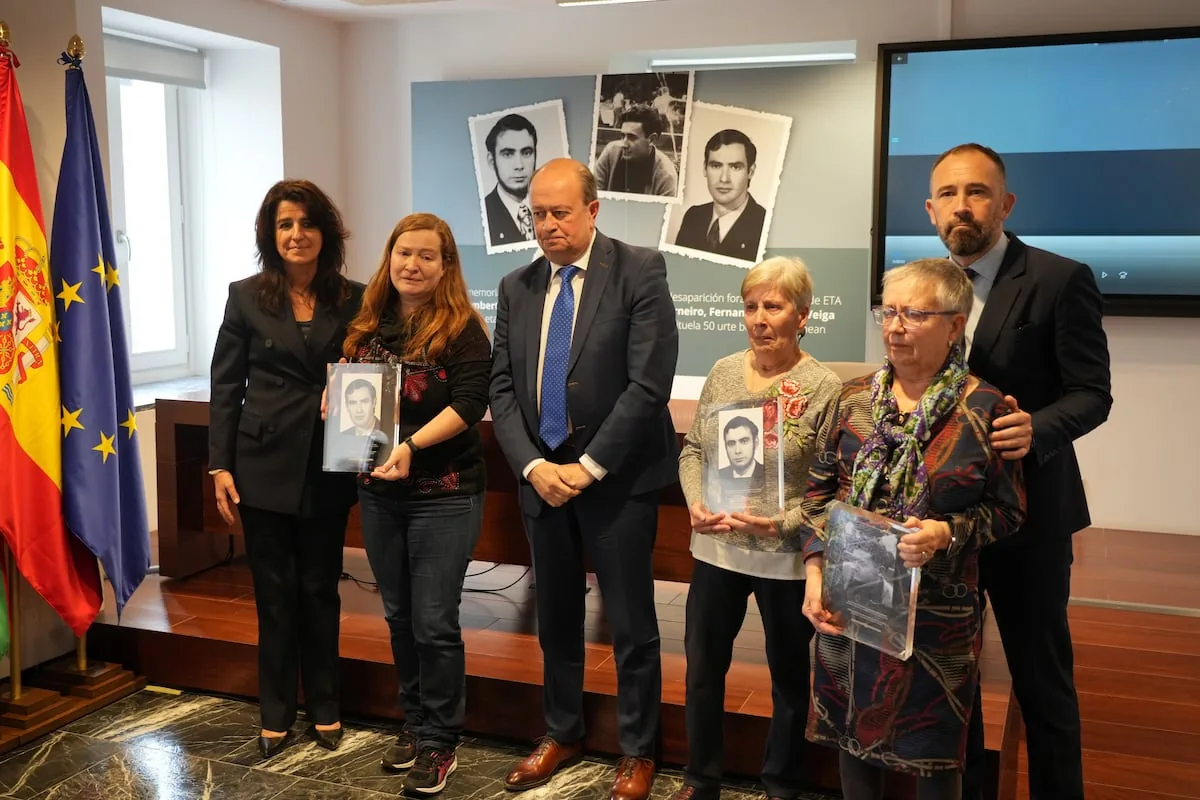
Almost 15 years after the end of terrorism, Spain still has six disappeared due to that cause, two more than Northern Ireland, despite the political violence exercised by the IRA and unionists being much greater. While the disappeared in Northern Ireland when the Good Friday Agreement was signed in 1998 were 16 and have been reduced to four, in Spain there are still six. An exhibition at the Memorial for Victims of Terrorism in Vitoria remembers the six disappeared due to terrorism: José Humberto Fouz, Jorge Juan García and Fernando Quiroga, young Galicians residing in Irun (Gipuzkoa) and disappeared in Saint-Jean-de-Luz (France) in 1973; Eduardo Moreno Bergaretxe, Pertur, disappeared in the French Basque Country in 1976; Francisco Javier Etxeberria, Naparra, also in the French Basque Country, in 1980, and Publio Cordón, in Zaragoza in 1995.
Read more The EU and the necessary debate on Israel
The exhibition is titled Present Absences. Disappeared due to terrorism in Spain. Its curator, Marta Rodríguez Fouz, a professor at the Public University of Navarre and niece of José Humberto Fouz, highlights that all cases share “the permanent pain that adding their disappearance to the terrorist act entails for families; the denunciation of police and judicial negligence with limited means to locate their remains and, despite the passage of time, the will of their families to find them and know the truth.”
The most distant and unknown case is that of the young Fouz, García, and Quiroga, who disappeared in Saint-Jean-de-Luz (French Basque Country) on March 24, 1973. “They worked and lived in Irun, went to the cinema in Saint-Jean-de-Luz, and nothing more was known. Their families thought it was an accident. The Irun Court opened proceedings. Leaflets offered the first clue that ETA members mistook them for police officers. Their families confirmed this in December 1973 through an Abc report that offered details of their kidnapping, torture, and murder, as well as the perpetrators. Its source was the General Information Commissioner. It was published in the wake of the ETA attack against the Francoist government president Carrero Blanco,” recalls Coral Rodríguez, Fouz’s niece and former socialist senator.
In January 1974, their families filed a criminal complaint in the San Sebastián Court. On October 18, 1975, it was dismissed. “There was no police or judicial investigation. France did not cooperate. Neither did Spain. It concluded that there were no indications and it was not competent. But in 1976, the Government recognized them as victims of ETA terrorism,” explains Rodríguez.
In January 1998, Coral Rodríguez, as a senator, brought the case to political debate in the upper house and subsequently to the Basque Parliament. “The families then learned of the existence of the case file closed in 1975,” she points out. In 2005, with the impetus of the Commissioner for Victims of Terrorism, Gregorio Peces-Barba, Judge Andreu reopened the case and in 2006 archived it without investigation. “We found out in 2018 because I asked at the Audiencia Nacional,” the former senator recalls.
Recently, she has asked Sortu —successor to Batasuna, after rejecting terrorism—, that if anyone knows, they provide clues to locate them. “ETA, in its dissolution in 2018, recognized unacknowledged cases such as the massacre on Calle del Correo in 1974, but it evaded this one. Its perpetrators were members of ETA. Their disappearance at the end of the dictatorship has been an obstacle to locating their remains and knowing the truth. Families will continue fighting for this,” she assures.
A key feature of this case, points out Raúl López Romo, from the Victims’ Memorial, is the generational handover in the recovery of their remains, as happens with the victims of the Civil War. And with Publio Cordón, a businessman from Zaragoza, kidnapped by the Grapo on June 27, 1995, and disappeared. His daughter, Carmen, has taken over from her mother, Pilar Muro, in the search for his remains.
According to López Romo, last summer, members of the Civil Guard and the French police, with the former head of the commando that kidnapped Cordón, Antonio Ramón Tejeiro, searched Mount Ventoux, in French Provence, to recover his remains. The search was unsuccessful. According to his kidnappers, he was buried there after dying while trying to escape and falling from the window of the house where he was held in Lyon, also in France.
Two months ago, Civil Guards and French police also returned to the house to search the garden and basement for new clues, adds López Romo. They had confirmed years earlier that Cordón only lived for 15 days due to marks in the closet-hideout that showed he had already died when his family paid the ransom to the Grapo on August 17, 1996. His family had to wait until 2012 for his legal recognition as deceased.
The disappearance of Francisco Javier Etxeberria, Naparra, a militant of the Autonomous Anti-capitalist Commands (CCA), dates from June 11, 1980. Unlike previous cases, the organization that made him disappear remains unclear. According to former CCA militants, he was scheduled to meet with members of military ETA in Saint-Jean-de-Luz to discuss buying weapons from a trafficker, and they attributed his disappearance to discrepancies between the two organizations. In turn, the parapolice group Spanish Basque Battalion (BVE) claimed responsibility and offered clues to locate his remains. These proved fruitless.
The Bayonne Court opened proceedings six days after his disappearance and closed it in 1982, attributing it to a “settling of scores.” “As in the other cases, there was negligence in the police and judicial investigation in France and Spain, aggravated by Etxeberria’s militancy. His family has also been the driving force behind the search for his remains and the knowledge of the truth. They believe it was a state crime,” says the exhibition curator.
After the case was archived, in 1999 the family filed a complaint with the Audiencia Nacional, which was archived in 2004. In 2016, the case was reopened after a former Cesid agent reported that he was buried near Mont de Marsan (France). The Audiencia Nacional extended a rogatory commission to France, which led to a search without results. Naparra’s case has reached a UN working group.
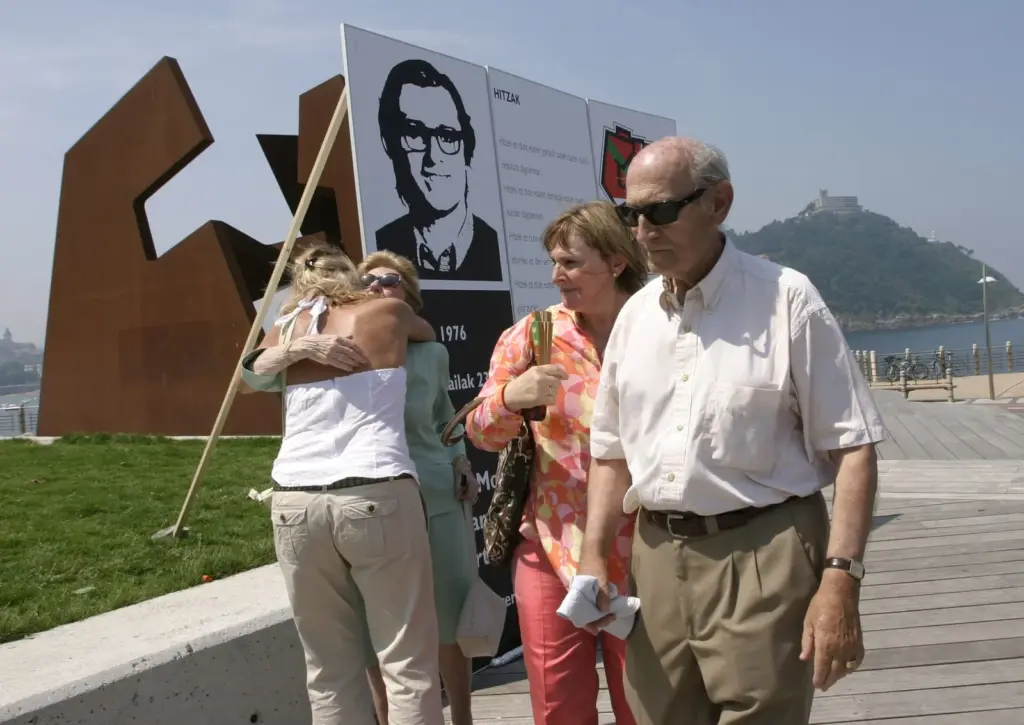
The disappearance of Eduardo Moreno Bergaretxe, Pertur, is the best known due to his political prominence —he was a leader of ETA-pm and advocated for the political path over militarism— and the persistent controversy over its authorship. He disappeared on July 23, 1976. In three months, it will be in the media spotlight as its 50th anniversary approaches.
His disappearance was initially attributed to the parapolice Spanish Basque Battalion (BVE), which claimed responsibility. But in 1978, his family accused the bereziak (ETA-pm militarists) and alleged that a few days before disappearing he had been kidnapped for a few hours, as well as letters from Pertur denouncing the police climate created by the militarists. His partner, Lourdes Auzmendi, and his sisters Alicia and Inés attribute the disappearance to them in their testimony at the exhibition.
The only police report from France on Pertur is from August 1977, comes from the Bordeaux Police Station, and is little known. After questioning Pertur’s relatives and colleagues, it concludes that his kidnapping could only have occurred with the complicity of one of his close associates. Subsequently, in 2008, Judge Andreu of the Audiencia Nacional reopened the case due to indications that Italian neofascists might have kidnapped him. Andreu interrogated seven expolimilis, three neofascists, three police officers, and a journalist. He concluded that there was insufficient evidence to charge anyone. He archived the case in 2012 without prejudice to reopening it if new evidence appeared. Pertur’s family and friends continue to fight to locate his remains.
Read more Workers in seven-thousand-dollar shirts: when luxury dresses the “normal people” of fiction