








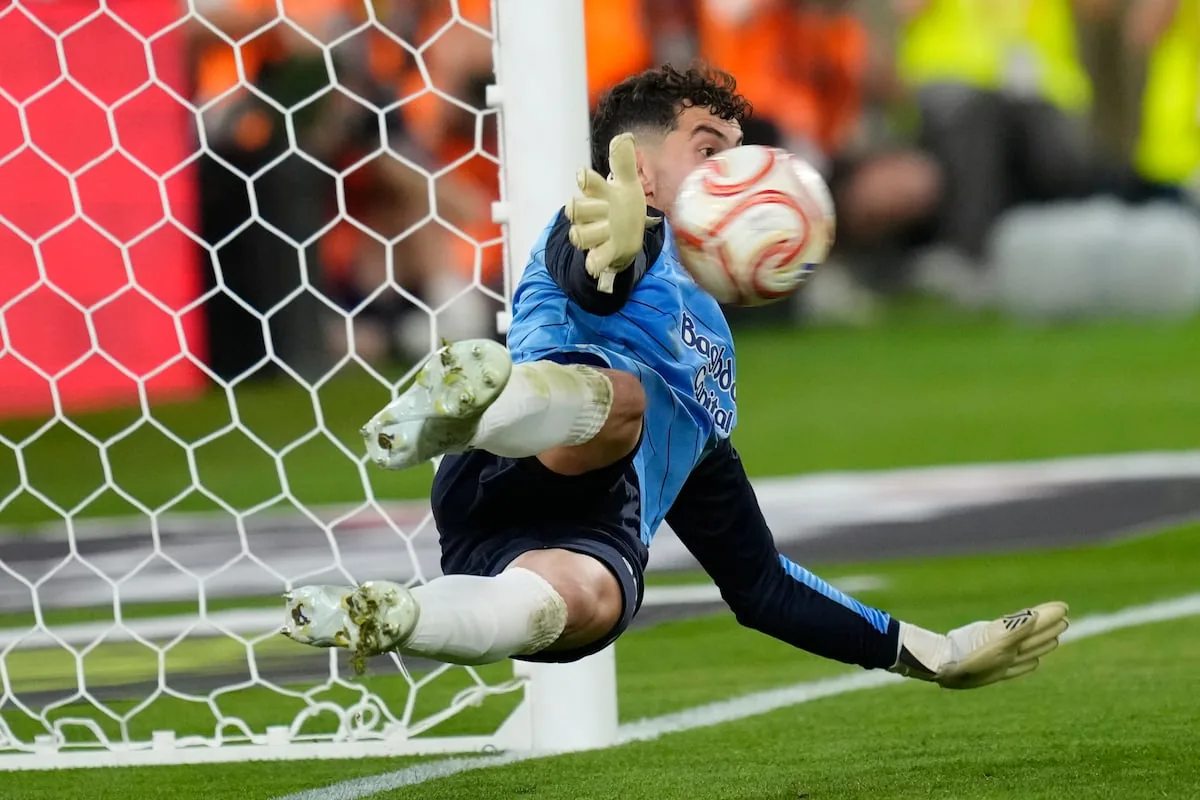
On the night Real Sociedad once again lifted a Copa del Rey, the scene found an unexpected protagonist who was, at the same time, deeply consistent with the club’s identity. Unai Marrero (Azpeitia, Gipuzkoa; 24 years old), a goalkeeper trained in Zubieta, held his team in decisive moments and saved two penalties from Alexander Sorloth and Julián Alvarez in the final shootout. His performance not only decided a title; it also reopened a historical line that had been suspended for years in San Sebastián.
Read more Complaints from Andalusians to the Ombudsman double in the last decade
Real’s goal has traditionally been a space of identity. In the seventies and eighties, Zubieta produced a remarkable generation of goalkeepers who, in many cases, had to develop elsewhere due to the dominant presence of Luis Arconada, a blue and white legend. Names like José Ramón Esnaola, Pello Artola, the ill-fated Javier Urrutikoetxea, or Agustín Elduayen illustrate a tradition that, however, lost continuity after Arconada’s own retirement in 1989.
From then on, Real spent decades navigating various solutions, without consolidating a figure from its own academy. José Luis González took over immediately; later came intermittent bets and signings like Sander Westerveld or Claudio Bravo. Meanwhile, attempts emerged from Zubieta that never quite settled. Asier Riesgo, who debuted in 2004, was the last homegrown Gipuzkoan goalkeeper to achieve some continuity. Afterwards, names like Eñaut Zubikarai or Toño Ramírez maintained a sporadic presence.
In this context, Marrero’s journey acquires a dimension that transcends the immediate. His debut in the First Division, on January 2, 2023, against Alavés at Anoeta due to Álex Remiro’s expulsion, marked the symbolic end of a prolonged drought. His performance in the final, however, opens up a possibility: that of recovering an interrupted tradition.
Those who have known him since his early years describe a profile away from the spotlight. Iban San Martín, his coach in the Lagun Onak de Azpeitia’s youth team, remembers an adolescent who was “introverted, very disciplined, and respectful.” The description is repeated with nuances throughout his career. “For a coach, seeing a player he has coached reach Real’s first team brings special joy,” he explains. But in his account, continuity weighs more than sudden emergence. “From a young age, he had striking potential. He was seen as ahead of the rest,” he assesses.
Read more El Roto: en harina electoral
Before arriving at Zubieta, Unai Marrero started in his closest environment: Ikasberri school and school football. His time at Lagun Onak, already at cadet age, marked a first turning point. He alternated in goal with Xabier Iturralde in a context of shared minutes that did not hide his progression. “The evolution was very fast. He had the conditions: reflexes, footwork, decision-making ability,” notes San Martín, current Councilor for Works and Services in the Zarautz City Council.
Real detected this growth potential in advance. In 2015, he began working within the club’s orbit, and a year later, he joined permanently. From then on, his career followed a recognizable pattern in Zubieta: prolonged training, internal competition, and a gradual entry into the first team. This process partly explains his behavior in a scenario of maximum demand. In the final, Marrero not only responded in the penalty shootout. His performance during the match offered a broader reading: security in aerial play, good judgment in decision-making, and a competitive continuity unusual for a debutant. “He is a goalkeeper who decides well when to come out and transmits security,” summarizes his former coach. The shootout, however, concentrates the narrative. Against Sorloth and Julián Alvarez, Marrero remained calm. “He has always been very active in these types of situations,” San Martín recalls.
Off the field, the portrait maintains the same line. “He’s a down-to-earth kid, very normal, very much from his environment,” he describes. San Martín insists on a trait he considers definitive: personal continuity. “You see him now and he’s the same. Always willing to help, to integrate into the group.” A way of being that, in the current context, acquires particular value. Marrero does not fit the mold of the visible leader. San Martín shies away from grandiloquent labels to define him: “More than a leader, he is humble.” And that phrase encompasses his entire career. “He has gone step by step, with effort and work.” The locker room respects him, the fans idolize him, and his name is now pronounced with more than just excitement.
Read more The short trench coat, a new interpretation perfect for transitional weather