









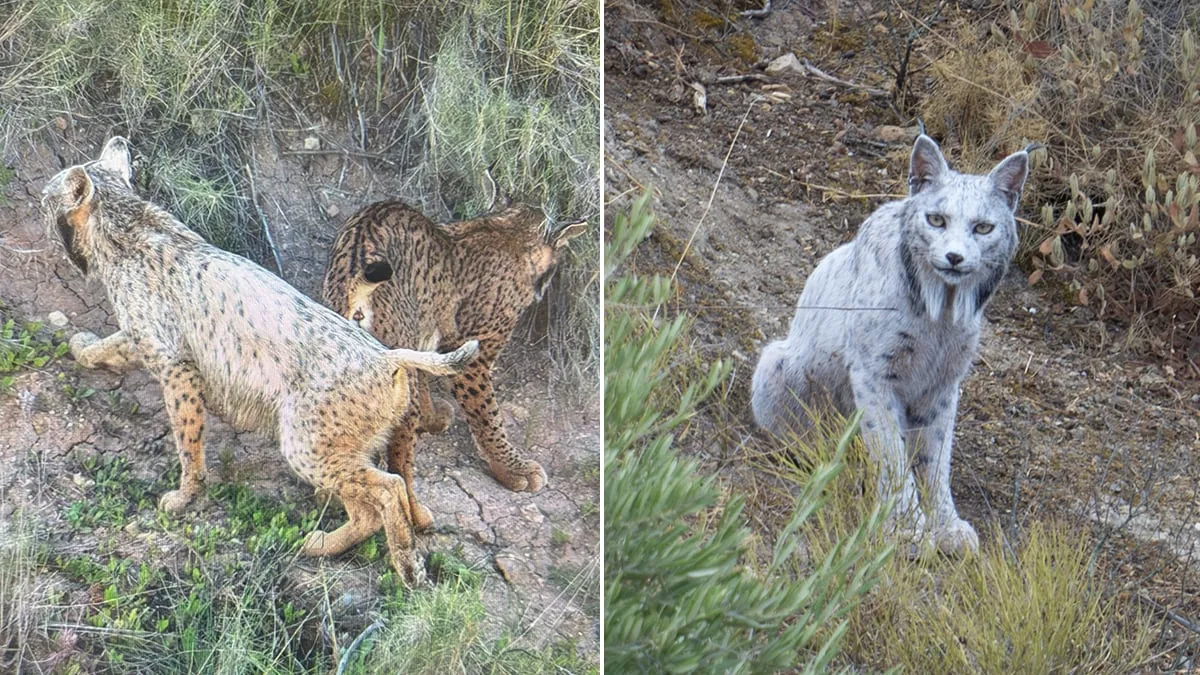
In early October last year, nature photographer Ángel Hidalgo captured unusual images of a completely white Iberian lynx in a mountainous area of Jaén. The specimen, a female named Satureja born in 2021, had lost the species’ characteristic coloration, between browns and oranges, to acquire an almost spectral appearance. Only the black spots remained ―the ID that allows each specimen to be identified―, although when she was born she was completely normal.
Now, six months later, new photographs taken by Hidalgo reveal that Satureja is progressively recovering her natural tones, as if she were a feline chameleon. In the images, she appears accompanied by one of her cubs from last year, which has normal coloration. The scene confirms her good state of health, although it does not clear up the mystery of the white fur.
Hidalgo, a specialist in lynx observation and tracking as well as a photographer, stopped following Satureja on foot during the mating season ―December and January― so as not to disturb her. “Between the nocturnal habits of the species and the very short winter days, my presence added very little and could hinder a lot,” he explains. But he did not leave her completely alone; camera traps ―“my eyes when I’m not in the field,” he describes― confirmed that she was active during the mating season and without any problems.
After this period, the photographer returned to Satureja’s territory and encountered her again between late February and early March. “At that moment, it was already noticeable that she was changing color,” he comments. He did not see her again until April, already with different fur. The new hair is appearing as she loses her winter coat, which was longer and thicker and in her case was white, to change to her summer coat. The molt occurs in spring.
During the last year, Hidalgo has witnessed the growth of one of Satureja’s daughters, who led him to her mother. “I discovered that she considered me part of her environment when, after hunting a rabbit, she brought it to my position, and especially when one day she began to walk and stop, as if she were guiding me, until she appeared with her mother behind her,” explains the photographer. “It was a magical encounter. I felt that the young lynx was introducing me to her origin, validating my presence before her mother,” he describes.
Read more Julio César N: the Teotihuacán shooter who praised the Columbine massacre and the fascist far-right
Unresolved mystery
What is still unknown is the reason for the lynx’s white color or why it has lasted until now. The Junta de Andalucía rules out that it is a case of albinism or leucism and suggests that the problem may lie in some type of product used in the field or that there may be a genetic predisposition.
They have documented another previous case, which did not come to light, of a female named Inés who experienced the same thing, and who also recovered her color when the winter coat changed. She has never been white again. Both come from the same place and may perhaps be related, a point that is not confirmed. Satureja ended up living in Jaén and Inés in Córdoba, but both follow similar patterns.
Technicians from the Junta de Andalucía, responsible for the species reintroduction program, hoped to capture Satureja to carry out tests. But it has not been possible, since as a specimen born in the wild, she does not carry any transmitter that allows her location. Even so, she was very close: “She was photographed in front of the cage, but finally decided not to enter,” sources from the Junta de Andalucía report. Attempts had to be suspended with the arrival of the breeding season, and cannot be resumed until it ends. However, they did manage to capture one of last year’s cubs, which has already been reintroduced in Palencia.
This year it is not yet known if Satureja has bred, because the cubs are still very small and have not left their hiding places. What does seem to be the case is that this lynx is ceasing to be the “white ghost of the Mediterranean forest” as Hidalgo christened her when he first managed to capture her image.
Read more Maps | How the Strait of Hormuz blockade works and why some ships pass and others don’t