









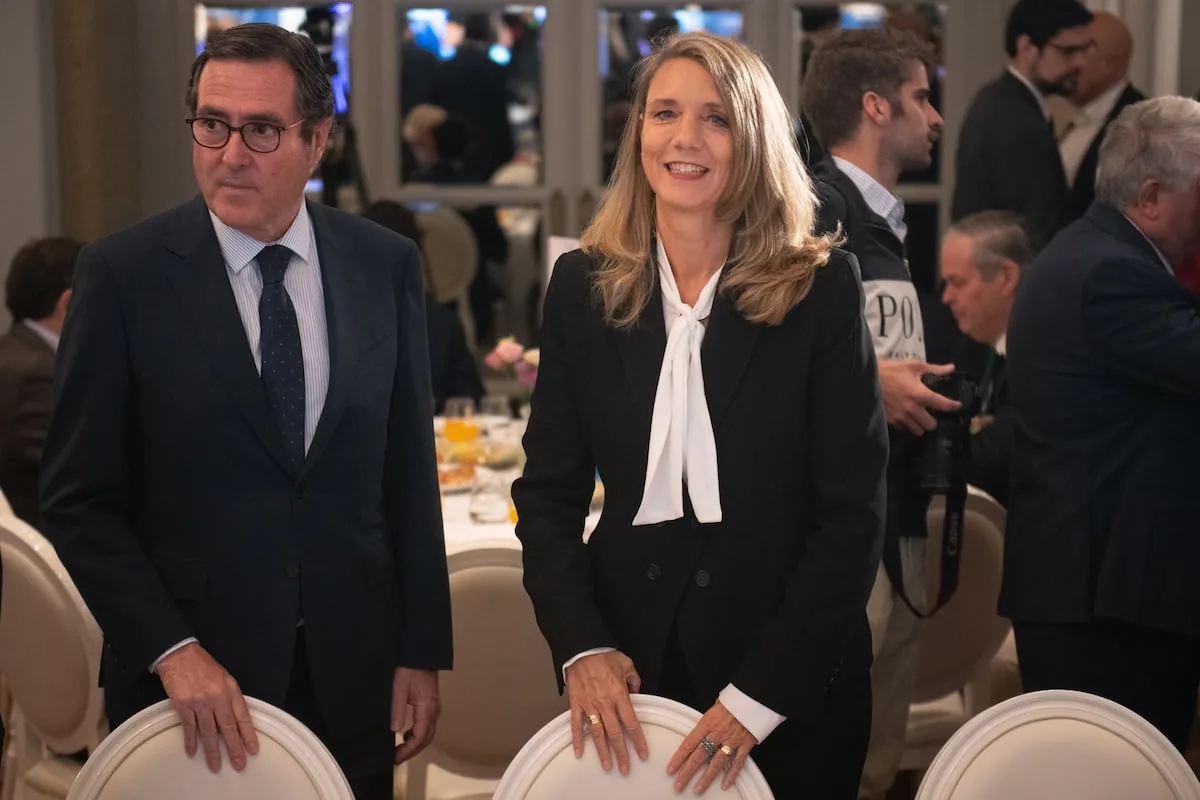
The president of the organization of small and medium-sized enterprises (Cepyme), included in the large employers’ association CEOE, Ángela de Miguel, warned this Tuesday that she will defend the role of business organizations and social dialogue in general “regardless of who is in front of them in the different governments,” in reference to the new agreements between the PP and Vox to govern in several autonomous communities. De Miguel, who spoke this Tuesday at an informative breakfast organized by Nueva Economía Forum, was asked if she feared that Vox would repeat, in the communities where it has just reached a government agreement (Extremadura) or where it is negotiating one (Castilla y León and Aragón), the attacks on the institutional role and financing of unions and employers’ associations that Santiago Abascal’s party already carried out in the Castilian-Leonese and Murcian executives.
Read more Apple’s weak flank: Tim Cook’s close relationship with Donald Trump
“We are very clear about our role, Article 7 of the Constitution states it, and we are going to defend social dialogue through the different political vicissitudes,” she insisted, referring to the decisions taken by Vox regarding employers’ associations and unions in the autonomous governments where it has governed. Both in Castilla y León and Murcia, coalition governments of PP and Vox approved measures in their day to cut subsidies to social agents, although the initiatives were challenged in the courts. “Against anyone who tries to limit social dialogue, we will be there defending it. Even if it is sometimes difficult to explain,” added De Miguel.
The president of Cepyme, who took office almost a year ago with the support of the CEOE president, Antonio Garamendi, after a turbulent electoral process, has maintained that the current Government has also deteriorated social dialogue. “Especially from the Ministry of Labor,” she said, “because there is dialogue, but it is not effective; we sit down and negotiate, but we do not get results in the final decisions,” added the president of the SME employers’ association.
Thus, De Miguel has assured that small and medium-sized enterprises and, above all, micro-SMEs (with fewer than 10 employees) “are the great forgotten ones of public policies” and has lamented that some 25,000 of these smaller companies have disappeared since before the pandemic. For this business leader, SMEs face three major problems that hinder their productivity and profitability: high costs, especially labor costs —she recalled that the minimum wage is 1,900 euros per month if the payment of social security contributions paid by the employer is included—; excessive bureaucracy that, for example, prevents them from accessing workers in dual training; and the lack of workers and generational replacement at the head of businesses, particularly in the service sector and in trades.
Therefore, she has demanded that the Government include incentives for labor integration in the initial assistance provided to foreign workers who are to be regularized. “It is very important to work on the training of all those who are going to be regularized,” De Miguel emphasized. And, specifically, she has called for efforts to ensure that, with a few hours of training, they obtain professional certificates that enable them to fill the numerous vacancies for which employers cannot find employees, she concluded.
Read more Zumthor designs the great museum of the American West in Los Angeles