




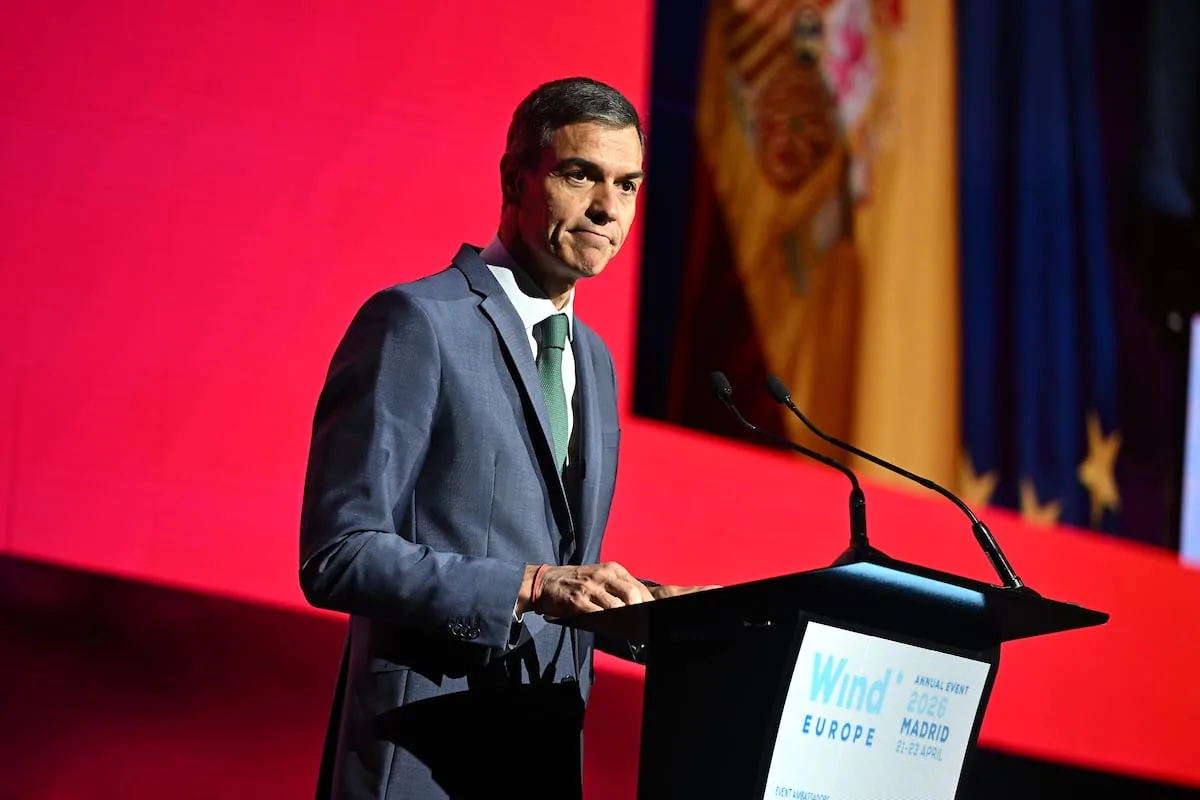
“Spain has shown that green pragmatism triumphs over fossil dogmatism.” Under this premise, the Spanish Prime Minister, Pedro Sánchez, defended this Tuesday that the energy transition is not a mere political slogan, but a “ticket to the future” and the only real safeguard for the continent’s economic sovereignty. Faced with a fractured world order, Sánchez suggested that Europe must choose between “turbines or turbulence,” illustrating the fragility of the current energy model. According to the Executive, dependence on fossil fuels —highlighted by the conflicts in Ukraine and Iran— has allowed “a single foreign leader to decide and 27 European economies to be at their mercy,” a vulnerability that already translates into an additional cost of more than 22,000 million euros for the European Union.
Read more Beto Brandoni, the last of an Argentine lineage
These statements marked the beginning of the WindEurope summit in Madrid, an event that brings together more than 60,000 professionals from the sector at a time when energy has shifted from the commercial arena to that of national security. In this context, the president insisted that Europe must commit to renewables and recalled that “energy freedom is priceless.”
At a time when the European Green Deal faces criticism in certain political blocs, Sánchez was emphatic that Spain is “better positioned than ever” to defend its continuity, relying on the advancement of renewable energies and the consequent reduction of its dependence on gas. As an example, he assured that in March of this year electricity prices were 20% lower than a year ago, despite gas becoming 60% more expensive as a result of the war in the Middle East.
Sánchez did not hide his concern about the duration of the conflict between the United States and Iran and its impact on inflation. In this context, he reiterated his call to the European Commission to establish a levy on the extraordinary profits of oil and gas companies, emphasizing that, in a complex environment like the current one, companies must contribute to alleviating the burden on consumers. “Spain is not content with leading in low electricity prices; we aspire for Europe as a whole to achieve that goal,” he added.
In the same vein, the European Commissioner for Energy, Dan Jorgensen, warned that dependence on imported fossil fuels represents an additional burden of 500 million euros daily for the European economy. Jorgensen stressed that, while the Old Continent has managed to drastically reduce its dependence on Russian gas —going from 45% to less than 10%—, the strategic error of entrusting energy to external powers must never be repeated. For the commissioner, the solution does not lie in national patches, but in a “true energy union” that replaces the “isolated” systems of the 27. This new paradigm will be articulated through an ambitious grid package that seeks to centralize infrastructure planning and radically reduce permit concession times for wind farms from a decade to just six months.
Read more Netflix begins filming its miniseries inspired by the Marta del Castillo case
Brussels’ diagnosis comes at a time when the industry is asking to move from speeches to actions, with clear and simple investment frameworks. Henrik Andersen, president of WindEurope, argues that a system based entirely on renewable energies could mean savings of up to 1.6 trillion euros in energy costs for Europe. However, he warns that the current tax model —which penalizes electricity while still favoring fossil fuels— is incompatible with industrial competitiveness.
In his speech, he insisted that pressure has also intensified due to the geopolitical context, with the conflicts in Ukraine and Iran, which have reinforced the idea that electrification is key to guaranteeing the continent’s prosperity and resilience.
The sector also looks at new risks. Rocío Sicre del Rosal, president of the Spanish Wind Energy Association (AEE), warns that Europe could move from one energy dependence to another of a technological nature, and emphasizes the need to protect its own value chain that today employs more than 440,000 people.
The vision of the continent enjoying industrial autonomy has been reinforced by Miguel Stilwell, CEO of EDP, who insisted that European competitiveness depends on leveraging resources that, unlike gas or oil, the bloc possesses in abundance, such as wind and sun. Furthermore, he lamented that while Washington uses tax credits to incentivize clean energy consumption, in Europe the electricity bill is still burdened by a tax load that, in his opinion, turns it into a state revenue collection tool at the cost of penalizing the electrification that is sought to be promoted.