









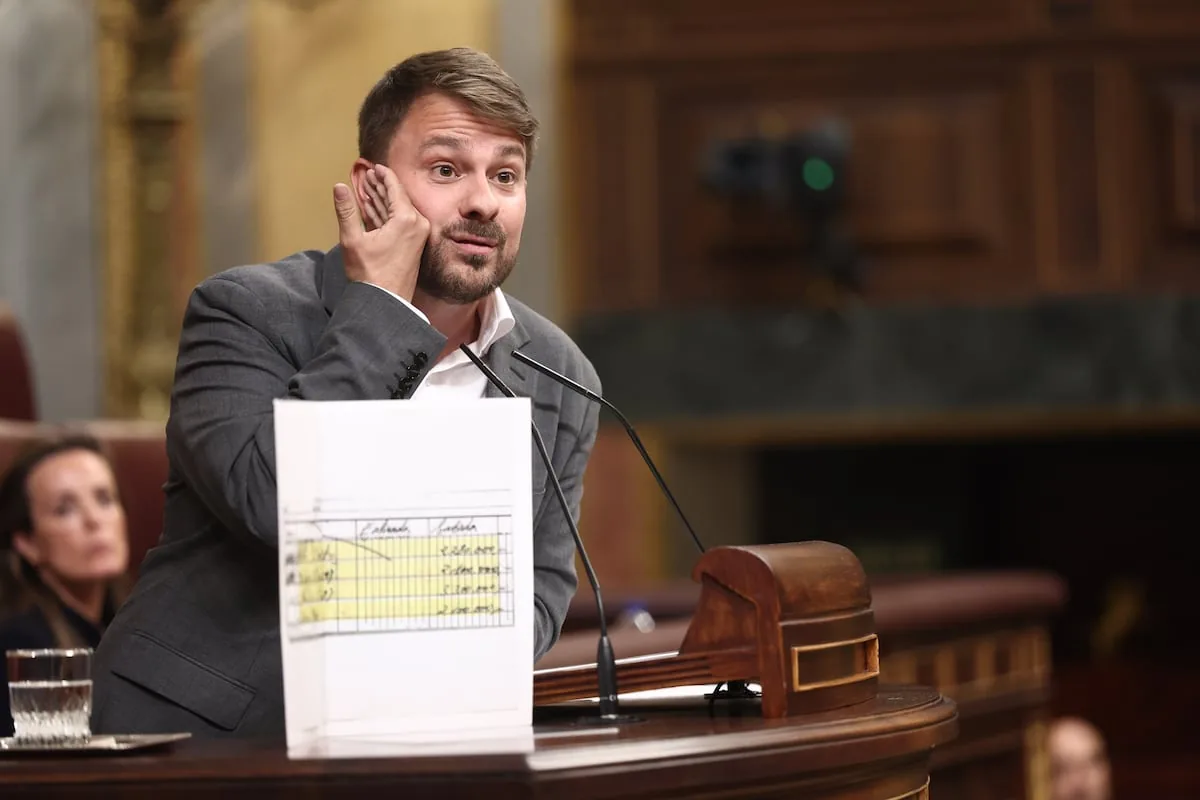
“But do you think a family can live on 900 euros? What country do you live in?” The question, addressed to the Popular Party, went from mouth to mouth among the spokespersons who intervened this Tuesday in the plenary session of Congress. From Podemos to PNV, from Sumar to EH Bildu. “You are very good family administrators, even magicians, if with barely 1,000 euros you believe that a family can access housing and eat every day,” ironized the PNV member Maribel Vaquero.
Read more The Community of Madrid will study the value of the tram rails found in Puerta de Alcalá
The current Civil Procedure Law considers a family vulnerable, for the purpose of establishing restrictions on their eviction, when their income does not exceed three times the Iprem, the reference index for determining the income that allows access to public aid and subsidies. This year the Iprem is set at 600 euros, so a family would be considered vulnerable when their monthly income is less than 1,800 euros. The PP intends to reduce it by half.
This is stated in a bill brought by the Popular Party to this week’s plenary session in Congress, which would represent a significant change in urban planning and housing regulations. One of the sections of the initiative lowers the income threshold for a family to be declared vulnerable to 1.5 times the Iprem, thus making it more difficult to evict them from their home. It also proposes reducing the period an tenant has to leave their home from two months to one, once a judge orders the eviction.
The left attacked him. “You are afraid of the poor, you dislike them, you hate them,” accused Oskar Matute, from EH Bildu, amidst protests from the Popular Party bench. The PP also turned against Sumar deputy Alberto Ibáñez when he urged the Popular Party spokesperson who defended the proposal, Soledad Cruz-Guzmán, to look him in the eyes and tell him if a family can live on such a meager income. “I understand that your blood boils, mine boils when I read your laws,” an angry Ibáñez retorted.
The PP’s proposal suggests reforming three laws, including the housing law, to remove the possibility of declaring areas as “stressed” in order to set caps on rental prices. This not only led the left to accuse the Popular Party of acting “at the behest of speculators and vulture funds.” This point, along with the tightening of the vulnerability criterion for families, led the PNV to abstain, despite the fact that a part of the PP’s initiative coincided with another that the Basque group and the socialists had previously brought to Congress.
Read more Sheinbaum questions security at the Teotihuacán pyramids: “How does one enter with a weapon?”
This aspect of the PP’s proposal would entail a reform of the land law, highly demanded by city councils of different political affiliations. It would consist of streamlining procedures for granting licenses, shortening deadlines for issuing reports on urban planning, and preventing these from being annulled in their entirety if the courts rule illegalities in any of their parts.
A very similar reform was presented at the time by the PSOE and harshly denounced by its Sumar partners. The main government party hoped to push it through with the PP, which shared the bulk of its content. But the Popular Party preferred to inflict a defeat on the government and, faced with the announcement of their opposing vote, the socialists withdrew it. The PSOE returned to the charge and presented an almost identical text together with the PNV. The PP again voted against it, along with the groups further to the left, and it was defeated.
This time it was the PP that appealed to the fact that it is a request from city councils of different parties and called for consensus on measures that, it argued, would facilitate the construction of new housing. “If housing is a state problem, let’s show that we are capable of reaching state pacts,” was the call from deputy Cruz-Guzmán, who specifically addressed the PNV to ask for “coherence with their voters, their citizens, and their industries.” Maribel Vaquero retorted: “You voted against it a year ago for political reasons and now you ask us for responsibility.” The same reproach came from socialist Isabel Pérez, who rejected the rest of the proposal because, according to her, it proves that the PP’s urban model “is speculation.”
Read more Karol G returns to Spain in 2027 with concerts in Barcelona, Seville and Madrid