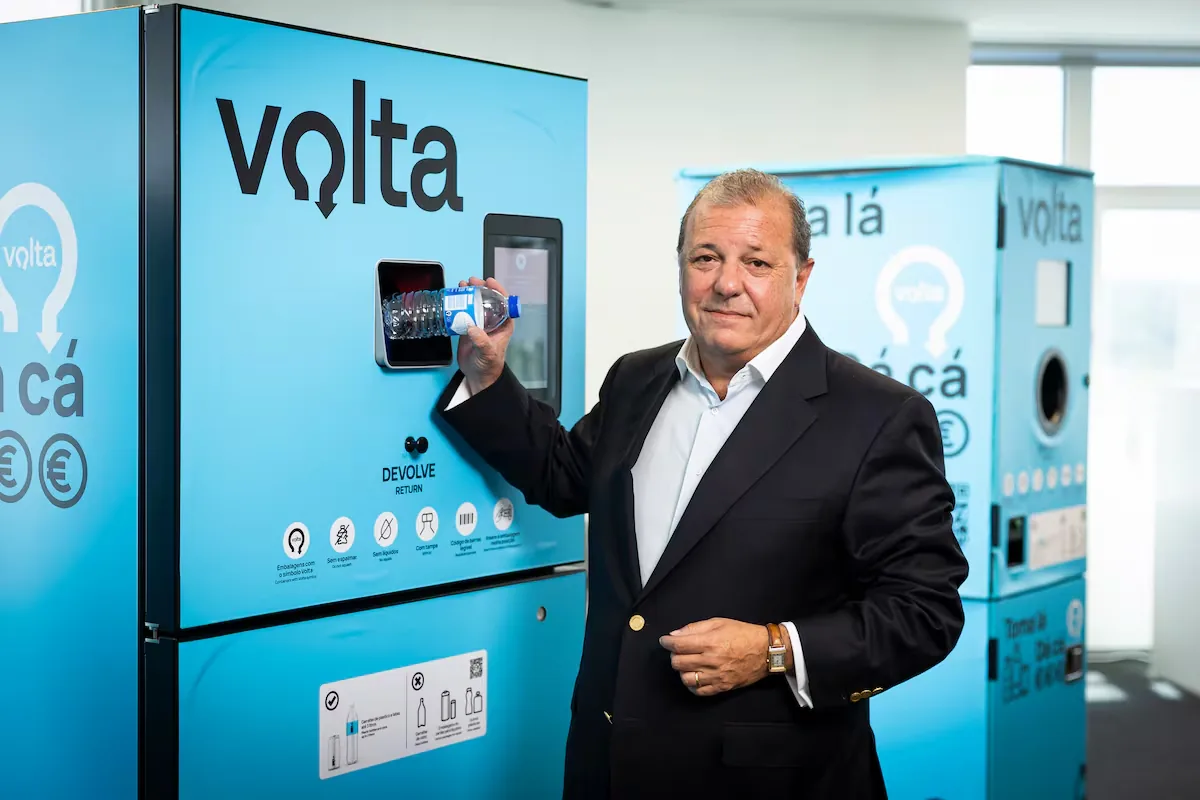








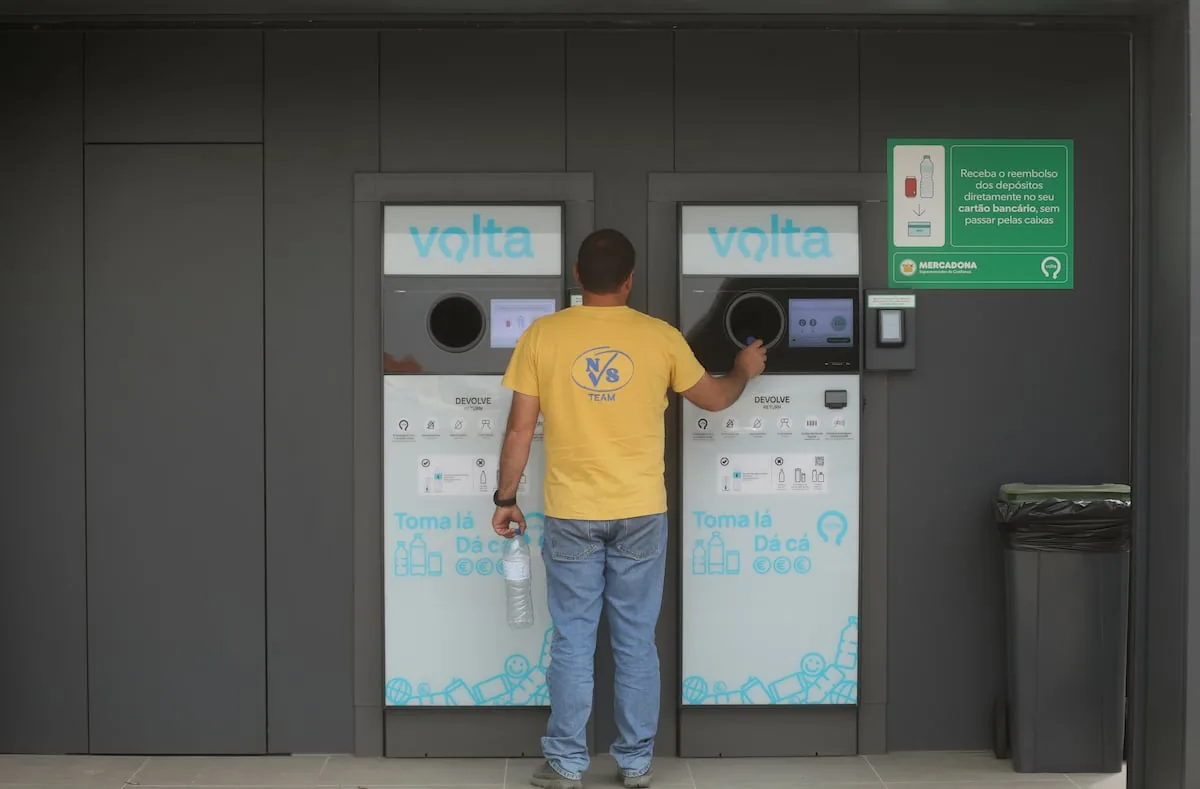
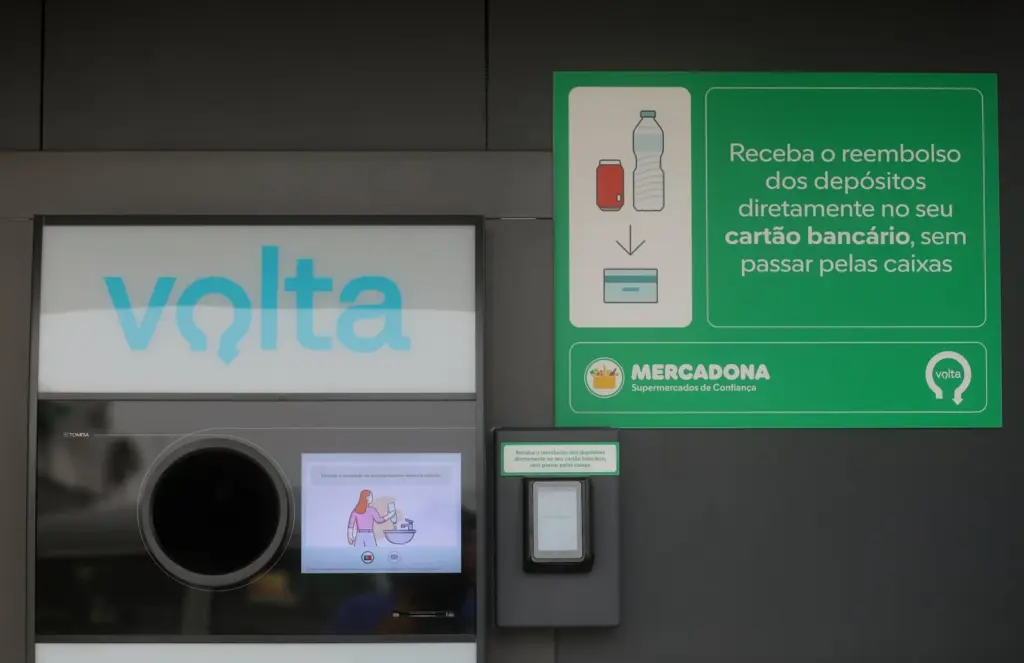
At the Mercadona supermarket in Caldas da Rainha, Portugal, customers can insert empty soft drink cans into a machine and receive a refund directly to their bank card. Since April 10, a Deposit, Return and Refund System (SDDR) for beverage containers has been operating in Portuguese territory, similar to the one that needs to be implemented in Spain by next November, although representatives of the companies involved have already stated that the deadline will not be met.
With this, there are now 19 European countries with this type of container collection, but its arrival in neighboring Portugal is especially relevant because it is a border market, which even shares many products with Spain that carry common labeling. The new machines of this system, baptized as Volta, in Portuguese establishments of the Spanish brand Mercadona show the great closeness between the two countries, and at the same time give clues as to what the SDDR here should be like.
“A few weeks ago we had a meeting with the Portuguese organization that runs it; coordination between the different countries is necessary, as we have seen in other places where there are SDDRs and they have cross-border effects,” says Antonio Romero, spokesperson for SDDR for Spain, the association created by representatives of distribution and beverage manufacturers in our country to implement this form of collection. “We believe that our model has to resemble Portugal’s, especially in the phase related to the consumer, who ultimately is the one who makes the system work,” he states.
Portugal’s SDDR includes single-use metal and PET beverage containers, i.e., cans and plastic bottles, up to three liters. To differentiate the products involved, in a first phase, these are limited to those bearing a Volta logo. When the consumer buys a drink in one of these formats, in a store or a vending machine, they pay a 10-cent deposit, which they only recover if they return the container at one of the collection points and in good condition. For reimbursement, different options can be chosen: a coupon redeemable for cash at the checkout, a discount voucher in the store, accumulation on a loyalty card… Mercadona machines in Lisbon allow direct reimbursement to a bank card.
While the conditions of Spain’s SDDR are still to be finalized, the deposit amount in Portugal coincides with the 10 cents marked as the minimum base by Royal Decree 1055/2022. In contrast, an important difference is that Spanish regulations include, in addition to plastic bottles and cans, cartons. “We believe that to avoid distortion, it is necessary for our system to only include PET and cans,” emphasizes Romero, who assures that none of the existing systems in Europe incorporate cardboard containers.
The obligation to implement this system in Spain is a consequence of the failure to meet the European objective for collecting plastic bottles for recycling. Although in 2023 the country was supposed to recover 70% of these beverage containers, an evaluation published in November 2024 by the Ministry for Ecological Transition calculated that only 41.3% was achieved, which automatically mandated the implementation of an SDDR throughout the national territory within two years, in accordance with Law 7/2022 on Waste and Contaminated Soils for a Circular Economy.
This deadline is November 2026. However, from the beginning, beverage manufacturing and distribution companies obliged to create the new Spanish collection system have asked to extend this date. In the opinion of the SDDR spokesperson for Spain, the Portuguese case precisely shows the need for more time. “In Portugal, this has been discussed for many years, as their first law incorporating the SDDR obligation was from 2018 and set the date as 2022,” comments Romero. “Ultimately, the definitive law was in 2024, and it still took two more years to implement it.”
In the Spanish case, at this moment, it is awaiting the Community of Madrid’s decision on whether or not to authorize the entities that have applied to manage the system in Spain. It is up to the Madrid Administration to rule because it is in this region where the registered office of the four organizations that have made the request is located: SDDR for Spain, Ecoembes, Corepet, and Procircular. This process has lasted almost a year, but theoretically, the time provided by legislation for a response expires in May.
While the Portuguese system is managed by a single entity, SDR Portugal, the possibility that the Community of Madrid authorizes several of these entities opens the door for there to be several competing managers in Spain. However, everything is yet to be decided. According to Carmen Sánchez, general director of Procircular, “we have told the Administrations that competition is good, but well regulated and organized by a coordination body that is private, public, or semi-public.”
For the organizations involved, beyond which entities obtain administrative authorization in Spain, the main issue is to establish the regulatory framework that will govern the system throughout the state. Without that, it is difficult to know when the machines will also arrive at the country’s supermarkets.
According to Sánchez, when the deposit system starts, the first positive effect will be noticed in city bins and street cleaning. In Spain, 18 billion containers are marketed each year, an enormous quantity driven by high temperatures and 96 million tourists. In fact, it is a similar quantity to Germany, which has almost double the population. “There will always be someone who cares about collecting containers because it’s a bit of money. The effect will be very positive, although a lot of information campaigns are needed, and we must be very didactic with citizens. Our estimate is that SDDR containers represent a third of the current yellow bin,” she notes.
Read more Elon Musk elevates his AI obsession: SpaceX secures a $60 billion purchase option for Cursor