









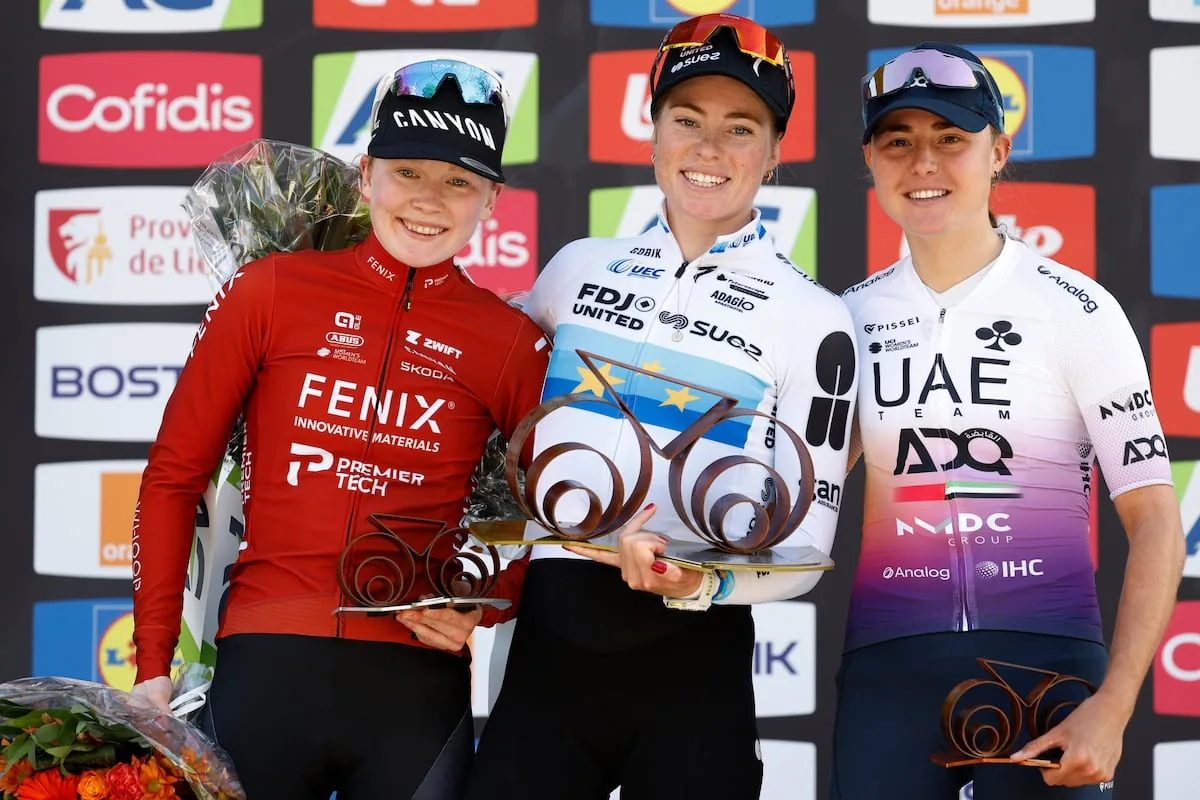
Paula Blasi plays innocent, oh what unconsciousness hers, not knowing what she’s getting into, and wins the Amstel Gold Race on Sunday. Chroniclers worldwide waver in their analyses. A few recognize that the Catalan cyclist is a crack, but most blame the second and third place finishers, the great veterans Demi Vollering and Kasia Niewiadoma, for not taking Blasi’s attack seriously on the penultimate ascent of the Cauberg, 22 kilometers from the finish line. But to maintain the breakaway with strength, without exhausting oneself, against such a pursuit, something more than unconsciousness, luck, or rivals’ apathy is needed, and three days after surprising the world around Maastricht in the Dutch countryside, Paula Blasi, who is no longer a surprise, demonstrates it in neighboring Belgium on the tremendous Mur de Huy, one of the sacred places of world cycling, where only two cyclists surpass her: the great Demi Vollering, who takes her revenge from Sunday, and last year’s winner, the young Dutchwoman Puck Pieterse, who overtakes her in the interminable final 100 meters with a refined punch honed year after year in cyclocross races.
Read more Rebeca Grynspan: “If I am elected Secretary-General of the UN, I will be a reformer”
Blasi enters the wall poorly positioned, 1,200 meters at 9%, and is still far from Vollering when the latter accelerates, seated on her bike, more than 600 meters from the finish line. The Catalan progresses to second place, her long braided ponytail emerging from under her helmet like a wild lioness’s tail, swaying from side to side, as she maintains a fierce, triumphant elbow-to-elbow battle with Niewiadoma. Vollering is unreachable. Second place extends its arms to her. Pieterse, an explosive redhead, cuts them off.
The UAE rider –a team where she shares life with Mavi García, 42, who arrives with her, helping her, at the foot of the Wall, in the group of 16 that broke away on the previous climb, to Cherave, and passes her water bottle to quench her thirst—wants to be a general classification rider, but wins classics because she still maintains the explosiveness she trained so much last year when she was coached by Paolo Slongo, the Italian who made Vincenzo Nibali and Elisa Longo Borghini. This year she has returned to work with Fran Escolá, her athletics coach. “And I’m progressing,” said the rider from Esplugues, who has a house in Cerdanya, near Alp, and trains in Andorra, in Ciclismo a Fondo a few weeks ago. “Before, I just held on, and now I ride the races; I read them better, and I can anticipate the movements of others and better calculate my own.”
No one can say anymore that Blasi was a young newcomer no one paid attention to. Blasi –23 years old, a middle-distance athlete until 20, also a duathlete, footballer, hyperactive, an inveterate reader, graduated in Physical Activity and Sport Sciences, so many things and more— can no longer repeat what she explained in the magazine: “Not knowing anything about cycling works in my favor. When I started, I hadn’t even heard of Vollering or Marianne Vos. That helps me not feel intimidated on the road. On the bike, we are all equal.”
She had already arrived at La Flèche Wallonne as one of the favorites. She already knew who Vollering was, and everyone already knew who she was. And so she will arrive on Sunday at the end of the spring road before thinking about the Volta a Catalunya and the Vuelta a España and its Angliru: Liège-Bastogne-Liège, the great Ardennes classic. The Monument that awaits her.