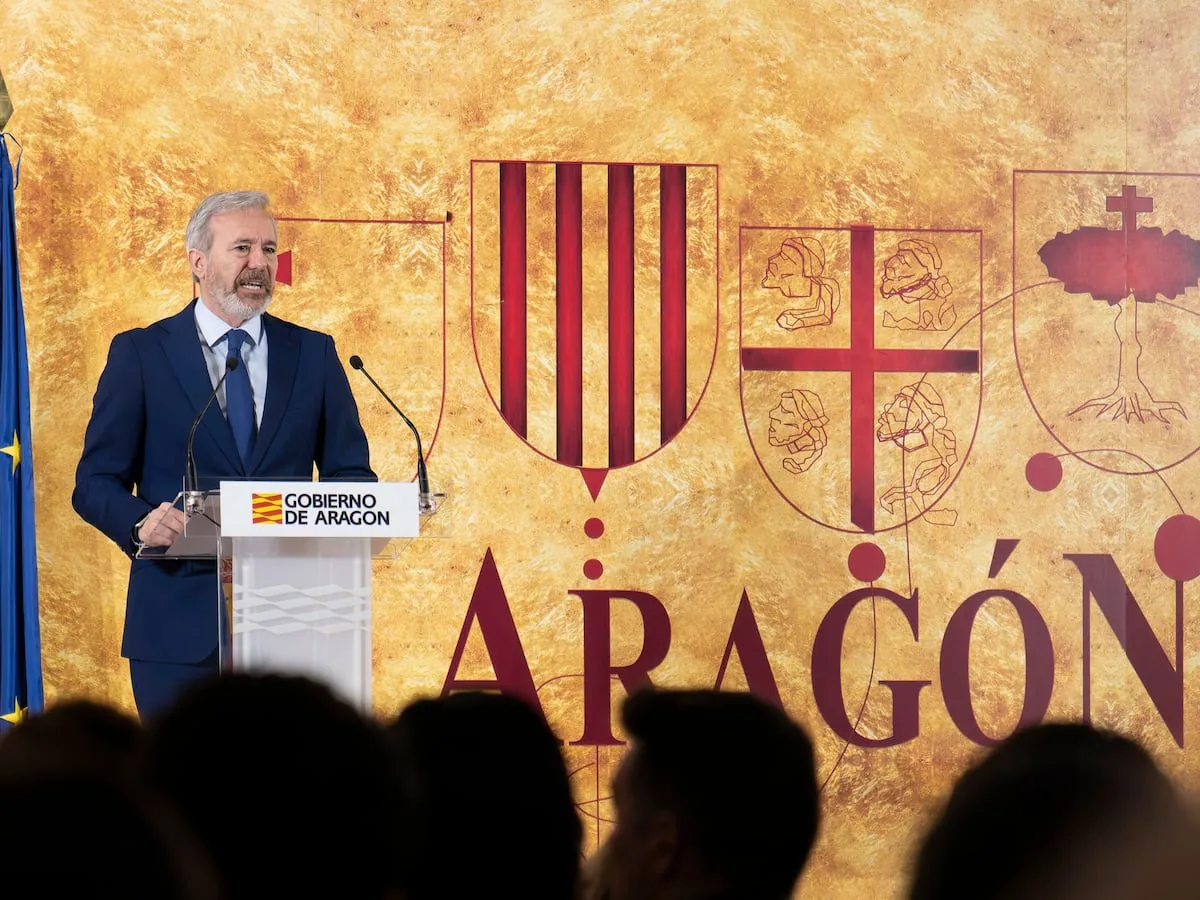







The PP reached an agreement this Wednesday with its former government partner, Vox, to re-establish the coalition in Aragon with three ministries under its charge. Both forces have agreed on a 13-point document, with a special focus on immigration, as they already did in Extremadura, with the popular party responding to a good part of the demands and arguments of the far-right on this point. The new Executive intends, among other objectives, to return unaccompanied migrant minors to their countries of origin, give priority to nationals in access to social housing, and limit other benefits and social aid for irregulars. Both formations have agreed to give the far-right three ministries, one with the rank of vice-presidency: one for Deregulation, Social Services and Family; another for Agriculture, Livestock and Food; and a third for Environment and Tourism (which includes the management of Inaga, the Aragonese Institute of Environmental Management), in addition to a senator of autonomous designation. In return, Vox commits to approving the four annual Budgets throughout the legislature. These are some of the measures included in the pact.
Read more Teotihuacán reopens its doors two days after the tragedy: “I had many doubts about coming or not”
Immigration. The Popular Party assumes Vox’s most extreme demands in the fight against immigration, the great banner of Abascal’s party, as it already did in Extremadura. And with measures ranging from the return of unaccompanied migrant minors to the suppression of economic aid for NGOs that assist foreigners, the commitment not to enable more places in reception centers, or the prohibition of the use of the burka and niqab in public spaces. As also reflected in Extremadura. As a starting point, the new Executive will “oppose by all legal, judicial, and political means any mechanism for the distribution of illegal immigrants [sic], both adults and minors.” Nor will they allocate a single euro to facilitate their entry or reception in Extremadura. But the pact does not stop there, and also incorporates the commitment to work “actively to return unaccompanied minors to their countries of origin” through “agreements with the countries of origin, which facilitate and expedite the effective repatriations and returns of minors with their parents.”
Occupation.The text, within the “Security” section, points to the “firm application of express eviction” and the development of autonomous mechanisms to support the “victims” of occupied homes, without further specifying what they consist of. Those convicted of occupation will not be able to benefit from access to the purchase or rental of social housing. The same section includes demanding that those responsible for safeguarding “crime statistics linked to massive and illegal immigration” publish them periodically.
Healthcare and social aid. The agreement contemplates, as in Extremadura, “the exclusion of access to structural social benefits and services for those in an irregular situation, limiting their access exclusively to cases of vital urgency.” This implies, according to sources from the Aragonese PP, that the Extremaduran income complementary to the state minimum vital income could be affected. The Aragonese popular party rules out that universal healthcare will be affected, but the text of the agreement is ambiguous. A “Benefit Fraud and Census and Effective Residence Verification service” is also created to deepen the control of immigrant registrations.
Taxes. The agreement partly replicates what was agreed in Extremadura, and applies an annual and progressive reduction of 0.25% in income tax for those who declare less than 52,500 euros, reaching 1% at the end of the legislature, and also contemplates deductions for taxpayers with disabled children. The signatories include this last measure within a section on “support for birth rates and work-life balance,” with increasing tax reductions per child (1,000 euros for the first, 1,500 for the second, and 2,500 for the third and subsequent ones). 25% of the expenses for support classes can also be deducted.
Read more Elche gets a boost and defeats a summer-friendly Atlético
Depopulation. PP and Vox specify the total income tax deduction for birth or adoption in rural areas. It also reduces wealth tax for young people buying homes, provided it is in a municipality with fewer than 10,000 inhabitants and away from provincial capitals. The agreement includes abolishing, in 2027, an environmental tax on pollutant emissions. The pact contemplates aid for “business operations” in Teruel, subsidizing the installation of video surveillance cameras, and the entry into force of a regional road plan endowed with 135 million euros.
Housing. The agreement reiterates the principle of “national priority, in accordance with current legality” for access to protected housing and social rental, with the same deadlines as agreed in Extremadura: 10 years of registration in Aragon for purchase and 5 for rental. The pact contemplates the construction of 4,000 public homes in four years and is more imprecise on other measures to increase supply, among which it mentions “streamlining urban transformation processes.” It also includes reductions, already throughout 2027, in the Stamp Duty for young people and large families who acquire housing.
Catalan. The agreement includes a section titled “freedom against indoctrination and imposition” which essentially means “freeing Aragon from the imposition of Catalan” (a language spoken in Aragonese municipalities bordering Catalonia and considered, along with Aragonese, “an original and historical language of the community” in the Aragonese Language Law of 2009) and the suppression of the Aragonese Institute of Catalan. Vaguely, it also mentions reforming “rules that “respond to ideological approaches,” but refers to a subsequent review of the legal system to determine which ones.