
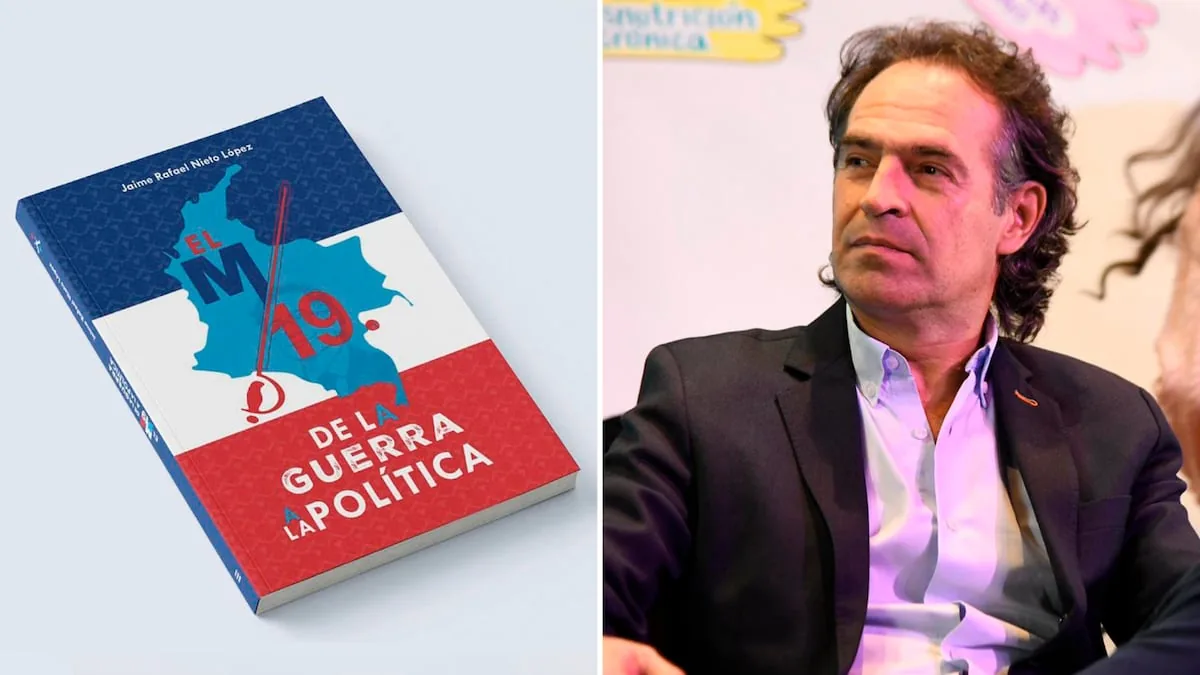
The order from the mayor of Medellín, Federico Gutiérrez, arrived a few minutes before the presentation of the academic book The M-19, from war to politics began. The discussion, organized at the Public Pilot Library, had to be canceled for allegedly vindicating the guerrilla group to which President Gustavo Petro belonged in his youth. “In Medellín, there will never be space for the apology of terrorism,” Gutiérrez wrote on X, at 4:49 p.m. on Tuesday. The auditorium, already full, rebelled. Although the library staff removed the sound and the Police surrounded the building, attendees remained in their seats. “This is not a space for rulers, but for writers, artists, and citizens,” says Jaime Rafael Nieto, author of the book and professor of Sociology at the University of Antioquia, by phone.
Read more Palace brings order in Morena
Gutiérrez took advantage of the presentation and its official cancellation to publicly reaffirm his positions on the guerrilla group, whose members signed peace in 1990 and later participated in the drafting of the 1991 Constitution. “The M-19 was not a ‘romantic narrative’: it was an armed terrorist group that left victims, pain, and death in Colombia. Our city respects the memory of the victims, not the propaganda of those who wielded weapons,” he emphasized on X. He also assured that the presentation had “an evidently political character,” despite being an academic work, and that it could not be held in a public library due to its proximity to the presidential elections. According to him, it would violate the law of guarantees, a norm that restricts state contracting in the months prior to elections and the use of public properties “for proselytizing activities.”
The mayor also lashed out at the officials who authorized the presentation in one of the city’s main cultural centers. “It is unacceptable that someone from the Library would have allowed this agenda. Here we defend legality. Neither the Mayor’s Office of Medellín, much less I, will lend ourselves to this.” The Public Pilot Library complied with the mayor’s message a few minutes later. “In compliance with the provisions contained in the Electoral Guarantees Law and taking into account the proselytizing content of the book, we inform you that the event does not have authorization to be held and has been canceled,” it declared in a statement.
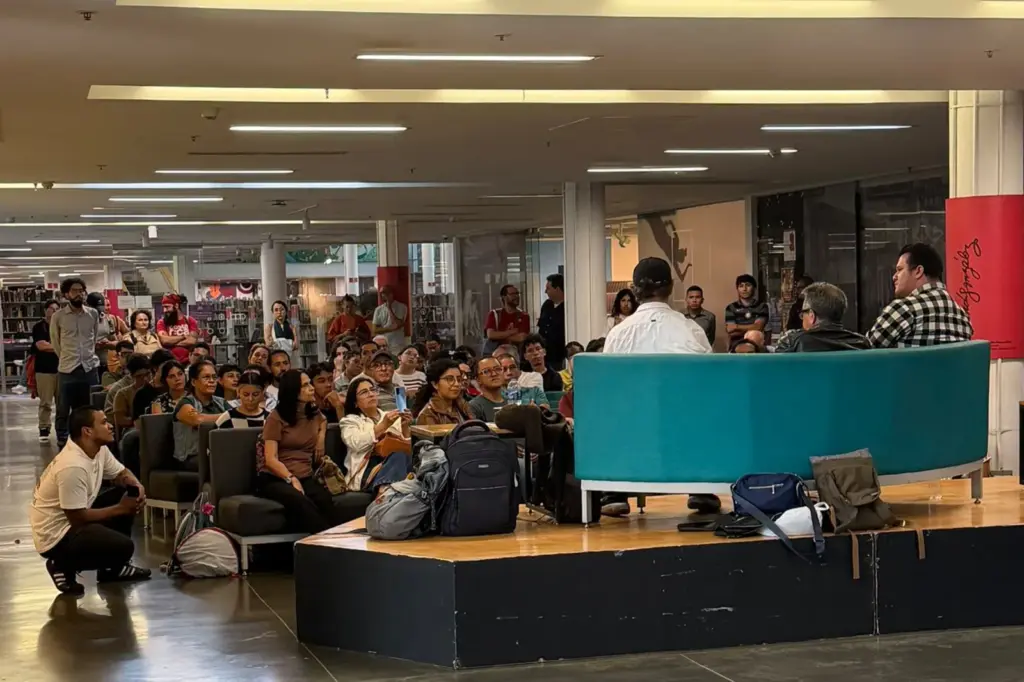
Meanwhile, the organizers of the presentation decided to go ahead. “What we did was consult the audience about what they considered most pertinent. There were three options: cancel the event, go to another place, or assert ourselves as citizens and occupy a public space in the city to hold the event as we had designed it,” says academic Nieto, while noting that they had scheduled the discussion a month ago. The decision was to stay in the library as an “act of civil resistance.” “The audience was made up of university professors, students, researchers, NGO leaders, social leaders. And it went very well for us. The mayor sent some police pickets, but nothing major happened.”
Nieto vindicates the “scientific and academic” nature of his work, which revisits a thesis he presented as a master’s student in 1995 and includes an epilogue on its relevance for understanding Petro’s government. “It’s about interpreting how the M-19 emerged and what its characteristics were. It’s not about justifying its actions, because then the research work would take on a partisan bias, and that’s not the case,” he states. Among the central points of the book, he mentions how “the absolutely closed nature of the National Front,” in which conservatives and liberals monopolized political power for 16 years (1958-1974), contributed to the emergence of the M-19. The central thesis, moreover, is that this guerrilla group was the armed actor “that best knew how to combine war with politics.” “Every act of war produced political effects. And that made it a political actor,” he says.
The author exemplifies with the taking of the Embassy of the Dominican Republic in 1980. “It was an act of war that denounced the systematic violation of human rights. It was the first time that this was discussed in Colombia, and of a national dialogue,” he explains. He also mentions the 1988 kidnapping of conservative leader Álvaro Gómez Hurtado as an action that led to “a negotiation process” that eventually resulted in the laying down of arms. “The rest of the guerrillas had a rather marginal political life. But the M-19 influenced the Colombian political conjuncture and played a leading role,” he emphasizes. In the discussion, he says, they talked about how these strategies are seen in Petro’s Presidency: “They are present in his political communication. For example, when he produces acts with a great capacity to drive the country’s debate.”
For Nieto, the mayor’s reaction shows “the fear of a sector” to recognize the impact that the M-19 has had on the history of Colombia, especially with its leading role in the drafting of the 1991 Constitution and the election of Petro as president. “It is a constitutive part of our identity, whether we like it or not. Denying it is like wanting to do without a mole we don’t like on our body,” he highlights. “The M-19 was configured as a third force [against conservatives and liberals] at a very high human cost, no doubt. But, if it were about that, we would deny a large part of Colombia’s history, which is drenched in blood and precisely protagonized by conservatives and liberals.”
Read more This Rafa (Jódar) also knows how to come back
President Petro confronted Gutiérrez in the early hours of Wednesday, via X. “The M19, after making peace, is a legal movement with legal status. What you are doing is censoring a book. He who censors books ends up burning them at the stake and then ends up burning human beings at the stake,” he said. Congresswoman Susana Boreal emphasized that “it is an academic investigation” that the mayor “decides to censor due to his ignorance.” Esteban Restrepo, former Secretary of Government of the Mayor’s Office of Daniel Quintero (2020-2023), commented on the same social network that he had filed a complaint with the Attorney General’s Office to investigate whether Gutiérrez committed offenses such as “exceeding his functions, prior censorship, and violation of human rights.”
The mayor has maintained the pulse throughout this Wednesday. “No matter how much some want to rewrite the history of Colombia, the M-19 was a terrorist group. They murdered, kidnapped, extorted, tortured, they are responsible for the Holocaust of the Palace of Justice, and many other crimes. I do know which side of history I am on,” he commented on X, where he also reproached the president for his former militancy in the armed group. Afterwards, he reiterated his argument in statements to the media: “It was an act in which they wanted to impose a political narrative (…). I am not going to remain silent so that many end up believing that those of the M-19 were victims and not perpetrators.”
Beyond the debate about the guerrilla, Gutiérrez rejected in his statements to the press that his decision was an act of censorship and again justified it with the law of guarantees. “Anyone can believe or buy what they want. No one here is vetoing anything. What I cannot allow as mayor is for a political event to be held while we are in an election campaign,” he said. “They say there was a veto. No, for God’s sake! Veto of what? Make the presentation anywhere else, you cannot do it in a public institution because of the law of guarantees,” he insisted when questioned by journalists.
This newspaper contacted the Secretary of Culture to delve into the mayor’s arguments. The entity responded that the spokesperson is the Public Pilot Library, which provided two phone numbers that did not answer multiple calls. The Secretary also pointed to the mayor’s office as responsible for speaking with the media, which referred to a video of the statements to the press.
The book, meanwhile, has gained unexpected publicity. The publisher Desde Abajo, known for its left-wing publications, has taken the opportunity to promote it on social media. “Break the censorship and acquire the book ‘M-19. From war to politics’ (…) Price: $40,000 plus shipping,” reads on its X. Nieto, for his part, states that the mayor has not even read the book and was carried away by his rivalry with President Petro. In the end, he believes, it was counterproductive. He sounds happy with the final result, despite the bad moment on Tuesday: “It was interesting to recover the discussion of the character of the M-19 and try to connect it with the contemporary debate of the Government.”