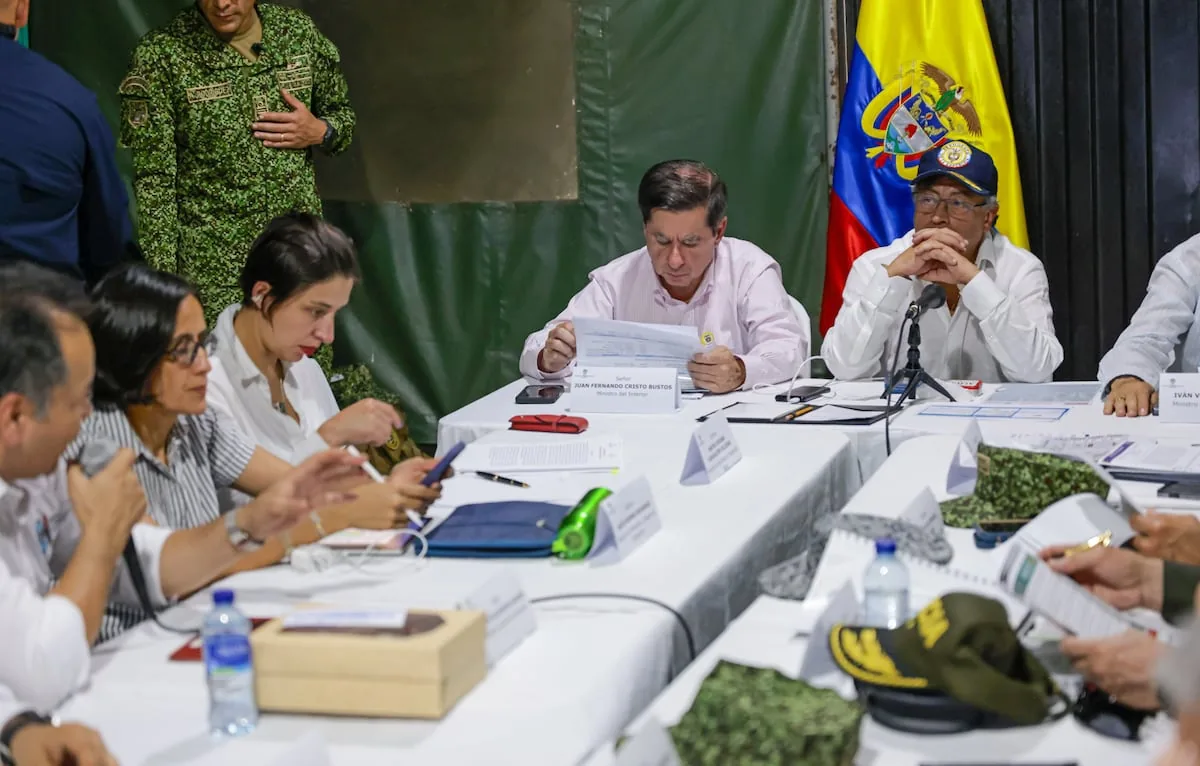
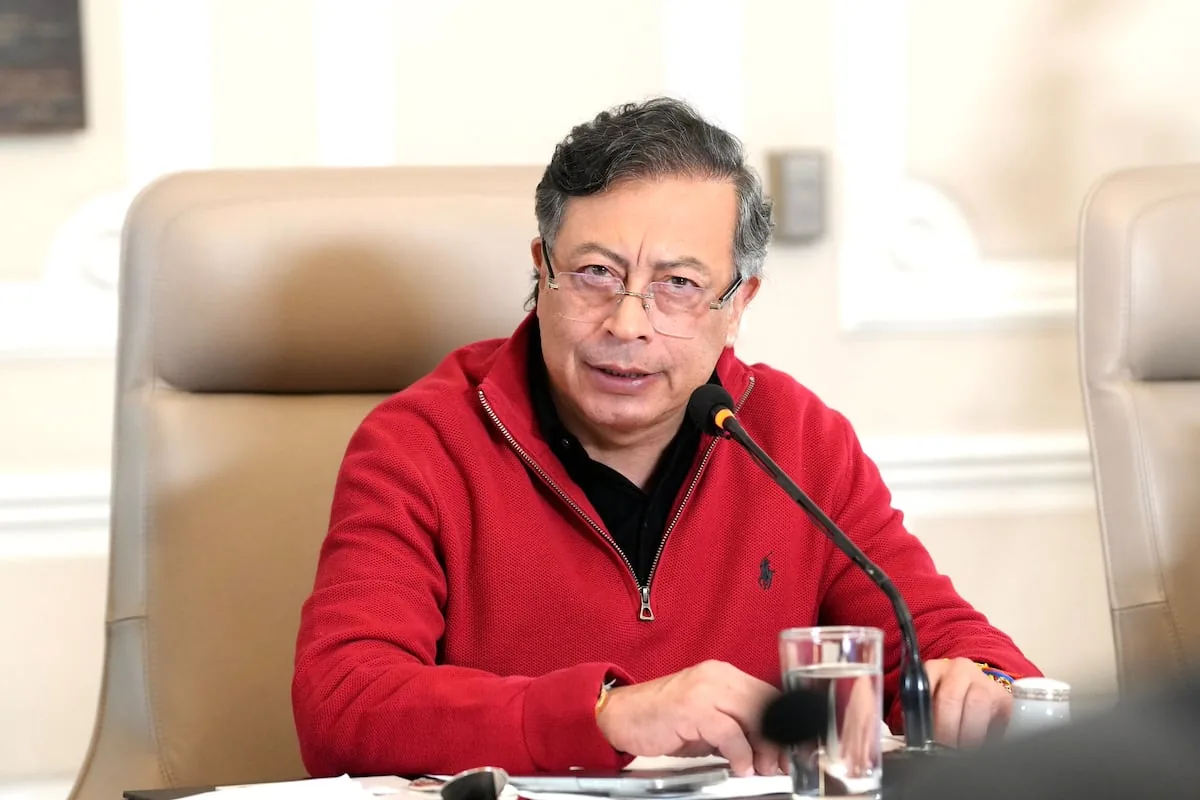
President Gustavo Petro usually makes big announcements on X or in his cabinet meetings. This Tuesday was no exception. As another affirmation, during the meeting and in front of the cameras, he announced that he had ordered his Peace Commissioner to suspend negotiations with the Staff of Blocs and Front (EMBF). This is the group of dissidents from the extinct FARC led and directed by alias Calarcá Córdoba, which has been in dialogue for two and a half years. The instruction, of which he gave no further details, leaves in suspense what had become the most successful peace negotiation for a Government that, with its total peace policy, launched a dozen initiatives simultaneously. It was his last card to sign a significant peace agreement before the end of the Petro Administration, next August 7.
“I have asked Otty Patiño, who is not here, that if Mr. Calarcá violated the pacts not to burn the jungle and dedicated himself to killing soldiers or his rivals with war crimes, like the Central General Staff, which is narco, then there is no peace. What are we going to do? I would like to make peace, but it has to be done on serious bases, not on lies,” the president said. In his extensive speech, he referred to the crimes that persist in the Amazon jungle and the local wars that this group wages in regions such as Catatumbo and northern Antioquia. Although he did not mention any specific case, so far in April, the Antioquian municipality of Briceño has suffered some 162 displacements, after several drone attacks and clashes between dissidents and the Army.
Under total peace, negotiations, their truces and ceasefires have occurred parallel to attacks and the modernization of the conflict. Defense Minister Pedro Sánchez himself had already suggested in an interview that the arrest warrant against Calarcá Córdoba, who has judicial immunity for being part of the peace table, should be lifted. But the Government’s clock is running out and the process seems to be entering a point of no return. There are minimal humanitarian agreements, but the illegal armed group has continued to commit crimes and expand its military power. In response to the announcement, the dissident group issued a statement assuring that it had ordered its troops to “act in legitimate self-defense” against the Army.
Even before Petro’s announcement, the dialogues were already suspended. Their continuity also hung by a thread due to pressure from the Prosecutor’s Office, which has supported the idea of reinstating arrest warrants against its leaders, including Alexander Díaz, alias Calarcá himself.
The incidence of this armed group has not been minor, but its visibility grew in 2023, after the Public Force detained several of its members at a checkpoint in Antioquia. There, they seized several electronic devices that, according to a journalistic report by Noticias Caracol, linked Wilmar Mejía, former director of Intelligence of the National Intelligence Department (DNI), and General Juan Miguel Huertas, director of Army personnel, with that illegal group. Since then, the case has had several twists, but it has not changed the fact that it calls into question the peace will of this armed group.
In mid-2025, the Government signed a resolution authorizing the creation of several Temporary Location Zones where members of Front 33, which is part of this group, would be concentrated. However, the agreement will be one year old without having materialized. In Tibú, the municipality where the zones were planned, no mechanism was ever installed to verify the process. In December, the Executive renewed the deadlines to execute the zones, but the first brick has not been laid to adapt the space as agreed.
Calarcá Córdoba is an old guerrilla who joined the FARC in the nineties and, despite the 2016 peace agreement, remained armed. His trajectory largely reflects the mutation of the armed conflict after the signing: some combatants moved away from the process, others never signed it, and many of them reconfigured illegal structures to retake or maintain control of strategic territories for illicit economies. His main military enemy is the dissident group led by Iván Mordisco, known as the Central General Staff, one of the largest groups in Colombia, and with whom the Government also has broken communication.
Calarcá returned to the center of conversation at the end of March, in the middle of Holy Week, when the governor of Caquetá, Luis Francisco Ruiz, reported that five siblings, between 3 and 16 years old, had to hide in the Amazon jungle to avoid being recruited by that illegal group. The events were a direct breach of the agreements signed last November, when the dissident group committed to de-escalate the conflict, prevent the recruitment of minors, preserve the Amazon in the areas where they have influence, and respect this year’s elections.
That pact occurred in the seventh cycle of negotiations, which produced a concrete roadmap with verifiable commitments and which the Government saw as the prelude to a partial agreement. The Executive did not rule out that the process would mark a success for the total peace policy, but the distance between what was agreed and what happened on the ground ended up eroding trust.
While at the table there was talk of de-escalating violence, in Catatumbo, Caquetá, Guaviare or northern Antioquia, armed confrontations, reports of recruitment and the group’s control over illegal economies persisted. Although the final word rests with Commissioner Patiño, a secretive man who avoids media attention, the order to halt the process leaves the commitments reached up in the air.