






In recent weeks, discussions about the disappearance crisis in Mexico have been reduced to a war of statistics. Last month, the Federal Government presented a report segmenting the more than 132,000 national records into three categories: 43,000 people without a trace, 40,000 with some registered activity, and 46,000 without sufficient data for the search. This reclassification immediately raised questions in two ways: on the one hand, due to the methodological opacity behind the figures, revealing that what some people have celebrated as “location” percentages are, in practice, mere administrative coincidences; on the other hand, due to the serious omission implied by the existence of 46,000 records without sufficient information and without a clear strategy from the government to remedy this problem.
Read more Who are the candidates competing against Michelle Bachelet for the UN Secretary-General position
Alongside this internal controversy, the Executive engaged in a direct confrontation with the United Nations Committee on Enforced Disappearances (CED), calling its report on Mexico’s situation “biased.” Arguing that forced disappearances no longer exist in the country and that the body ignores the “institutional effort” and regulatory advances of the last administration – such as reforms to the General Law and search and investigation protocols – the official discourse focused on denigrating the messenger, losing sight of the fact that laws are only useful when they translate into real results for those who are currently searching for a loved one.
However, amidst the crossfire between the Mexican Government and the CED, the land once again proved the families right. More than a year after the discovery of hundreds of garments and human remains at Rancho Izaguirre – and days after the regrettable statement from the Ministry of Foreign Affairs (SRE) regarding the CED’s conclusions – personnel from the Attorney General’s Office (FGR) reported the discovery of new human remains in a septic tank on the guarded property, confirming that the insistence of the Guerreros Buscadores de Jalisco collective in describing the ranch as a place of extreme violence was well-founded. “The quantity [of remains] is greater than last year,” the collective publicly denounced.
The same week that Teuchitlán returned to the public eye, and days before the visit to Mexico of Volker Türk, United Nations High Commissioner for Human Rights, Mexico City held a mirror up to the Mexican Government: the institutions responsible for investigating the disappearance of people are, at best, insensitive and negligent, and, at worst, corrupt and colluding. Under international scrutiny, the official communication strategy crumbled in the face of what emerged from the earth. In less than 72 hours — the time the police demanded Edith Guadalupe Valdés’s family wait to search for her, unless a bribe was involved — the country learned of her femicide and the systematic failures of the prosecutor’s office, which prevented her from being located in time. Almost in parallel, the capital watched in horror as families extracted more than 1,076 remains and bone fragments from the lagoons between Tláhuac and Chalco.
“Every time they throw dirt, something comes out,” say the families who, today, under Türk’s gaze, continue to sift through the site. They do so while denouncing that experts, pressured by time or indifference, discard bone fragments that could belong to one of their loved ones. The State’s haste to hide what is happening in the country’s capital – while receiving the United Nations High Commissioner on an official visit and preparing to host hundreds of thousands of tourists for the World Cup – clashes with the patience of the earth, which refuses to be an accomplice to the tragedy.
Read more Sheinbaum takes control of Morena
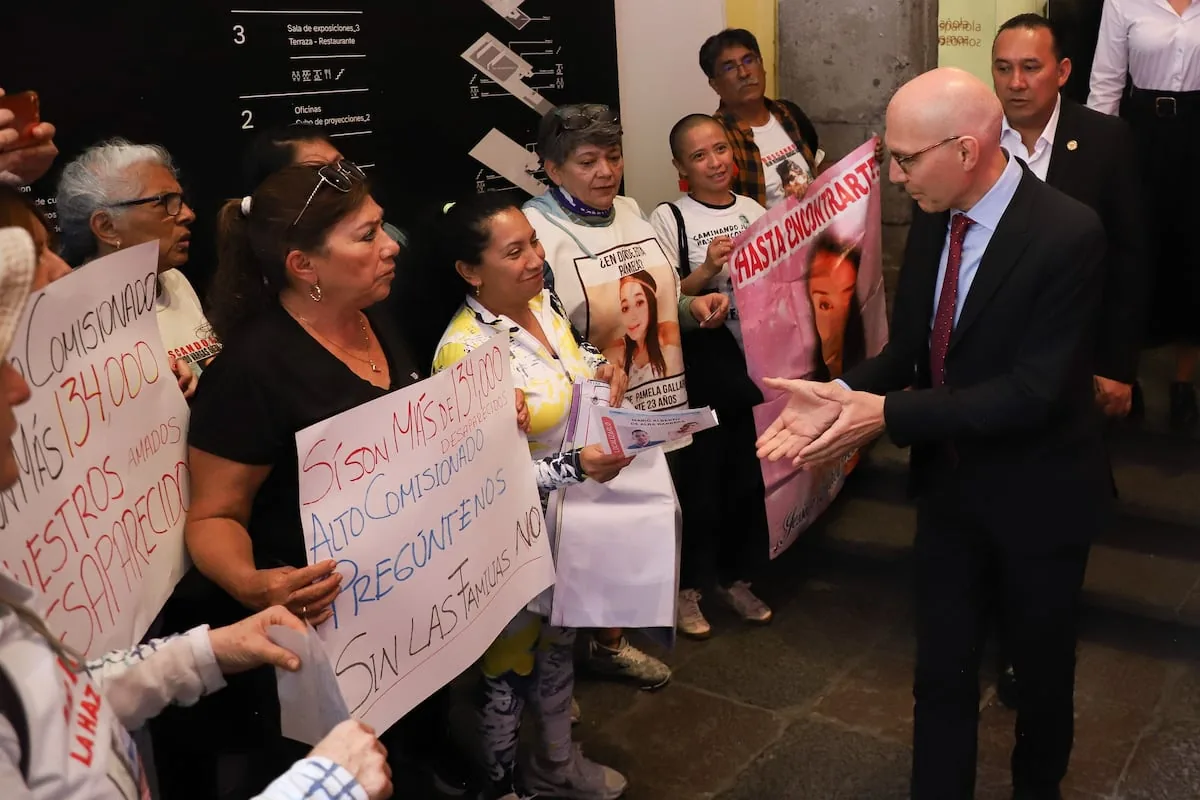
As careful hands sifted through the borders of Mexico City and the State of Mexico, various platforms of families of disappeared persons met with the High Commissioner on Tuesday. “They should have asked for the Azteca Stadium for this meeting; even then, all the mothers who want to be heard wouldn’t fit,” was heard outside the venue, while inside, searching families asked the United Nations official not to leave them alone, to take a stand against the State, which, by action or omission, continues to be an accomplice to the disappearances. This request is not minor, as the High Commissioner has an unprecedented role in Mexican politics: his stance can force the Mexican State to assume the consequences of two decades of abandonment policy.
The most relevant aspect of the High Commissioner’s visit is not his departure message – although the support historically shown by UN-HR in Mexico remains important for the families and the organizations and academic bodies that accompany us – but rather what Türk heard directly from the families. In the face of official disqualification, reality has asserted itself with irrefutable force: this country cannot address the tragedy involving the disappearance of more than 132,000 people and 83,000 unidentified human bodies and remains in isolation. On the contrary, this urgently demands international technical cooperation for the search, investigation, and identification of all the people we are missing.
The families, today transformed into experts, lawyers, and anthropologists as a consequence of the tragedy, have demonstrated that the State’s time is not the time for justice. As long as the Mexican Government continues to wear itself out in rhetorical battles, the tireless search of the families will remain the ethical and moral counterbalance in a country that seems to have lost its compass. At the end of the day, laws only make sense when there is someone willing to implement them, and in Mexico, that will does not reside in the prosecutor’s offices, but in those who, against all odds, continue to search among the earth for what indifference snatched from them.
Read more The sacred soccer cleats of the Aztecs