






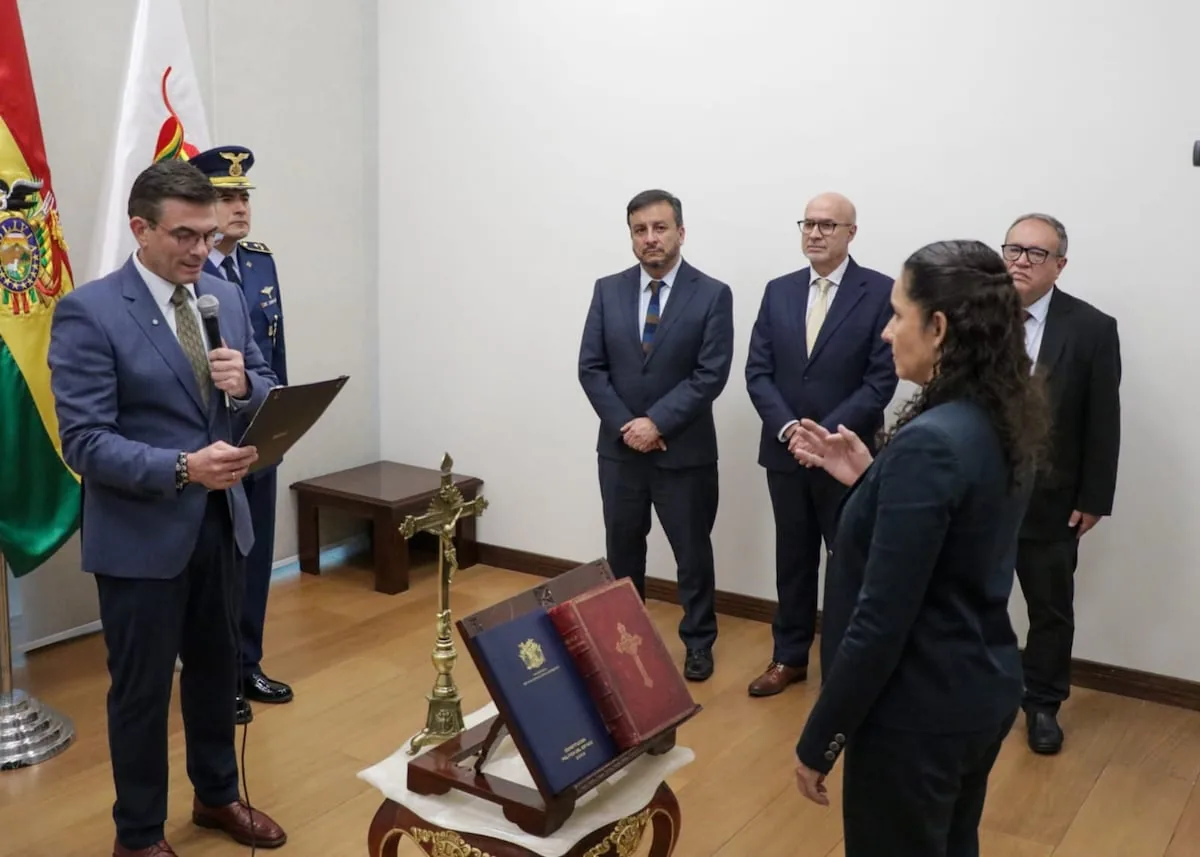
The Bolivian state oil company, Yacimientos Petrolíferos Fiscales Bolivianos (YPFB), is going through a crisis exposed by three presidents in five months. The corporation’s leader, Claudia Cronenbold, who took office on March 30, presented her resignation letter this Wednesday, alleging that she found the institution “significantly more deteriorated than expected.” President Rodrigo Paz, from the first days of his administration, which began last November, accused previous members of the corporation of a millionaire embezzlement that influenced the economic recession hitting Bolivia. He even denounced an “international mafia” within YPFB, a company that does not seem to stabilize with the change of government, amidst a new gasoline crisis in the country.
Read more Mexico against Turk: The reality of the disappearance crisis prevails
Hours before taking the presidential sash, Paz warned the previous management of the oil company linked to the past government of the Movement for Socialism (MAS): “Get ready because we are going to prosecute you for treason against the homeland.” Already then, an arrest warrant for alleged fuel smuggling weighed against the former president of YPFB, Armin Dorgathen, now a fugitive. Meanwhile, the country suffered long queues to get fuel: the Government, with its coffers at a minimum due to the fall in gas exports, could not continue to maintain the subsidy and caused shortages. Shortly after his arrival, on November 10, Paz appointed a new president of YPFB, Yussef Akly, and eliminated the hydrocarbon subsidy.
Gasoline increased its price by 86% and diesel by more than 160%, but the queues disappeared and the supply seemed guaranteed. However, problems returned to YPFB last February, when public transport driver unions reported that their vehicles were damaged by low-quality gasoline. After weeks of pressure, the Government took the blame. Akly was dismissed, and President Paz then promised a “second half for YPFB”: “We will be firm in supporting the very tough fight against the corruption in the state company, to recover a company for Bolivians and ensure it stops being a company for a few power groups.”
The damage was already done, and since then, strikes and road blockades have been carried out by transporters from different regions of the country demanding economic compensation. The Government has gone city by city, union by union, to establish the conditions for repairs, but urgency is pressing, and pressure measures continue in cities like Santa Cruz de la Sierra or Tarija. Added to this is the announcement of a meeting next Tuesday of the Bolivian Confederation of Drivers’ Unions to determine actions to accelerate compensation. More than 10,000 claims regarding vehicle damage have been registered, and YPFB assures it has paid nearly 150,000 dollars to those affected.
Read more Who are the candidates competing against Michelle Bachelet for the UN Secretary-General position
The fuel crisis has also spread to the country’s production sector, with complaints of diesel scarcity. Institutions such as the National Chamber of Industry or the Cochabamba Agricultural Association assure that they have been without diesel for several days and that the country’s food production chain will be affected with losses and delays. The Minister of Hydrocarbons, Mauricio Medinaceli, shifted responsibilities to YPFB when asked by the press this Tuesday about the situation: “It is the YPFB company that is in charge of supply and quality; as a ministry, we are focused on the hydrocarbon law. YPFB is the spokesperson on these issues.”
Moments later, Cronenbold’s resignation was announced. “Understanding that the national Government requires results with a speed that current technical times and legal frameworks condition, I consider that the most responsible and loyal thing to the country’s project is to allow new management routes to be explored that align with the urgencies of the national agenda,” she justified in a letter. Two months earlier, Margot Ayala, former director of the National Hydrocarbons Agency (ANH), a unit dedicated to the control and regulation of fuels, also resigned amidst pressure over fuel quality.
The Government has maintained two versions regarding the poor quality of fuel. When the scandal first broke in February, Minister Medinaceli and Akly assured that residues, magnesium, and rubber were found in the storage tanks, the maintenance of which was blamed on the previous government administration. Later, on March 31, Paz presented at a press conference an alleged plot of corruption and gasoline adulteration within YPFB. He claimed that the corporation’s tankers irregularly discharged more than 1,000 liters out of their nearly 33,000-liter capacity after refueling in Chile. To compensate for the extracted liquid, the content of the tankers was mixed with water and oil.
Read more Sheinbaum takes control of Morena